
lovingly reviewed by rob mclennan
From Hamilton poet Ben Robinson comes the full-length The Book of Benjamin (Windsor ON: Palimpsest Press, 2023), a project that alternates between an ongoing block text on the left side and short, observational moments that accumulate across the length and breadth of the book on the right. “MARRIED ON JUNE 29, 2015,” the block text writes, early on in the collection, “EARL AND MICHAEL BENJAMIN-ROBINSON WERE THE FIRST SAME SEX COUPLE TO LEGALLY MARRY IN THE STATE, STARTED THE FIRST BLACK GAY PRIDE CELEBRATION IN MISSISSIPPI IN 2004 AND OPENED ITS FIRST LGBT RESOURCE CENTER. THEIR WEDDING PHOTOGRAPHER, BENJAMIN ROBINSON, A PHOTOGRAPHER OF 15 YEARS, PLAYED A MAJOR PART IN GETTING THEM IN TO THE COMPETITION, PAUL SAID.”
The simultaneity of these paired texts is reminiscent of the structure of the second trade collection by poet Darren Wershler (formerly Wershler-Henry), the tapeworm foundry, or the dangerous prevalence of imagination (Anansi, 2000), a book that ran a simultaneous and ongoing text across the length and breadth of the book along the bottom of each page, akin to a news ticker, providing an alternate to the book’s main action.
Through The Book of Benjamin, Robinson’s two texts exist in tandem, akin to DNA strands wrapping into and around each other, with a further level of alternating subject, as the text on the right side moves from presumed biographical details and observations by the author around his own life and alternate Benjamins he has encountered along the way, to the Biblical Benjamin, out of Genesis; youngest of Jacob’s twelve sons, and brother of Joseph. “At work, I overhear an adult ask a child what her new sibling’s name is. The child freezes, just stands there until her mother jumps in to clarify that the newborn doesn’t have a name yet, but they are considering a few. One is Nora. // Later that afternoon, another customer comes in and one of my coworkers asks what their last name is. The customer stares at my coworker for a moment before replying, ‘Don’t have one’ and walking away. // Later still, a customer comes in whose last name is nobody.”
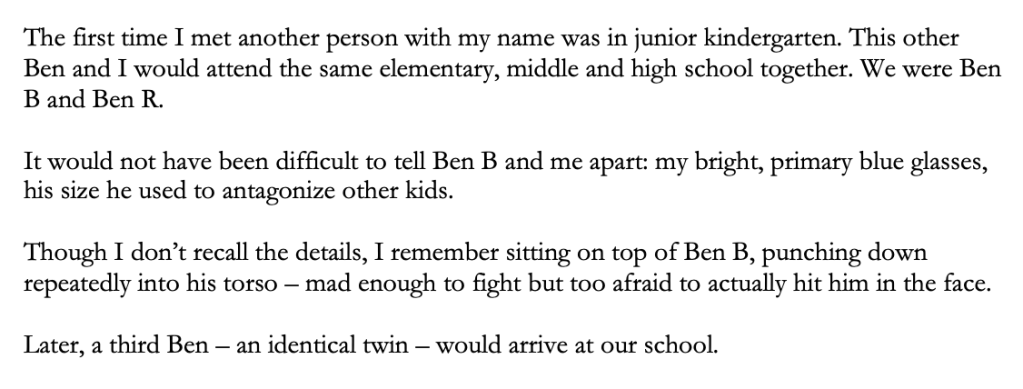
The Book of Benjamin is a curious book-length episodic exploration around identity and being, and the fluidity of naming, offering namesakes and slippery notions of who exactly can be whom, echoing the framing of Ottawa-based Chris Eaton’s novel, Chris Eaton, a Biography (Toronto ON: Book*hug Press, 2013), which wrote on multiple Chris Eatons, or even Cobourg poet and editor Stuart Ross’ inclination to find and friend every other Stuart Ross he could find on social media, as well as his own play upon the character “Razovsky”—a namesake variation that he might have been had his family name not been altered to “Ross” before he was born—through poems such as in his collection Razovsky at Peace (Toronto ON: ECW Press, 2001). Who do we become once tethered to, or even untethered from, our given names? Robinson plays with the arbitrariness of becoming ourselves, which is so deeply tied to naming, to names (something my adopted-self knows full well, having been a whole other person until nearly a year old).
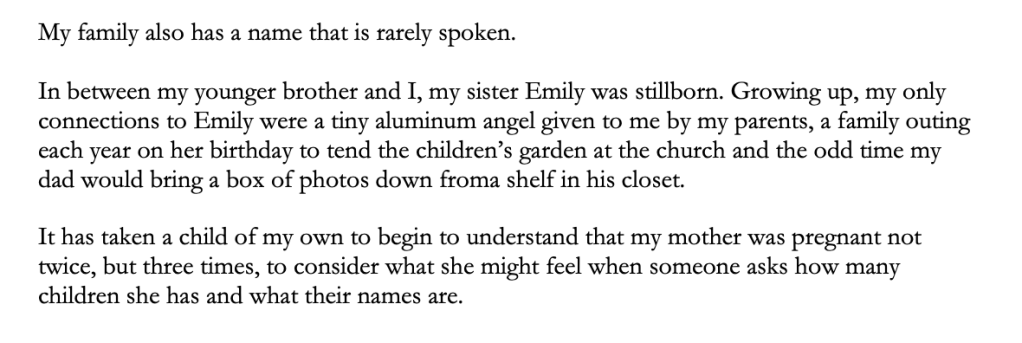
The narrative of The Book of Benjamin unfolds (as overused as that word is, the descriptor is apt), slowly and surely, across an enormous distance through the most intimate of details. He writes of naming, as the back cover offers: “Like an obsessive baby name book with only one entry, The Book of Benjamin establishes links between identity, birth, and grief. Braiding the story of his stillborn sister with the Biblical account of Benjamin to explore how names and their etymologies might shape our self-understanding, Ben Robinson resists the individual focus of the memoir, while investigating new forms of masculinity.” The weaving of his late sister, braided through the narrative of the collection, acknowledges both a grief and his sister herself, little more left than that memory, the grief and the fact of her name.
Through The Book of Benjamin, the weaving of name and self ripples out into elements of family, from his parents and siblings, to him becoming a father himself, which can’t help but evolve into a conversation, and a book, for, about and through his lost sister. In many ways, The Book of Benjamin is less a book about the author and his name than a book that allows her, the late Emily Robinson, to be acknowledged, and discussed openly, and the rippling effects of both her and that unfathomable loss. As he writes:
rob mclennan lives in Ottawa, where he is full-time with the wee girls he shares with writer Christine McNair. His collection of short stories, On Beauty (University of Alberta Press), will appear in August 2024. His next poetry collection is the book of sentences with University of Calgary Press, the second in a suite of collections that began with the book of smaller (University of Calgary Press, 2022). He edits the chapbook press above/ground press and the online journal periodicities : a journal of poetry and poetics, among other schemes.
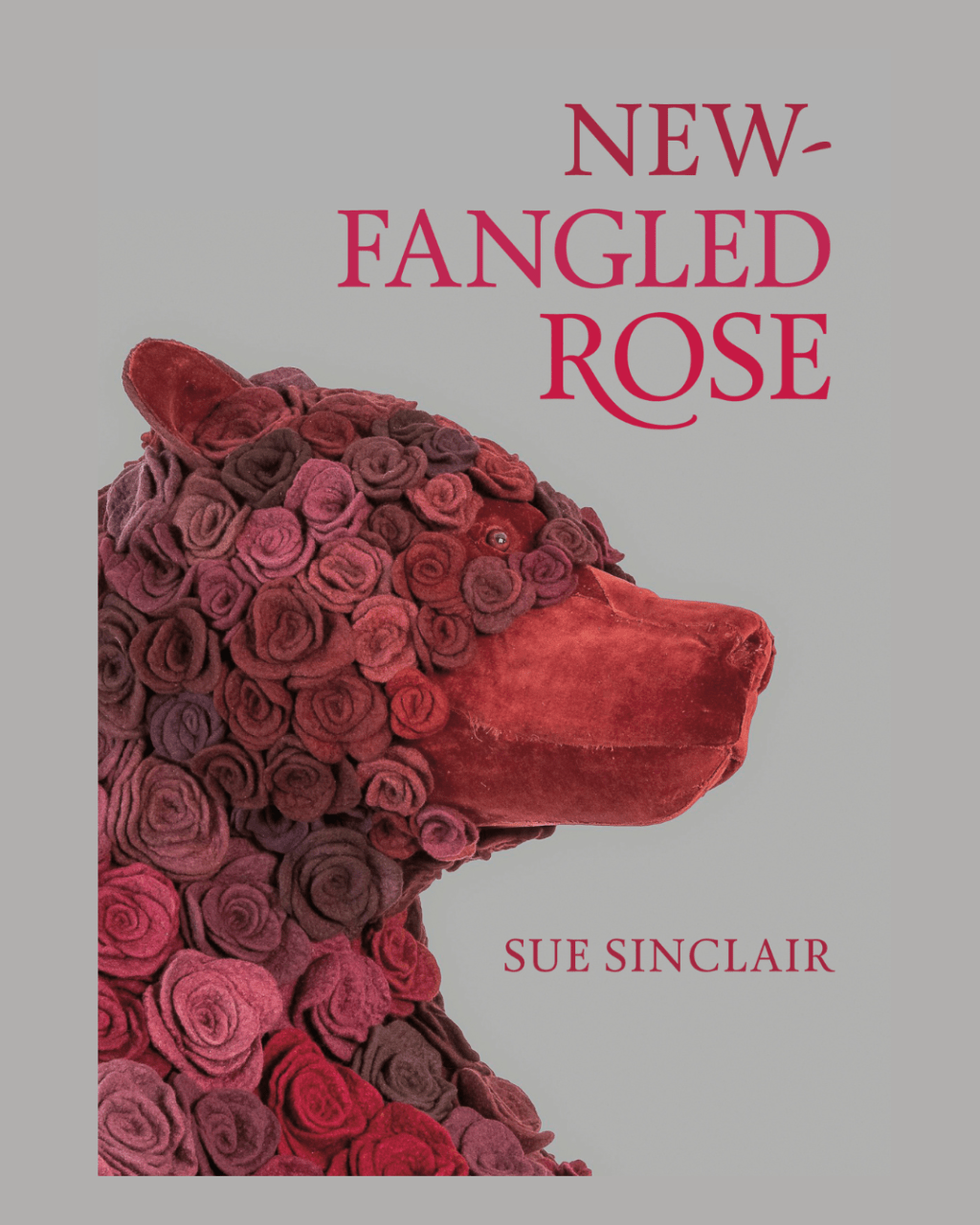
 The Woodlot
One response to “The Book of Benjamin by Ben Robinson (Palimpsest Press)”
[…] Read the full book review here! […]
LikeLike