lovingly reviewed by rob mclennan

From the very first line of the opening poem of Victoria, British Columbia poet and therapist Melanie Siebert’s latest poetry collection, Signal Infinities (Toronto ON: McClelland and Stewart, 2024), comes an electrical charge: “As if breath has sourced a new element, / a charged conductivity, / proteins holding open each cell’s gates, // water or something like water presses in. // As if a fine mist wicks / between this thought and the next.” (“Water takes up the office”). Following her Governor General’s Award-shortlisted debut, Deepwater Vee (McClelland and Stewart, 2010), there is some big canvas stuff happening in Signal Infinities, a simultaneous structure of big ideas, small details and precise, sweeping gestures. “biting his hoodie strings / fountaining Basquiat dreads / saintly for math’s sake,” she writes, as part of the third section-sequence, “TRYING TO READ LAKE’S CASE NOTES,” “Gen Z levels of sleep deprivation / his voice is musical code / his concentration finessed / to a nanospear / tuned to every test like enemy footsteps [.]”
Set with opening poem followed by five sections, Siebert structures her lyric accumulations across a framing of, as the back cover offers, “a therapist [who] takes up an apprenticeship to a lake, to bare attention.” She writes an ongoingness, from the quartet of the opening poem “Water takes up the office,” the suite of individual, interconnected lyrics of the section “THE SESSIONS ON REPLAY,” to the extended sequence of fragment-notes of the poem “Somatic Psalms” and the nearly twenty pages of similar structure across the poem-section “TRYING TO READ LAKE’S CASE NOTES.” “the first-time knife held / to his own throat,” she writes in that particular section-sequence, “does not emit / absorb or reflect light / in the spring-loaded slapdown / of five psych reports / ten years later more is unknown / than known [.]” Her lyrics offer themselves as strings of innumerable, interconnected moments, one step following another; an examination towards and into the possibility of clear-thinking, insight and clarity. Or, as the poem “EVENTUALLY I ACKNOWLEDGE I CAN’T REALLY / REMEMBER MY CHILDHOOD” includes:
It was a sad little parade
but I’m not sure I knew that yet.

The caragana shelterbelts required no care
and caught soil trying to leave.
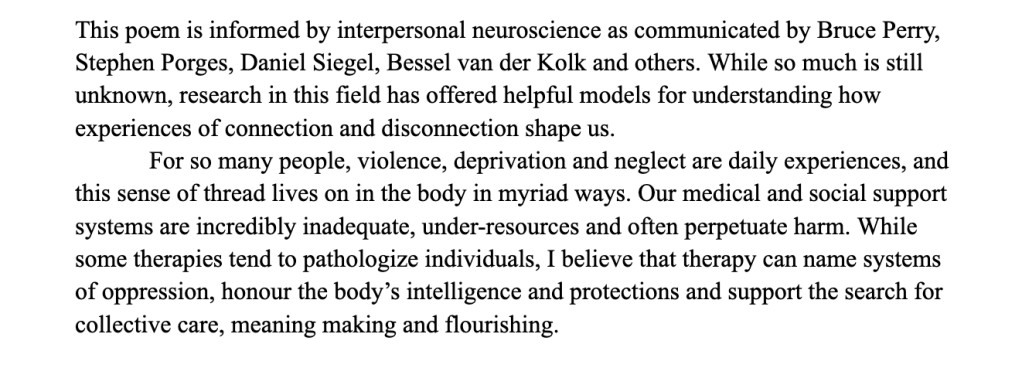
I’m fascinated by how Siebert works to cohere what might, at first glance, seem akin to the two halves of her self—the poet and the therapist—meeting and interacting across a single, book-length engagement. Her “Notes” at the end of the collection speak to the depths of two seemingly wildly diverse practices coming together, suggesting the work a kind of study across and between two poles, providing a clarification and articulation that might not have been otherwise possible. “pretty is a source / of comfort source / of terror,” she posits, further in the third section-sequence, “her unsoothable / attraction // the next and the next and the next / some / with hands that go / peaceful or dormant / some with suddenly flooding fists never / again fists / humming easy death fists / curing you fists feeling / nothing fists [.]” Her notes on the sequence “Somatic psalms” offers:
It is only through water, across Siebert’s masterful stretch, where her lyric and therapy meet. As well, there has been what feels like a swelling, a surge, of book-length poems around ecological concerns out of British Columbia lately, which makes sense, given elements of ongoing climate concern and crisis, as well as specific crises that British Columbia residents have been directly living, there on the ground. One can point to books this year alone such as Kim Trainor’s A blueprint for survival: poems (Guernica Editions, 2024), or Matt Rader’s FINE: Poems (Nightwood Editions, 2024), both book-length narrative lyrics engaging with a sense of immediate crisis in new and inventive ways. “We are searching / for a story with internal coherence,”Siebert writes, as part of the sequence “Somatic psalms,” “one that can meet / the shambled particulars / and the muscle memory / with limber bonds, / something / where the feet still know / exactly how / to balance lightening [.]”
rob mclennan lives in Ottawa, where he is full-time with the wee girls he shares with writer Christine McNair. His collection of short stories, On Beauty (University of Alberta Press), will appear in August 2024. His next poetry collection is the book of sentences with University of Calgary Press, the second in a suite of collections that began with the book of smaller (University of Calgary Press, 2022). He edits the chapbook press above/ground press and the online journal periodicities : a journal of poetry and poetics, among other schemes.


 The Woodlot