by Chris Banks
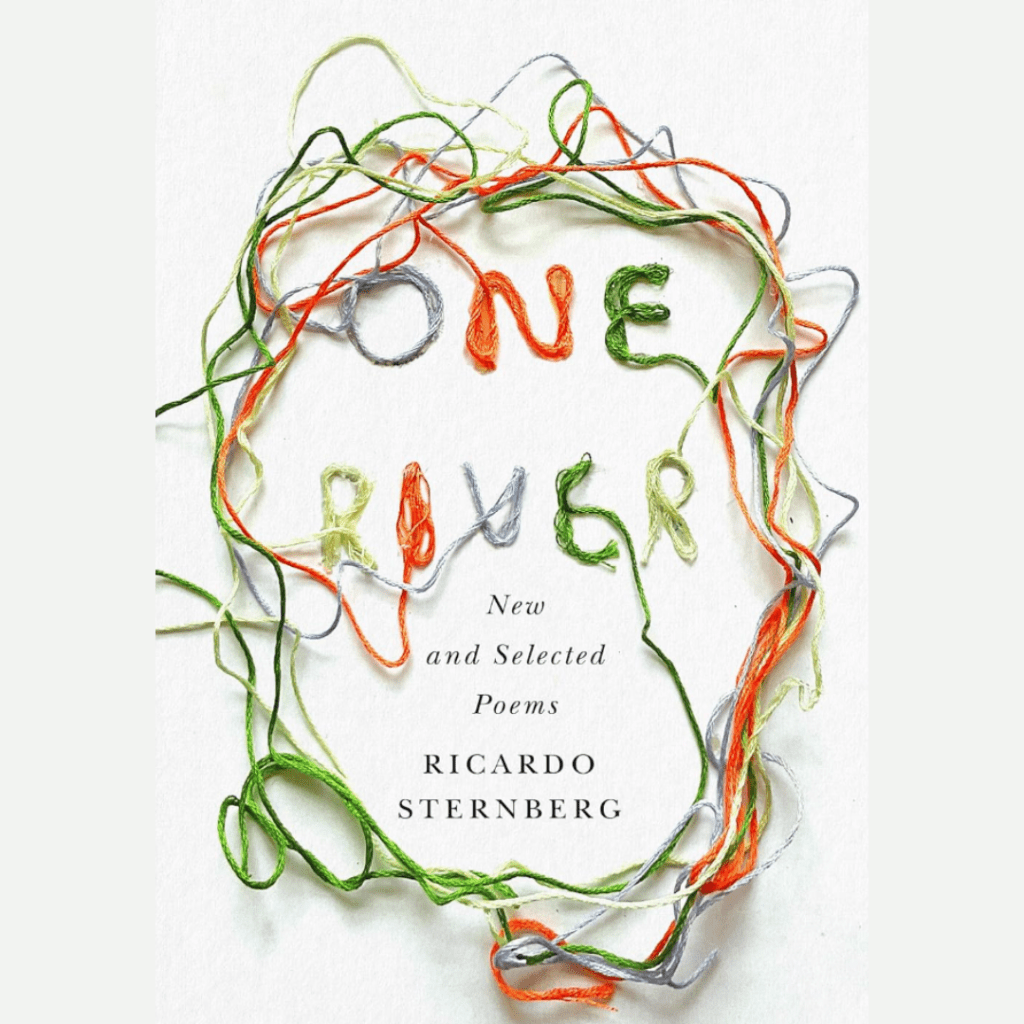
In the title poem of Ricardo Sternberg’s New and Selected Poems One River, he writes “This new me is so much like the old me /there’s a chance you didn’t even notice” which feels so humble, so self-effacing for a veteran poet whose work has been quietly whispered about for nearly three decades in Canada. On the back jacket, Jason Guriel calls Sternberg an unassuming and unlaureled master and Nyla Matuk says the collection One River is “nothing short of genius.”
Oh boy, that is a lot of serious praise from some very hard to please Canadian poets who, judging by their own work, place a large portion of a poem’s worth not only in the surprises it contains, its distillation of ideas and singular images, but its syntactical pattern-making where the poems establish a rhythm or a structure (or both!) and then subtly alters or varies them. So I guess the question is: is this praise of One River justified?
After reading the whole poetry collection, I say yes and here is why.
When you read One River : New and Selected Poems by Ricardo Sternberg, the poems themselves do all the talking without need of a preface, and the poet has chosen assiduously from four previous collections so the poems bound within the book feel rich, the subject matter fantastical, and the line breaks inevitable—very often short enjambments that feel permanent in the way words etched into a marble block are permanent.
I admit to really admiring the shorter poems in this collection because I believe shorter poems are much harder to write. You have to tame the Imagination, put a leash on it, make it walk a tightrope of short line breaks and short stanzas, every word adhering to an established rhythmic pattern, before breaking these patterns all in the space of less than fifteen lines. This is much harder than just letting the Imagination ‘rip’, or as I call it letting ‘the big dog eat’, I suppose.
Here is a poem that appears early in the collection called “Gifts”, and I will try to articulate why its such a terrific performance of thinking and personal lyric compression:
Gifts

When I gave her smiles
she gave me a wooden bell.
I have never known such sorrow.

When I gave her some tears
she gave me a small drum.
Now the neighbours know my joy.

When I gave her silence,
the green bird she gave me
flew down my throat.

It is with his voice
and none other
that now I sing in sleep.
The first two stanzas create this really beautiful rhythmic pattern of one or two syllable words, the first two lines being quite short, and the third line extending a little further. This pattern is broken, however, in the next two stanzas, which also wakes up the reader to the ideas presented in the last two stanzas, the idea of a green bird that “she gave me / flew down my throat” and that the poet now uses to “sing in sleep”. Is the green bird jealousy? A metaphor for the imagination? Is the “she” referred to an actual lover or a muse figure? Does it matter? I think this poem conjures all these associations often from scant lines that are no more than five or six syllables.
Sternberg reminds me a little of the fabulist poet James Tate but with the personal lyric intensity and distillation of Robert Hass or Gregory Orr’s best work. Here is another elegant and evocative personal lyric taken from “Crooked Sonnets” in the collection that masterfully employs short lines again, and powerful personal feelings, but this time in a stripped-down sonnet form:
Just when I thought
it was dead or dying
love, like Lazarus,
came back: summer,

the year I turned forty.
Once again it caught me,
rolled me under its wave,
threw me breathless on the beach,

spitting sand and words.
What does the heart ever learn
that it did not know at fifteen?

Incongruous discipline,
a sweet short circuit,
an unlearning is what love is.
Here, I love, love, love the tightly controlled first stanza with its 4-5-5-4 syllabic lines, a rhythmic pattern the poet immediate breaks in the next stanza where love is compared to a wave rolling one under and then leaving one “breathless on the beach, ‘ spitting sand and words”, but honestly, it is the next lines that really make this a masterful poem for me. I am always a sucker for the deceptively sweet and simple, the words “What does the heart ever learn / that it did not know at fifteen?” feels profound, elegiac, comforting, and compassionate. This is how good poetry works on a reader.
I said earlier, there is something in Sternberg’s delight in mythopoetic storytelling that echoes James Tate (at least to my eyes and ears), but where Tate’s obvious powers was in the prose poem and dialogue and character building and what I might call the surreal swerve, Sternberg’s poems contain all of these these things (perhaps not dialogue) but simmered down into tightly controlled lines his own incongruous discipline demands. Here is a poem from “Map of Dreams” that uses short lines and couplets to build a compelling sea yarn:
No sooner had we left
the coastal waters,

the familiar latitudes
than we were lost.

Rum-drunk, the captain
had himself blessed

and strapped to the mast
from where he begged to hear

something from the sirens.
Sail by power of dreams,

they crooned, by ignoring maps,
by letting the helm go.

When our supplies dwindled
we became desperate

and hammered our crosses
into crescent moons.

But neither cross nor moon
could replace the charts

the captain had destroyed.
We sailed as we could:

now for the sake of sailing
the silk sheen of this sea;

its blue susurrus.
As a poet, who does not want to be lured onto sea rocks by sirens or to sail by the power of dreams? At least for me, the sea voyage feels like a metaphor for writing poems and that writing is the voyage, and the destination is meaningless unless you are willing to sail “for the sake of sailing / the silk sheen of this sea”.
Another poem that feels like a myth or a parable is the aptly titled “Parable” that again employs short lines, syntactical patterns to great effect:
Parable

Disguised as a camel
the millionaire broke
through the gates
of heaven.

Brazen, that camel
brayed in the choir,
sang rough hosannas
out of key.

Good grief,
cried God,
and then stared
in disbelief.

But only when
down on earth
at the circus
a clumsy camel

failed to thread
the needle’s eye
was the gatecrasher
recognized,

stripped of harp,
halo and wings
then sent hurtling
into darkness.
This poem from Sternberg’s book “Bamboo Church” plays on the book of Matthew where it talks about it being “easier for a camel to go through the eye of a needle, than for a rich man to enter the kingdom of God” but Sternberg reverses the order here; has the millionaire disguised as a camel causing a ruckus in heaven:
Good grief,
cried God,
and then stared
in disbelief.
This compact stanza is pure Sternberg with its distillation of alliteration, and end rhymes all wrapped up in brief, but satisfying 2-2-3-4 syllable lines. Another favourite poem I read is “Some Dance” from the book of the same name, which plays with the idea of listening to the ‘music of the spheres’ and that some ‘stars are stars / that ring slightly off / as if the grand tuner / had grown distracted and the idea of this loss of pitch ‘makes the universe amenable. / By that small discord / it becomes more human.”
I think many readers will connect with the idea of an “imperfect perfect” human universe, and although I do not believe in a grand tuner, per se, I believe Sternberg has carefully tuned both the subject matter and the sound matter of his poem.
Of all the new poems, my favourite is the collection’s title poem “One River” which had me wondering is that what we do as poets, mend “the heart with needles and string”?
One River

This new me is so much like the old me
there’s a chance you didn’t even notice.
Mere passage of time proved no guarantee
when, stubborn, the self refuses change.

I’ve tried my best to learn new tricks,
yet find more comfort in the old groove:
howling at the moon like lunatics
do, mending the heart with needles and string.

I forgot that sometimes the broken
is as beyond repair as words
uttered that cannot be unspoken.
Who said you can’t step into the same river twice?
The first stanza has fairly uniform 10 syllable lines but then the poet Sternberg alters this a little in the second stanza, and breaks the pattern entirely in the third stanza where the poet admits sometimes “the broken / is as beyond repair as words / uttered that cannot be unspoken.” The poet as magician says he finds more comfort in the “old groove”, but I think this is still a surprising elegant and beautiful personal lyric.
So far I have really talked about Sternberg’s structures, but his imagery is both exciting and refreshing too, like referring to a spider as “a small / missionary of sadness” and describing the great heads of Easter Island as “In sea-fog / the statues appear / to weep”, or even a snail in a hurry whose “silver trail / he dispenses / like a man / whose purse is broken?” This is pitch-perfect imagery from a master poet. A grand tuner of words that wants us to pay attention to what he is doing on the page.
One River: New and Selected Poems by Ricardo Sternberg is the kind of poetry collection that only comes from nearly three decades of trying to write meaningful, personal lyric poems with compelling poetic structures, and the incongruous discipline that takes finds itself in this collection where Sternberg purposely drops a wrench in the gears of the sound patterns he makes to “wake up” his readers, and to make them notice each syllable and each line has been carefully weighed, but also perhaps emphasizing that artistic perfection is maybe a pipe dream—a siren song we keep listening for but which never comes.
This is a terrific, masterful collection that I hope finds a wide audience. It deserves all the praise it has been getting.
Chris Banks is an award-winning, Pushcart-nominated Canadian poet and author of seven collections of poems, most recently Alternator with Nightwood Editions (Fall 2023). His first full-length collection, Bonfires, was awarded the Jack Chalmers Award for poetry by the Canadian Authors’ Association in 2004. Bonfires was also a finalist for the Gerald Lampert Award for best first book of poetry in Canada. His poetry has appeared in The New Quarterly, Arc Magazine, The Antigonish Review, Event, The Malahat Review, The Walrus, American Poetry Journal, The Glacier, Best American Poetry (blog), Prism International, among other publications. Chris was an associate editor with The New Quarterly, and is Editor in Chief of The Woodlot – A Canadian Poetry Reviews & Essays website. He lives with dual disorders–chronic major depression and generalized anxiety disorder– and writes in Kitchener, Ontario.

 The Woodlot