
By Chris Banks
In the background, there is a lake,
And beyond that, some low hills.

(The photograph was taken
The day after I drowned.

I am in the lake, in the center
Of the picture, just under the surface

-from “This is A Photograph of Me”, Margaret Atwood
In Jim Johnstone’s excellent Bait & Switch: Essay, Reviews, Conversations, And Views On Canadian Poetry, he describes the first poem he really encountered, and thought hard about, as being Margaret Atwood’s “This Is A Photograph Of Me”, a much loved and much anthologized poem. I, too, love this enigmatic poem, and have taught it many, many times, but I confess I read it differently than Johnstone, as for me at least, it is not so much that the speaker is speaking underwater, or that the land is pressing down on the speaker to enact a water burial (although the poem can certainly be read that way too), but for me that poem is highlighting that, in poetry, there is the imagery, or in this case, the flat pastoral perspective of the photograph, and then there are the ideas happening beneath the imagery.
Maybe I’m thinking of this poem, and Johnstone’s essay, and Atwood’s poem this morning because I just discovered that the American poet Stanley Plumly’s Collected Poems is due out in hardcover in a few short months, and Plumly has stated one of my favourite quotes about imagery which is “imagery is the memory of memory.” What does this mean? Well, I think it means imagery is not simply about verisimilitude, just as Atwood’s poem is not simply about a picture of a Canadian lake, but it seems Plumly is suggesting ideas inhere in images, and poetic images are closer to archetypes, dreamy prototypes of human experience (sort of the way Rorschach’s inkblots are not simply ink on paper either).
Just as poems are meant to be uttered, images in poetry mean something other than themselves: childhood, loss, heartbreak, ceaseless joy, the perils of aging, the ancient and the eternal, and so forth. Metaphor and simile are the tools to make this most plain to readers, but the deep resonance inherent in images themselves is always there. Images trump mere words, because images in a poem bring a poem alive, just as when you read a poem aloud it enters your flesh.
The American Richard Hugo in his collection of essays The Triggering Town talks about how all poets have triggering subjects, but what strikes me is that for most of the poets I adore, these triggering subjects are often images themselves: father, river, child, winter stars, sun. I suppose this is why I prefer a poem about a Mediterranean sunset over a thousand polaroids of the same thing.
Again, going back to Stanley Plumly, he reminds us the self decodes and detaches, teases out what is welling underneath a poetic image, “especially as the self itself is a metaphor for memory”.
A great companion poem to “This Is A Photograph Of Me” is Canadian poet Gwendoyln MacEwen’s “Dark Pines Under Water” which plays with imagery and human intuition. Images can be private, or public, but if they are any good at all, they reveal some underlying nature within us. I remember being nineteen and reading MacEwen’s s“Dark Pines Under Water” and being so taken by its famous imagery evoking the Canadian Shield country of my youth, a terrain of lakes and moraines and wilderness, something I knew intimately from spending my summers in Muskoka.
I’m not sure I really understood the poem as a young man for, truthfully, I think I was much more taken with the speaker’s vatic lyricism, a frustratingly ineluctable quality present in all of MacEwen’s best work, but decades later, it seems to me what this poem actually does with great ease is call into question the relationship between poetic imagery and the world at large:
This land like a mirror turns you inward

And you become a forest in a furtive lake;

The dark pines of your mind reach downward,

You dream in the green of your time,

Your memory is a row of sinking pines.


Explorer, you tell yourself, this is not what you came for

Although it is good here, and green;

You had meant to move with a kind of largeness,

You had planned a heavy grace, an anguished dream.


But the dark pines of your mind dip deeper

And you are sinking, sinking, sleeper

In an elementary world;

There is something down there and you want it told.
Early in the poem MacEwen contends that what we identify as ‘the image’ in a poem is not merely a mental picture, but something much deeper, more akin to an archetype. It sets up this argument in the first stanza where MacEwen writes “This land like a mirror turns you inward / And you become a forest in a furtive lake; “ which suggest a few possible readings. There are the pines fallen into the water, or if you prefer, the reflections of pines cast upon the water, but then, by extension, there are also the pines we see reflected within our minds which are pure image.
But unlike mimesis, or mere correspondence, these images are also the essence of what they represent. It is this quality that MacEwen interrogates in the poem’s conclusion when she writes ”There is something down there and you want it told.”
Donald Hall basically sets out this case in a brief essay entitled “Notes on the Image: Body and Soul” where he says “’Spirit and image’ meant ‘ soul and body.’ But ‘image’ has come to mean precisely not-body, not-X, because the image is an imitation or a copy of X. From a copy or representation of a thing, the word can then move to mean the essence of a thing; therefore ‘ image’ comes to mean ‘spirit,’ which began by being its opposite”(143).
I suppose this is why imagery is such a tricky thing to talk about because images interject themselves between the world out there and the mind’s capacity to ascertain our experience of that world.
Another Canadian poet that immediately comes to mind when I think about imagery is Tim Bowling. Of all the poets of his generation, Tim Bowling’s poetry is the most unabashedly linked to place. His poems cast a wide net over history and subject matter, but the primary influence that runs through all of his books is The Fraser River in British Columbia where he grew up and once worked as a fisherman.
Rivers, of course, are an old image in poetry and mythology as they have been terribly important to the cultivation of human civilization, but it seems for Bowling they also constitute a condition of the mind by mirroring consciousness itself. The Greek philosopher Heraclitus may have said we can never step in the same river twice, but neither does a person think exactly the same thoughts twice. Words, sensory images, memories may often return, spring to the mind as if by their own accord, and yet the experience changes because our circumstances change.
Never does Bowling merely “describe” The Fraser River, for his poetic vision is larger than that. He embodies it as a spiritual source where connections between consciousness and river, people and salmon, life and loss are renewed in his best work.
Words may make up the sinews of our language, but imagery is most definitely its spirit.
Perhaps this is why poetic imagery and memory are so closely linked for poets as they both represent a kind of eddying thought, sustaining energy. On the one hand, they describe things and phenomena, i.e. objecthood, but they also mean something beyond themselves—or, at the very least, there is a nagging feeling they do because of their recurrent nature.
The last poet I wish to talk about is Jim Johnstone. I started this essay by mentioning his early fascination with Atwood’s “This Is A Photograph Of Me” and interestingly the first poem in his terrific The King of Terrors about a health scare that forced the poet to face down his own mortality is explored through his relationship with Anstruther Lake, a reoccurring image in his work, and a special source of inspiration for his Anstruther chapbook press. The first poem “Future Ghost” in The King of Terrors is quite long and begins:

Here Anstruther Lake becomes inextricably linked to memory, and you feel the poet reaching down, wanting to get the words just right, wanting to excavate something of his life while there is still time– to, in fact, discover what is down there, below the surface, waiting to be told.
Another pertinent part of the poem comes a page later when the poet Johnstone writes:
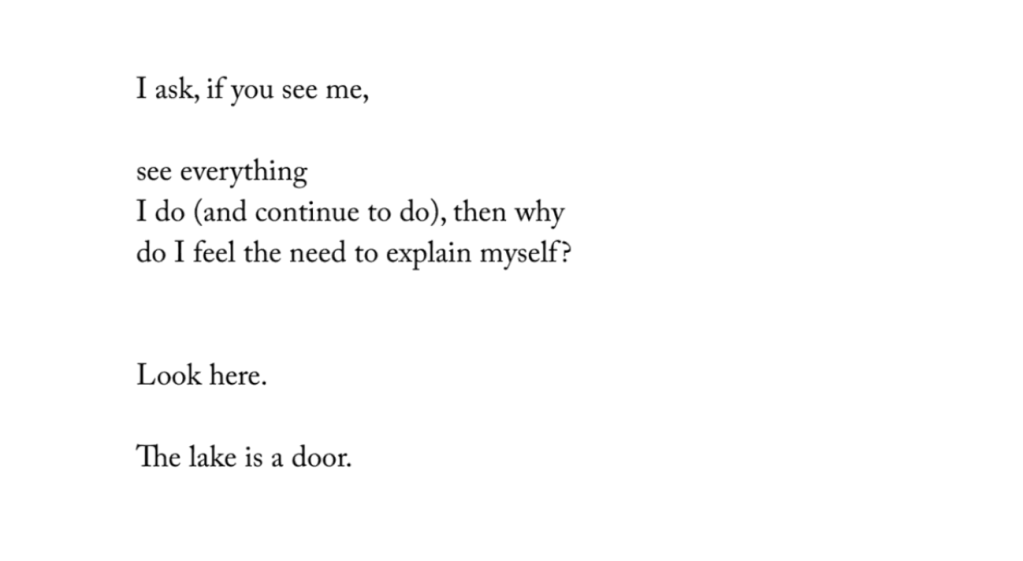
The immediate connection to Atwood’s “This Is A Photograph Of Me” gives me shivers here, and the image of the lake as a door is striking as if Johnstone the poet is saying just beyond this door, or perhaps more apt, underneath it, we might coax a little human understanding, or lure the collective unconscious, to the surface.
To end this piece, I guess I like Plumly’s phrase ‘the memory of memory’ because it pinpoints for me what poetic imagery is supposed to do. It reveals something within ourselves, whether that be a special set of associations or correspondences or new knowledge as Plumly suggests, but in the best poems what it reveals is something of the collective human experience. Not simply a photograph of me, or you, poetic imagery is a photograph of us.
Chris Banks is an award-winning, Pushcart-nominated Canadian poet and author of seven collections of poems, most recently Alternator with Nightwood Editions (Fall 2023). His first full-length collection, Bonfires, was awarded the Jack Chalmers Award for poetry by the Canadian Authors’ Association in 2004. Bonfires was also a finalist for the Gerald Lampert Award for best first book of poetry in Canada. His poetry has appeared in The New Quarterly, Arc Magazine, The Antigonish Review, Event, The Malahat Review, The Walrus, American Poetry Journal, The Glacier, Best American Poetry (blog), Prism International, among other publications. Chris was an associate editor with The New Quarterly, and is Editor in Chief of The Woodlot – A Canadian Poetry Reviews & Essays website. He lives with dual disorders–chronic major depression and generalized anxiety disorder– and writes in Kitchener, Ontario.
 The Woodlot