by Chris Banks
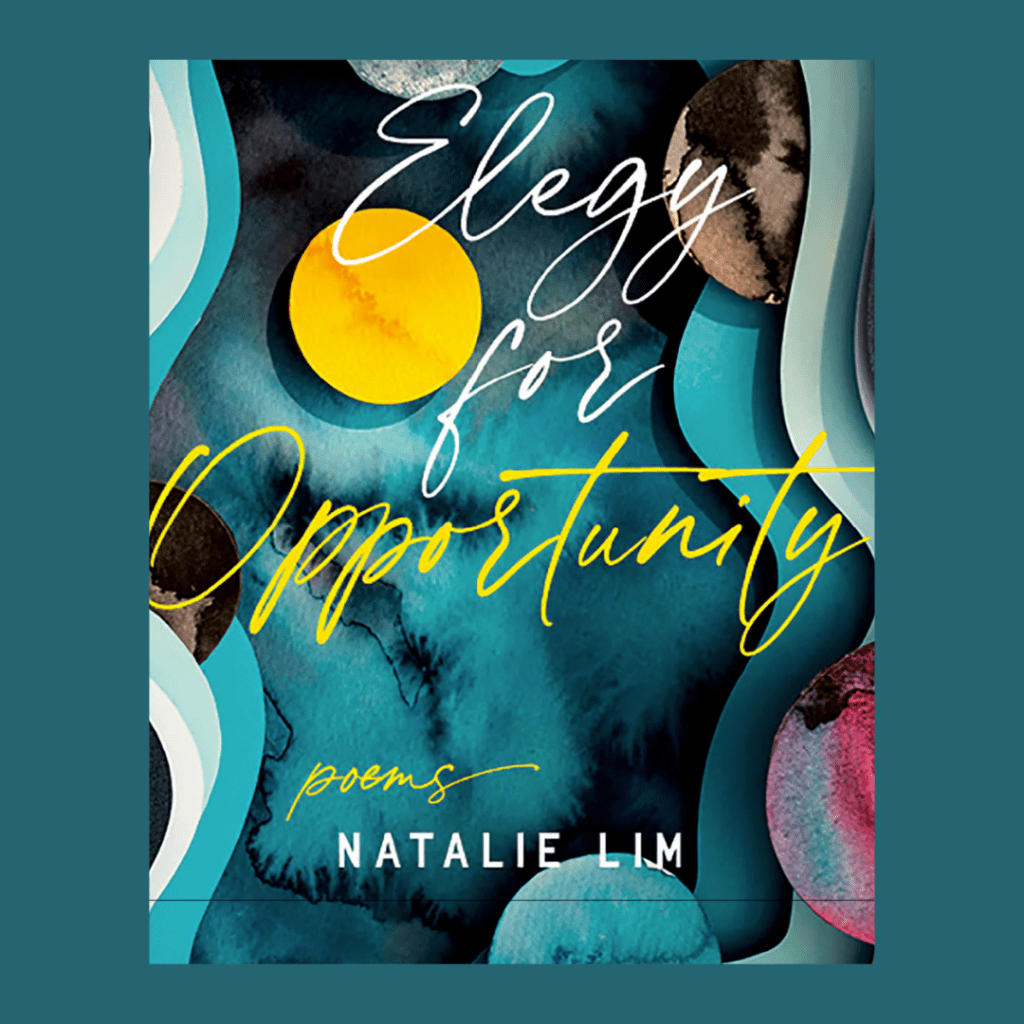
Natalie Lim’s debut collection Elegy for Opportunity out with Wolsak & Wynn this April is a first book by a talented young poet whose siren song is the confiding intimacy of her own poetic voice. Lim eschews a lyrical florid style for a more plain-spoken, or “prosaic” approach, which is meant to make poetry readers comfortable, almost imagining the poet as a friend confiding in them. I like this technique in poetry for what the poem often reveals is not just something about the poet’s private life, but the feelings and flaws that brand us as part of the greater human race.
Take her poem “On Biology”, and note the whispering self-honesty of the very first line:
I am scared of killing everything I touch.
this includes people, which is new,
and plants, which is not.
did you know we lose vertebrae
as we age? we’re born with 33 and die
with 24, usually, the lower ones fusing together
by the time we can call ourselves grown.
I turned 24 in the middle of a pandemic
and stopped calling my friends. what is there to say
at this point? I’ve tried online dating. I’ve tweeted.
I’ve baked one batch of sugar cookies, gotten bored
and felt guilty about it, because what a privilege it is
to be bored instead of desperate or sick. I try to do
the small things I can, for myself and the world –
go on walks, sign petitions, take baths, donate.
all of it feels like failure, but I don’t know what else
there is to do. I don’t know what else there is.
if I call you, can we talk about the days fusing together?
about how our backs hurt, just, all the time now?
tell me about what you’ll do once this is over,
about what you want to be when you grow up –
tell me you miss me.
tell me we’ll find space to grow.
tell me it gets easier
than this.
The language of this poem is plain, unadorned, but this is to lure the reader into the opening lines with its casual storytelling, and its confessional approach where the poet admits, “I am scared of killing everything I touch” or even later in the poem, “I try to do / the small things I can, for myself and the world – /go on walks, sign petitions, take baths, donate. / all of it feels like failure, but I don’t know what else / there is to do.” I like this poem very much, especially the biological fact that we lose vertebrae as we age which grounds the poem’s themes of loss and small sacrifices in our own bodies as if to signify it is really us baking sugar cookies, or who are secretly desperate, or who are signing petitions, so by the end of the poem, readers wish they had an answer for the speaker who writes: “tell me it gets easier / than this.”
The American poet Tony Hoagland once wrote in his book The Art of Voice, “In a world where, as one poet says, ‘people speak to each other mostly for profit,’ it is exhilarating to listen to a voice that is practicing disclosure without seeking advantage. That is intimate.” I think this is the easy intimacy, the relationship between poet and reader, Lim is exploring in this debut poetry collection.
Some of the poems, particularly the shorter pieces on pop culture like the animated movie “Inside Out”, or the pieces titled after dates like “February 18” , feel like the poems could be taken a step further, and the poet is just learning to “hook” readers into her poems with their intimate tone and self-revelations. My favourite poems from Lim’s collection are the longer ones that marry self-disclosure to a memory or an activity like in “Girls Camping”, or to a high-stakes NASA mission involving a Mars Rover. This is where the title poem “Elegy for Opportunity” comes from, and here is the ending which is particularly noteworthy:
there is nothing lonelier
than the little Mars rover,
no longer chirping back to base
about earth and rocks and maybe-life,
nothing lonelier than us,
creating things
we will sing to sleep one day, nothing lonelier
than thinking of that robot,
sitting still and silent now
on the shores of a planet
we promised she could call home.
The poem makes me a little sad for the Mars rover Opportunity marooned on the red planet, but really this poem is about how we feel, at times, lonely and marooned inside ourselves, rolling over the surface of the Earth with its Whole Foods stores and empty park benches and half-marathons.
The poet Lim makes allusions to many young Canadian and American poets – Julie Mannell, Isabella Wang, Sarah Kay – showing her wish to be in dialogue with these young poetic voices, but the best poems to me are the ones that really swing for the fences and try to be in dialogue with everyone, “this brave new world, polished too bright” as he she writes as in her poem “All This To Say”. Here is an excerpt:
when you want something badly enough,
it turns your stomach to coiled muscle.

when my hunger clenches this desperately
I am surprised blood does not pour

from my eyes, surprised always at how my body
protects me from the animal of itself.

I cried in the bathtub, on the bus,
in the Starbucks on Granville while strangers stared

but said nothing; I am that same stranger
who stares, sips my latte in silence.

I place Amazon orders, buy spinach in bulk,
bring a reusable mug to save ten cents.

I forget my reusable mug.
wax poetic while taking out the garbage.

an ocean away, the earth continues her burning.
I feel her clenching in on us,

protecting herself from these animals she carries,
our need for green numbers, upwards arrows.
This poem begins with the raw truth of how yearning coils inside the speaker, and then there are further self-confessions like, “I cried in the bathtub, on the bus, / in the Starbucks on Granville while strangers stared / but said nothing” which makes us want to trust this speaker, but then the poem zips across the earth to an “an ocean away, the earth continues her burning.” This is what I most enjoy in a poem: the interplay of intimate self-revelation and the Other, the microcosm and the macrocosm, the familiar and the fantastical conjoined together. Great stuff!
In her debut poetry collection Elegy For Opportunity by Natalie Lim, the speaker confides in her readers as the poems are caught somewhere between private anecdotal experiences, and a larger worldview of climate crisis and shared human connectedness. The self-honesty of her poetic voice is one to be trusted, honed through personal monologues and larger meditations on pop culture and politics. The best poems in this collection are rich, multi-layered, and are what poetic communion–the subtle art of the emotional whisper, that bond or transference between poet and reader–is all about.
Chris Banks is an award-winning, Pushcart-nominated Canadian poet and author of seven collections of poems, most recently Alternator with Nightwood Editions (Fall 2023). His first full-length collection, Bonfires, was awarded the Jack Chalmers Award for poetry by the Canadian Authors’ Association in 2004. Bonfires was also a finalist for the Gerald Lampert Award for best first book of poetry in Canada. His poetry has appeared in The New Quarterly, Arc Magazine, The Antigonish Review, Event, The Malahat Review, The Walrus, American Poetry Journal, The Glacier, Best American Poetry (blog), Prism International, among other publications. Chris was an associate editor with The New Quarterly, and is Editor in Chief of The Woodlot – A Canadian Poetry Reviews & Essays website. He lives with dual disorders–chronic major depression and generalized anxiety disorder– and writes in Kitchener, Ontario.
 The Woodlot