Poetry on Environmental Collapse and Mental Health ( A Review by Kate Rogers)
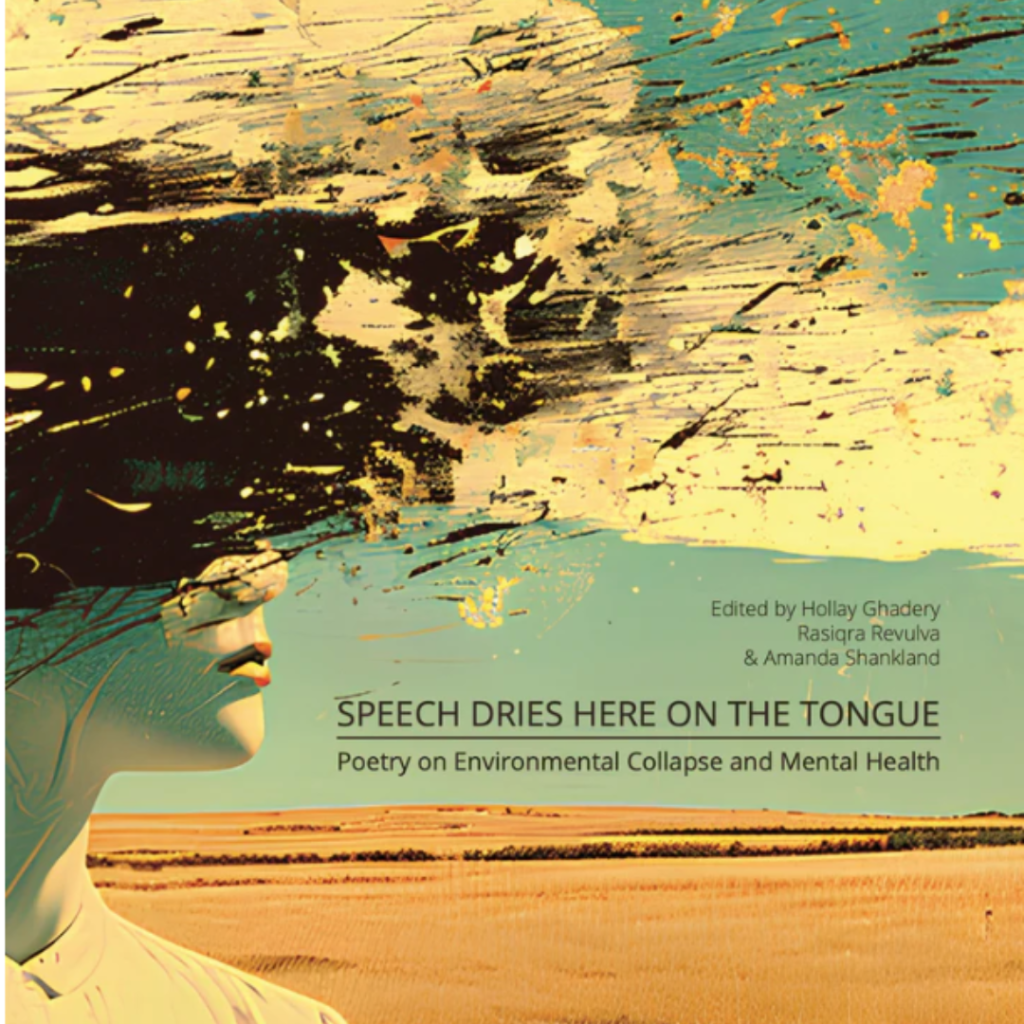
SPEECH DRIES HERE ON THE TONGUE:
Poetry on Environmental Collapse and Mental Health
Editors: Hollay Ghadery, Rasiqra Revulva
& Amanda Shankland
The Porcupine’s Quill, Guelph, ON; 2025
ISBN: 978-0-88984-490-2
Reviewed by Kate Rogers
In their preface to the anthology SPEECH DRIES HERE ON THE TONGUE: Poetry on Environmental Collapse and Mental Health, the editors rate our conflicts with each other as important as ecocide, “how we treat each other is deeply connected to how we treat the natural world.” In this age of polarization environmental degradation can be silencing. Yet, even in the middle of the Climate Crisis and widespread ecological destruction the anthology’s editors remind us that we retain agency: “Poetry can serve as a space to envision alternative futures, creating room for collective dreaming and transformation.” At the same time, they believe their vision must support the voices of those who are hopeless, “making space for the essential work of embracing pain, grief and anger.” Many of the poems I quote in this review inhabit the darkness.
Emergency doctors in Western Canada have reported a rise in climate-related anxiety and suicides following the intense wildfires which begin earlier each year. While I have been reading the anthology and writing this review more than 20,000 people endangered by wildfires have been evacuated from Manitoba, Saskatchewan and Alberta. The lack of clean drinking water on Indigenous reserves and industrial pollution in low-income neighbourhoods regularly push people to despair. This anthology offers a forum for poets grappling with the intense realities of living with environmental destruction, and for readers to “listen, feel and respond.” Twenty-one poets share their perspective: “even as speech may dry on the tongue, it gives us a thirst for change.”
As Canada’s new government vows to build to boost our economy in the face of Donald Trump’s tariffs, some Indigenous communities worry that proposed consultation timelines will not respect their tribal structures: “Our communities don’t all have the capacity to move at the speed of business.” (CBC interview with Algonquin Grand Chief Savanna McGregor, Algonquin Tribal Council, May 30, 2025.) [i] Will Indigenous communities need for consultation be honoured when permits and the environmental assessments for big mineral extraction projects are fast-tracked by government?
In his poem “Burning Off Last Season,” D.A. Lockhart, who is pùkuwànkoamimëns of the Moravian of the Thames First Nation, watches a neighbour burn last season away: “Omen admires its own form before folding into / a soft dissipation of air, heat and ash…refuses the touch of water… Ceremony shall deliver / rich black nourishment.” Traditional Indigenous use of fire to release nutrients in the soil could help all farmers, just as fire breaks could be used to limit wildfires. Will Indigenous cultural practices be respected, even followed, as we all face greater environmental challenges?
In her poem “If I had a son I would call him Ben,” Mi’kmaq poet Tara McGowan-Ross considers the best response to disaster: a kind farmer advises her in such circumstances to “loose the horses.” Yet, “Well-meaning saviours arrive with their animals / mulched in the panic-box of the trailer, beaten / to death by the pursuit of freedom.”
Farm animals communicate with the speaker: “my cousin-calf takes my whole hand in his mouth / like I have something to offer him that isn’t death.” She tells a departed friend, “Pigs are a somewhat closer relation. …In the years / since you killed yourself, I have stopped eating pork /…When I feed the mean thing it gets // bigger and more hungry.” She stares clear eyed at the negative consequences of human ambition.
In their poem “Contamination” A.J. Dolman, who lives on unceded, unsurrendered Aninishinaabe Algonquin territory, seems to be saying they are complicit in the Capitalism which drives relentless development. Their speaker acknowledges “This island was sacred / so we named the board rooms / for what was—grasses, berries, / cedar and sedge, dense brush / that held shale in place, / water, muskrats, et cetera // My boss jokes that I chose / the best seat in the building.” … “Last month I / dropped my cellphone on the street, / nearly lost myself” // … “Once they excavated a hundred / thousand tonnes of poisoned soil / they deemed the land remediated, / peeled back centuries, rampant / brickworks, black birch frames, shipped / in miles of fresh rebar, built shiny, / glass nests into the clouds.’
In “Prayer in the Age of Climate Change” Guelph, Ontario based gregor Y kennedy wrestles with the contradictions of Capitalism and our age: “The glass ceiling. / The concrete floor. / A sense of nowhere to go / Much less home.” Yet there is also beauty: “…a certain patch of trilliums / On the brink of blooming / Who gesture with three green hands / A universal sign of hope. // So true. / And equally / Not far away / The forest fires / Have never raged so wild / So early.”
In two of her “Three Senryu” in the anthology, former Vancouver poet laureate Fiona Tinwei Lam contemplates our denial:
i
BC wildfire haze
blends with contrails: Maui-bound
vacationers doze.
ii
They refuse to see—
World blind to oblivion.
Smoke must be too thick.”
In “Fire and Flood,” London, Ontario poet Jennifer Wenn’s speaker joins “Lear and his Fool / on the blasted heath,” cowers “uselessly, / looking for a sign, / hoping for a sheltering tree / with roots deep enough to / anchor in blazing barrens .”
Kathryn Mockler’s poem “Pareidolia” (the ability to see faces in inanimate objects) explains that scientists have variously considered that tendency to be neurotic, or inspired by happiness. She shows us the conflict between those confronting environmental disaster and those insisting on denial: “In the picture of the sky there are two clouds. One of the clouds looks like a man with his hand on his hip and the other cloud appears as a giant head with no body. // The man and the head are arguing about the existence of God, climate change, and whether the gains are worth the losses when it comes to extinction.”
In “Movement XVI” Toronto-based Khashayar Mohammadi’s speaker opens the poem with despair and a question about life in a hard-surfaced city : “the dark resignation to loss. How long to run after joy and just find construction cones scattered.”
All the poets quoted here are grappling with alienation and despair in the face of environmental destruction, yet as Concetta Principe’s speaker shows us in “The Painting of How I Feel,” art is the route taken by them all to seek understanding and resilience: “Sunflowers, smelling in strokes that washed Van Gogh’s mind, drove him into a mad universe….He filled his jug with madness.”
“The crack through Van Gogh’s canvas. Sunlight sprouting from the jug…” …”But above all there’s Picasso’s blue. It is the ground I walk on, holding madness shining brightly. It is the jug folding cosmic grass into itself.”
I recommend this anthology for anyone eager to read poetic responses to climate disaster and environmental destruction. And anyone unwilling to look away.
***
Kate Rogers won first place in the subTerrain magazine 2023 Lush Triumphant Contest for her five-poem suite, “My Mother’s House.” Her poetry also recently appeared in Where Else? An International Hong Kong Poetry Anthology. Her reviews have appeared in Arc Poetry Magazine, Prism International, Rice Paper and Periodicities.
Between 2023 and 2025 Kate Rogers was director and co-director of Art Bar, Toronto’s oldest poetry reading series. Kate is co-author of Homeless City with Donna Langevin (Aeolus House, Toronto, 2024). Kate’s latest poetry collection is The Meaning of Leaving (AOS Publishing, Montreal 2024). In 2019 Kate re-patriated to Canada after teaching in mainland China and Hong Kong for two decades.

 The Woodlot