
By Chris Banks
I thought I might write something about poetic influence, which for a poet is a little akin to a magician revealing his tricks are just versions of another magician’s tricks, Anonymous The Magnificent, who lived a hundred years ago, but that is the way it is with the poets we love, and take inside our minds and hearts and spirits: their voice becomes part of our own voice. If you are a young poet and trying to write your first ‘real’ poems, poems that speak from a place that is your own, from your own life, but also from someplace else too–the Other, for instance–one of the ways to do that is to really study the poets you love, and not so much ‘ape’ their style, but attempt to take a little bit of that “magic” which makes their poems special, and add it to your own bag of tricks.
Thirty-five years ago, I was enamoured with the imagery and vatic quality of Gwendolyn MacEwen’s imagery and deep lyricism and storytelling. I bought all the books. I listened to her voice over and over on vinyl in the library at the University of Guleph. Even as I write this, I hear her voice saying “Now there are no bonds but the flesh; listen –. there was this boy, Manzini…” and even though I do not write like MacEwen, something about her fabulism, her ability to spin a tale, to conjure strong titles and characters like “Motorcyle Icarus” or “Manzini: Escape Artist” or “The Red Bird You Wait For” has stayed with me.
When I was preparing my first poetry manuscript, and revising it, and revising it (it went through three solid rewrites!), my editors challenged me to stop writing so small, and try to write poems in the 30-32 line range. I stopped writing 12-15 line imagistic little “curios”, and I started reading the longer poems of Patrick Lane and the fantastic American poet Dave Smith who had just put out his The Wick of Memory: New & Selected poems.
If you were to read my second book The Cold Panes of Surfaces, and then read The Wick of Memory, Smith’s influence is unmistakeable: the highly condensed descriptive imagery, the strong regional flavour, etc. Smith taught me to write about the apple orchards and closed-down highway gas stations and little pioneer cemeteries which was part of my teenage landscape.
Another poet who taught me about jaw-dropping imagery and dreamy lyricism is the American Mark Irwin whose entire oeuvre I own. His subtle phrasing, the way he writes in his book Bright Hunger, “ in that country we live only a day, how slow the hours of each season. / How we find / in each lingering now all moments / just as you found in the cloud / of death one leaf of joy…”. Lyrical, meditative, surreal and contradictory. I am entranced by Mark Irwin’s poems, and I have tried to get some of his qualities into my own poems, like the poem “Citadel” from my second book, or the poem “Ivory Towers” from my later book Midlife Action Figure.
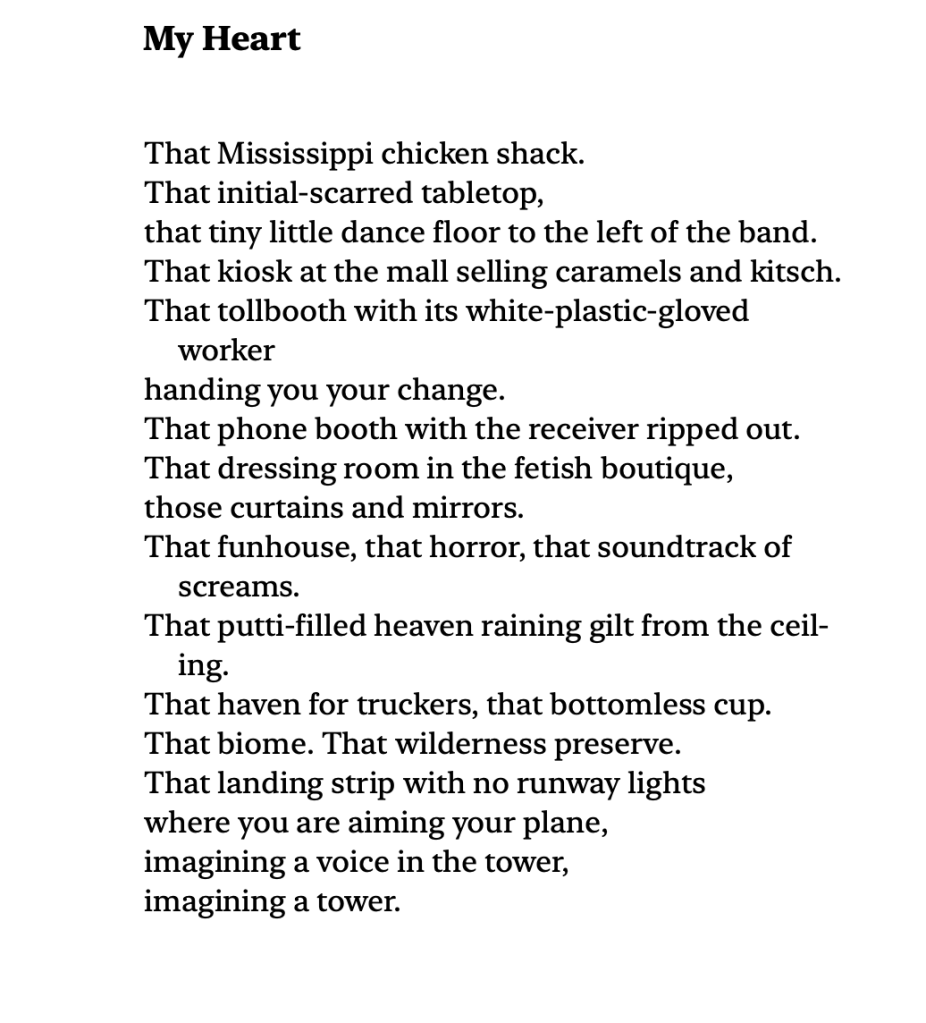
I also love the play of humour and seriousness and surreal associations in the work of Bob Hicok, the exuberant non-sequitur poetic style of Dean Young, the anger and narrative torque of Philip Levine, the introspective sweeping meditations of Larry Levis, the wit and pop culture references and descriptive imagery of Kim Addonizio. Look at this small poem called “My Heart” from Addonizio’s Lucifer at the Starlite:
Now here is my own poem “Alcohol” from my book The Cloud Versus Grand Unification Theory:
That troll under the bridge.
That suicide bomber in Toys “R” Us.
That Bermuda Triangle. That hopeless flirt.
That one-man zombie apocalypse.
That singalong in Hell. That plastic church.
That monster in the labyrinth.
Half-man. Half-beast.
Still thirsty.
I think it’s obvious to see that Addonizio’s poem had a profound influence on my own poem, but the poems are different enough too. That’s the magic of influence. The magic of poetry.
So why am I pulling back the veil and revealing some of my carefully guarded influences? Well, I think again starting out as poets we are so “chained” to idioms and familiar patterns of speech, conventional ways of thinking, it is hard to find our way out of them. By reading other poems and other poets closely–especially those poets who have a strong inimitable voice–it helps to defamiliarize language, and therefore help us to begin to think in non-habitual ways.
In his book Why Poetry?, Matthew Zapruder has stated,” Poetry exhibits the purest form of defamiliarization. This is because in a poem, other tasks, such as telling a story, or fully and exhaustively expressing an idea, never take priority… …it is in poetry… …language can be made deliberately strange” (43). I like this quote and I think what helps us to make our poems fabulous and strange is by reading those poets who seem to be speaking an entirely different language than you. An elevated language. One that gives purpose and artistic expression to our lives.
Harold Bloom, in his The Anatomy of Influence, writes, “For art comes to you proposing frankly to give nothing but the highest quality to your moments as they pass, and simply for those moments’ sake.” I certainly believe that, but I would take it a step further and say if you are going to be influenced by some other poet, it should be someone’s poetic voice of the highest quality, a voice which is enviable, special, enlivening, and unfamiliar in order that maybe some of that unfamiliarity rubs off and enters your own poems.
Influence is inevitable, but what you do with it, of course, is up to you.
Chris Banks is an award-winning, Pushcart-nominated Canadian poet and author of seven collections of poems, most recently Alternator with Nightwood Editions (Fall 2023). His first full-length collection, Bonfires, was awarded the Jack Chalmers Award for poetry by the Canadian Authors’ Association in 2004. Bonfires was also a finalist for the Gerald Lampert Award for best first book of poetry in Canada. His poetry has appeared in The New Quarterly, Arc Magazine, The Antigonish Review, Event, The Malahat Review, The Walrus, American Poetry Journal, The Glacier, Best American Poetry (blog), Prism International, among other publications. Chris was an associate editor with The New Quarterly, and is Editor in Chief of The Woodlot – A Canadian Poetry Reviews & Essays website. He lives with dual disorders–chronic major depression and generalized anxiety disorder– and writes in Kitchener, Ontario.

 The Woodlot