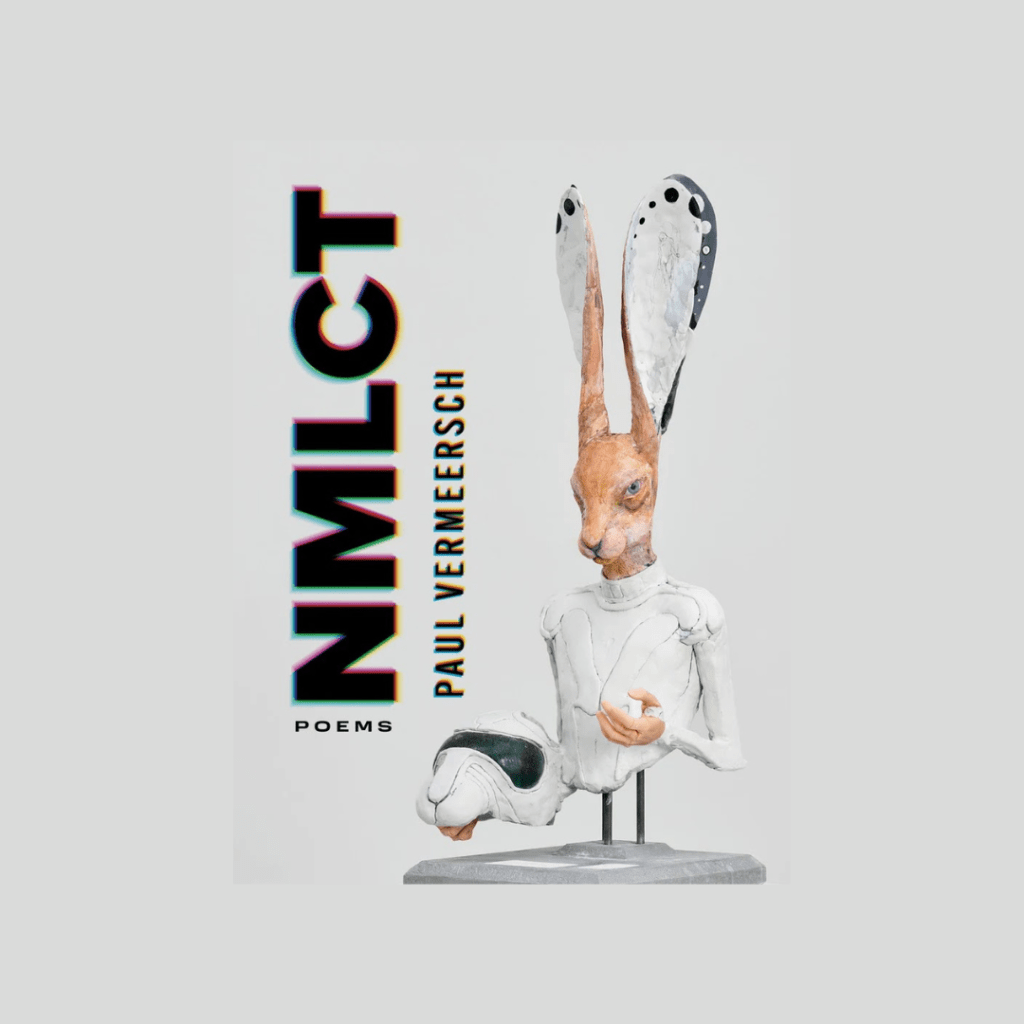
By Chris Banks
Andre Breton said, “The imaginary tends to become real” and this is a banger of a quote to start off a review of Paul Vermeersch’s latest poetry collection NMLCT (pronounced “Animal City”), out this Fall with ECW Press. Although I would say NMLCT is, at its core, a “visionary” high concept poetry collection that delivers on its own high concept, it’s also very much a book about the real world we currently find ourselves living in.
For myself, I read NMLCT several times, really sat with the poems, mulled over its lines like “The shroud of intelligent life is unintelligent life”, and then began to think about the human potential we have lost by giving our lives over to AI algorithms, and functional “minimalist” design, and the endless multiplication of machines.
Yes, our lives may be easier, but our connections to nature which is also our connections to mystery, to wonder and to awe, have been radically altered, paved over, like putting a suburb of square foundations on top of a forest.
In NMLCT, Paul Vermeersch is saying what has been lost is not simply part of our animalistic nature, but our ability to think outside the “mirrored box.”
There is a density of images and evocative lines in NMLCT that remind me a lot of the American poet Charles Wright, but only if Charles Wright was a reluctant cyborg, or a prisoner of intelligent machines. Honestly, I have not really read a poetry collection like this one. It’s a highly original book.
In the first section “MCHNCT”, Vermeersch states “You are here. Partially” suggesting we have become lost in a maze of dull prosperity, and boring La-Z-Boy comfort, which is leading to our own human obsolescence in an age of AI Chatbots (Vermeersch makes it clear at the end of NMLCT that no part of his book was created with artificial intelligence, chatbots, language models, or any similar technology).
These are poems talking about our increasingly beige, machine-driven world: mice with human ears growing on their backs, walls reverting “from white to intrinsic grey”, streets fluctuating “like 8-bit snakes—Up. Up. Down. Down. / Left. Right. Left. Right”, and even luxury brands shilling revolution, not because they believe in the righteousness of the cause, but because the spidering online algorithms say that is where the Zeitgeist is currently bagged and tagged.
If you look at his poem “HORIZONTAL SURFACES PUNCTUATED BY VERTICAL OBJECTS”, you see these themes knit themselves into tightly controlled lines and new synaptical connections out of the faded“blueprints” of civil engineering:
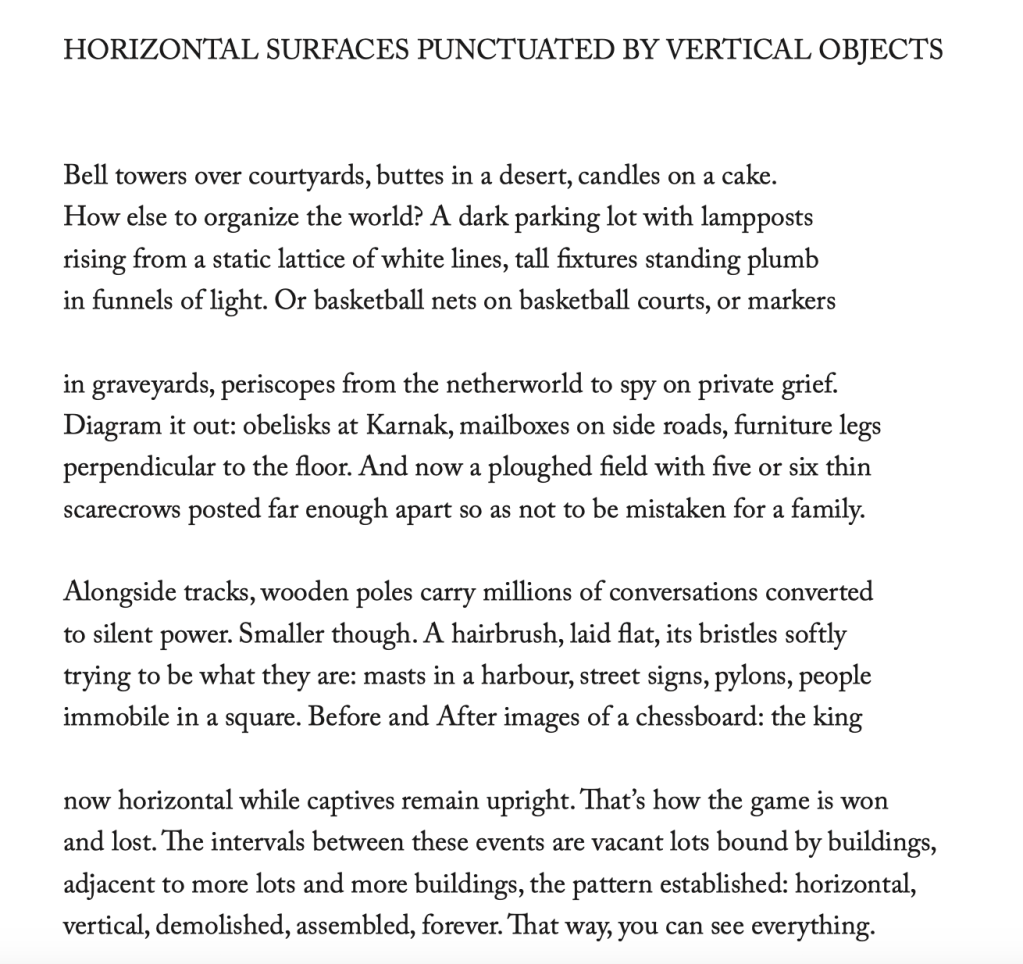
The contrast of obelisks at Karnak–monuments to the sun god Ra and by extension to the extraordinary–with a ploughed over field “with five six thin / scarecrows posted far enough apart so as not to be mistaken for a family” is rich with irony, and speaks not only to our loss of connection to earthly spaces, but to the once great mysteries that were tied to and evoked by those connections to nature. “What is food, what is fur, what is fire?” Vermeersch writes in another poem which at least to me is saying we have lost a sense of our priorities, and in the poem “ESCAPE FROM MCHNCT” the speaker offers up a remedy for humanity’s ailments: words. The speaker says, “Words say there is another place” as if language is the default home, and then even later, the speaker implies words are “the home of limitless opportunities.” I couldn’t agree more.
In the titular section of the book entitled “NMLCT”, the speaker having emerged from MCHNCT, the scales newly dropped from their eyes, now sees the forest for the trees, the organic amidst the machine code, the “real life” amidst the suburbs and the people wearing Hawaiian shirts like camouflage:

In this poem, Vermeersch rightly points out leopard print or butterfly patterned shirts are a kind of camouflage turned in on itself, made visible, but one can hide amidst the visible, “paint NMLCT / in radiant tiger stripes to make our camouflage / camouflage again.” I love the evocative ending line too where, “We become the rainforest no one sees set ablaze”.
I’m not sure I understand everything in the book, and there are poems with bar codes that left me scratching my head a little, but even those poems go along with the book’s design aesthetics, and overall, there is a plethora of memorable, stirring lines in this poetry collection, like: “The magic bean is a treasure, but the beanstalk is an aberration” or “The future is someone else’s archaeology”, or “Because we did not invent the sun, we have convinced ourselves we cannot trust the light of day”, or “Sunlight / falls apart. The shadows are cast in every direction. My god, it’s full of birds.”
That last line is such a wonderful, playful twist on an iconic line from Stanley Kubrick’s 2001: A Space Odyssey. Pure poetry.
I really am gobsmacked by these “visionary” poems, and I’m extremely happy for Paul Vermeersch, not simply because he is a close friend (we started publishing poetry around the same time in the 2000s), but because I have seen him work with conceptual poetics, and how his mastery really has grown through earlier books like Between The Walls, and The Reinvention of The Human Hand, to this new, richly rewarding and complex collection NMLCT out this Fall with ECW press.
I recently read Dana Gioia’s essay Poetry As Enchantment where he writes, “the central aim of Surrealism was to connect and to reconcile dream and reality–a vision that haunted much of twentieth century poetry.” Well, in NMLCT, it feels very much like poet Paul Vermeersch is attempting to reconcile dream and reality in the twenty-first century too.
There is rigour and tension in these 16 line, formally-constrained poems, but also a sharp, restless and original consciousness that is the nucleus of this whole poetry collection. NMLCT encourages us to make new thoughts, new connections, new poems amidst the old abandoned computer code and made-to-sell cheap design work, amidst “the glitches” of background machine noise. These spellbinding poems, at once allusive and engaging, are portents, wards against the artificial intelligence and misinformation we find so much of our modern lives are now mired in, but they are also, I think, signposts, maps for finding our way back out, through words, to our genuine selves.
Chris Banks is an award-winning, Pushcart-nominated Canadian poet and author of seven collections of poems, most recently Alternator with Nightwood Editions (Fall 2023). His first full-length collection, Bonfires, was awarded the Jack Chalmers Award for poetry by the Canadian Authors’ Association in 2004. Bonfires was also a finalist for the Gerald Lampert Award for best first book of poetry in Canada. His poetry has appeared in The New Quarterly, Arc Magazine, The Antigonish Review, Event, The Malahat Review, The Walrus, American Poetry Journal, The Glacier, Best American Poetry (blog), Prism International, among other publications. Chris was an associate editor with The New Quarterly, and is Editor in Chief of The Woodlot – A Canadian Poetry Reviews & Essays website. He lives with dual disorders–chronic major depression and generalized anxiety disorder– and writes in Kitchener, Ontario.

 The Woodlot
One response to “Raging Against The Machines: A Review of Paul Vermeersch’s NMLCT: Poems (ECW Press, Fall 2025)”
[…] and vivid imagery. Although not a long poem, per se, Paul Vermeersch’s latest collection NMLCT out with ECW Press this Fall feels like a long poetry sequence, and has narrative elements. Then […]
LikeLike