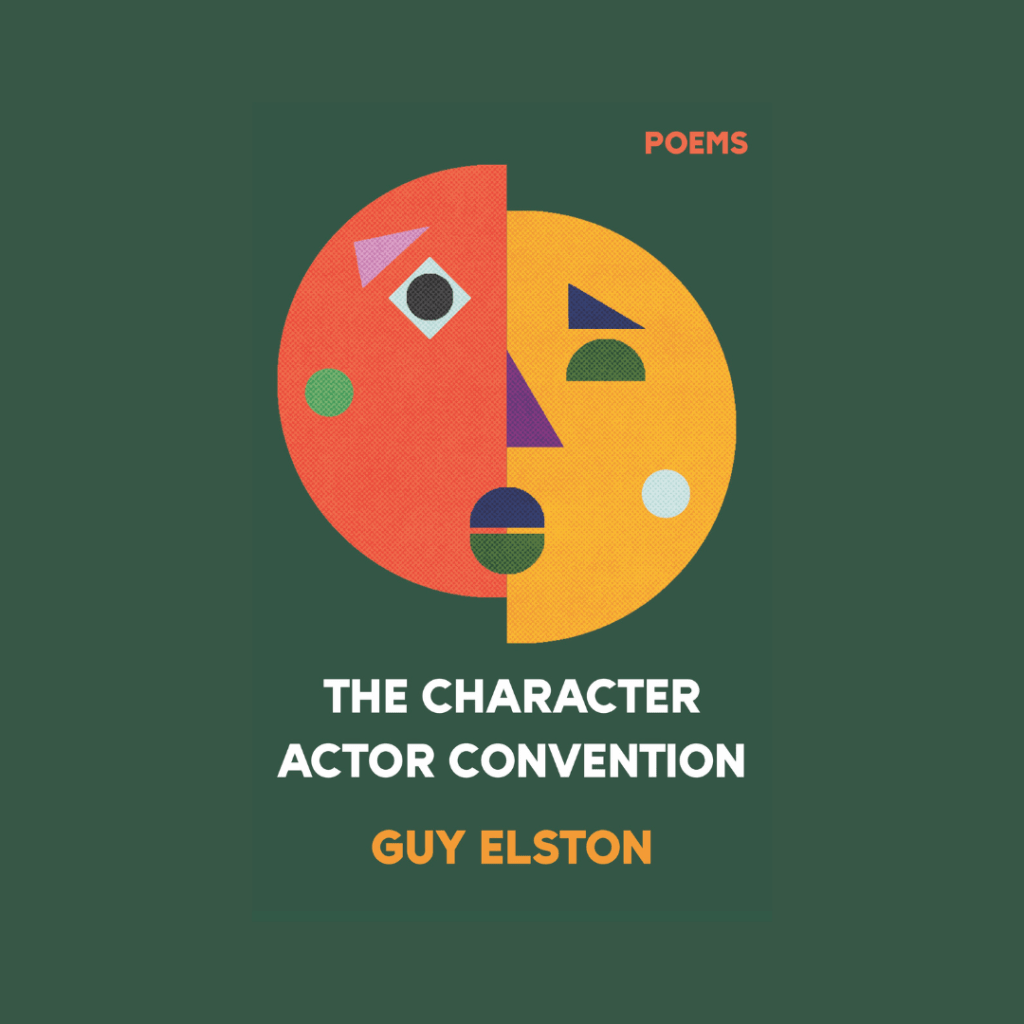
by Chris Banks
“Before I understood it, I loved it” writes Guy Elston in his poem “Lodestone” which might just be the credo of every young poet who has ever lived, read a poem, and was somehow changed, and then spent years trying to understand the whys and hows of poetry.
I like The Character Actor Convention (The Porcupine’s Quill Fall 2025), I think, mainly because Elston hides behind so many voices and personas and shifting perspectives in the book. There are dramatic monologues of dead pheasants, and Autumn’s board of directors, fresh imaginings of meet-ups with Napoleon and Saint Augustine, and the dream of a Dream historian, making me believe the speakers in this book are not Elston, but a multitude of movie extras and extraordinary heroes like King Arthur checking phone notifications. Elston writes in that particular poem, “Arthur might be a composite character”. Well, so is the trickster poet writing these poems.
When reading the book, I was trying to see if I could deduce Elston’s poetic influences, and there is definitely a little bit of the playfulness of Mark Strand’s later poems, or maybe I’m just assigning that to poems like “No More Worlds” that has the speaker bantering with Alexander the Great:

This poem is fun and playful, and riffs on conquering countries and the much fussed over trope of Glory. It’s really mischievous to think of Alexander The Great wandering Queen & Bathurst, looking for a country to lead, when our own nation’s identity is still one we are grappling with ourselves.
Really, reading The Character Actor Convention, I felt like this is a young poet’s book, as if Elston is discovering his own poetic voice by leaning hard into other poetic voices, and other perspectives, and trying to draw out something both familiar and unfamiliar from them. Maybe it’s from a belief “No-one’s big enough to swallow poetry” as the Whale says in the poem “The Whale”. That line makes me smile, not simply because of the anthropomorphism, but because I believe this to be true. “Poetry is an act of mischief,” said American poet and teacher Theodore Roethke, and there is a lot of mischief in this book.
What is poetry? Can you lasso the poetic imagination and make it give up its secrets? The answer here is both yes and no. You can come away with some insights and fresh understandings, but Elston’s speakers, by wearing various masks, are saying maybe one comes to finding their own poetic individual voice through play and personas and hard work, and not earnestly wishing to be a marquee name.
For me, the poems I found the most formally astute or controlled were the prose poems, again putting me in mind of the deceased American poet Mark Strand, or even the ever terrific Richard Siken. Check out the first part of the poem “The Seasonal Industrial Complex” which feels not just wholly realized, but again just such a delight to read and to experience.

The ending “It’s our guarantee that things will get better, just first they’re going to get worse” cracks me up, but also hits me right in the solar plexus, too. Ooof! That idea of “the living inside of the dying” truly gives me pause, and speaks to the vitality of poetry, and of people trying to make a difference, in contrast to the planet going about its business of warming, and Capitalism placing our hopes and dreams in the cross-hairs. Even with all that going on, Elston puts on a brave face on as he writes later in a poem “The world has cracked, / but the sun’s not going anywhere. / May as well live forever, while I’m young.”
Ah, the flush and cynicism of youth, at once. Gather your pieces of birthday cake while ye may, Elston seems to say, because at some point, the birthday cakes stopped getting baked for you, and life becomes a little more fragile. The idea of mortality is the theme of another poem called “Instrument” which feels like a fresh modern iteration of “Butterfly on Rock”. Check it out:

This might be my favourite poem in the whole collection. That first line starts the poem off with a bang, and its true that death is probably going to be a lot less climatic than us poets–young or old—think or write about. Yup, one day you are crossing the living room floor, and you don’t quite make it due to stroke or cardiac arrest. I also like the image of life seeping out of the spider “like a glove” relaxing.
Honestly, I think The Character Actor Convention by Guy Elston out now with The Porcupine’s Quill is a fine debut from a promising new voice in Canadian Poetry. I felt the poems challenged my notions of poetic voice, but also offered up an array of startling images and delightful personas which made me feel like a “free-entrance” tourist in a gift shop where both seasoned poets and the most cynical of readers will find poems to enjoy.
Chris Banks is an award-winning, Pushcart-nominated Canadian poet and author of seven collections of poems, most recently Alternator with Nightwood Editions (Fall 2023). His first full-length collection, Bonfires, was awarded the Jack Chalmers Award for poetry by the Canadian Authors’ Association in 2004. Bonfires was also a finalist for the Gerald Lampert Award for best first book of poetry in Canada. His poetry has appeared in The New Quarterly, Arc Magazine, The Antigonish Review, Event, The Malahat Review, The Walrus, American Poetry Journal, The Glacier, Best American Poetry (blog), Prism International, among other publications. Chris was an associate editor with The New Quarterly, and is Editor in Chief of The Woodlot – A Canadian Poetry Reviews & Essays website. He lives with dual disorders–chronic major depression and generalized anxiety disorder– and writes in Kitchener, Ontario.
 The Woodlot