
by Chris Banks
How happy I was if I could forget
To remember how sad I am
Would be an easy adversity
But the recollecting of Bloom

Keeps making November difficult
Till I who was almost bold
Lose my way like a little Child
And perish of the cold. - Emily Dickinson


I begin a review of Isabella Wang’s brand new poetry collection November, November with this short lyric by Emily Dickinson because it captures some of the same emotions I felt while reading Wang’s collection of five long poem sequences, or “passages”, passages which feel like letters ,or diary entries to friends, at times, and at other times really controlled, leaning heavily into huge lyric moments like love of life and beauty: or losses of mentors like the terrific Phyllis Webb who passed away in 2021; or a health scare diagnosis in your twenties which is what happened to the poet Wang during the writing of this book. These poems in November, November are deeply meditative, grief soaked and fear ridden, both sprawling at times and concise– but never, never timorous.
I really applaud the poet Isabella Wang for eschewing an easy sophomore collection of short simple personal lyrics, but given the time this collection was written, a time when the world was coming out of a worldwide pandemic, and Wang was grappling with the precarity of her own life and health–maybe it was not so much daring but fighting for one’s life and one’s wish “to get it all down” while there is time.
Given that each of the five “passages” feel like long poem sequences, Wang had the personal freedom to break a lot of rules as the conventions for writing long poems are still up for debate.
Whole sections of poems are without punctuation, and there are spaces between words in individual lines that help to punctuate the rhythm of the poems which made it easier for me to feel, if not always understand, what the poet was communicating. Long poems sort of make up their own rules as they go along, and as I read this particular collection, I really felt that Wang who is a talented poet, a much more talented poet than myself at her age, really needed to get a torrent of words and emotions down on the page.
The first section for me “Constellations: November 2020” was not the strongest in the book, as I found it a little hard to understand, although the emotions were palpable, but the collection really takes off in “Passage 2: November 2021” where I felt the language was under more control, and references to the loss of her friend and mentor Phyllis Webb felt both poignant and world-shattering, woven skillfully with the colour of Wang’s grief. She reminds us in this section “the heart pulses / distances the mind cannot imagine / to cross in a lifetime.”
In passage 3 simply entitled “December 2021”, the poet receives a cancer diagnosis and, the poems become very condensed in their language and their imagery, employing both lyricism and reportage, to render what must have been an incredibly difficult time. The mind reels. My favourite poem from this section is the poem “If, There is Time” of which I only offer up the first few stanzas.
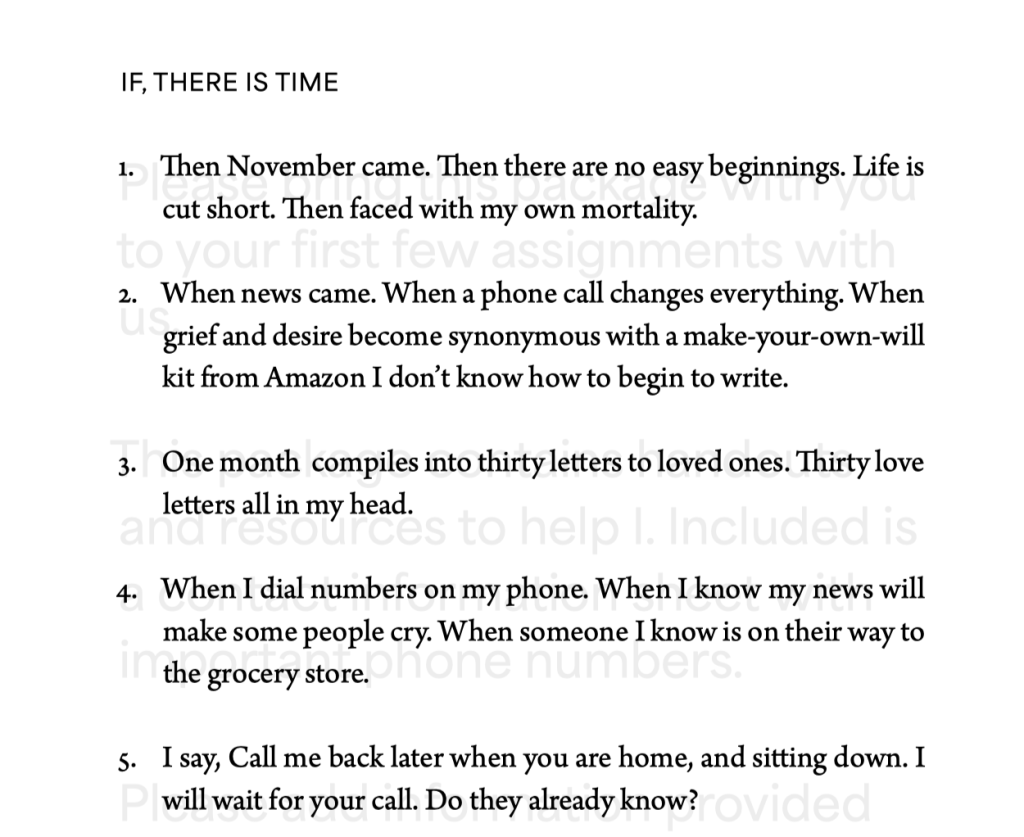
This section is where as a reader I start to catch up with what Wang is doing in the book, and the idea of writing thirty letters to loved ones really gives the reader a time to pause and to reflect about what they would do if they were placed in a similar situation. The very next poem is called “The Patient Is A Body”, and stands in stark contrast to “If, There is Time” for it uses near clinical language and repetition, and an almost reportage-style structure to pester the reader’s empathy felt in the last poem, so they can feel how the poet felt when meeting with medical professionals who treat the bodies but not the minds of patients.
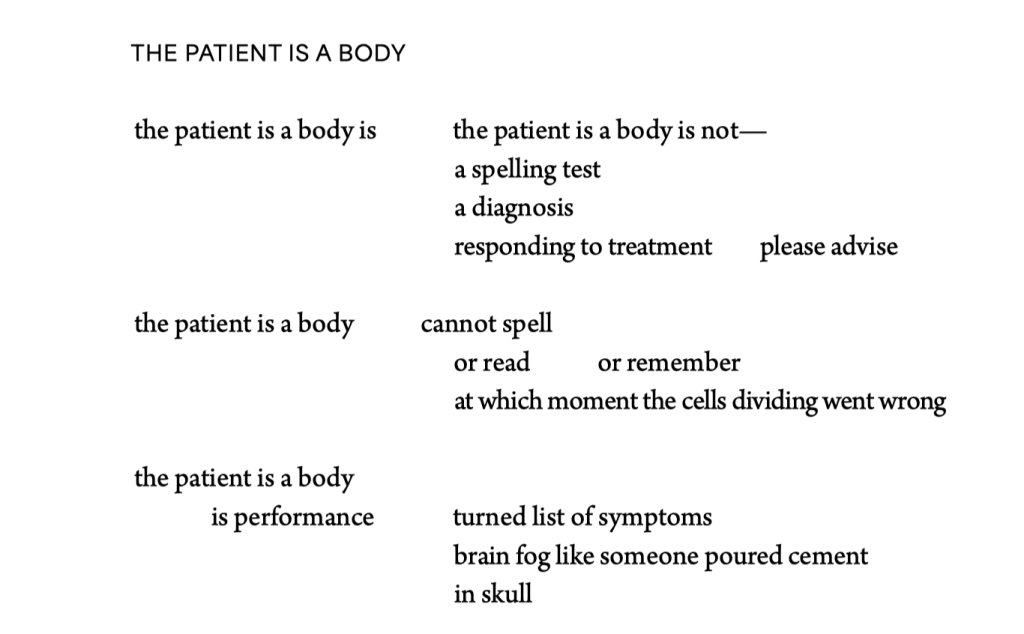
This is only the first few stanzas of this poem, but it is enough to make one feel the anxiousness of the poet facing her mortality, and the near clinical indifference of medical professionals looking to treat symptoms, and not the psyches, of their patients.
There are also “sonnets” to be found in the fifth passage that I found really interesting, especially “Sonnet 2” which I really found works well and has many, many arresting lines:
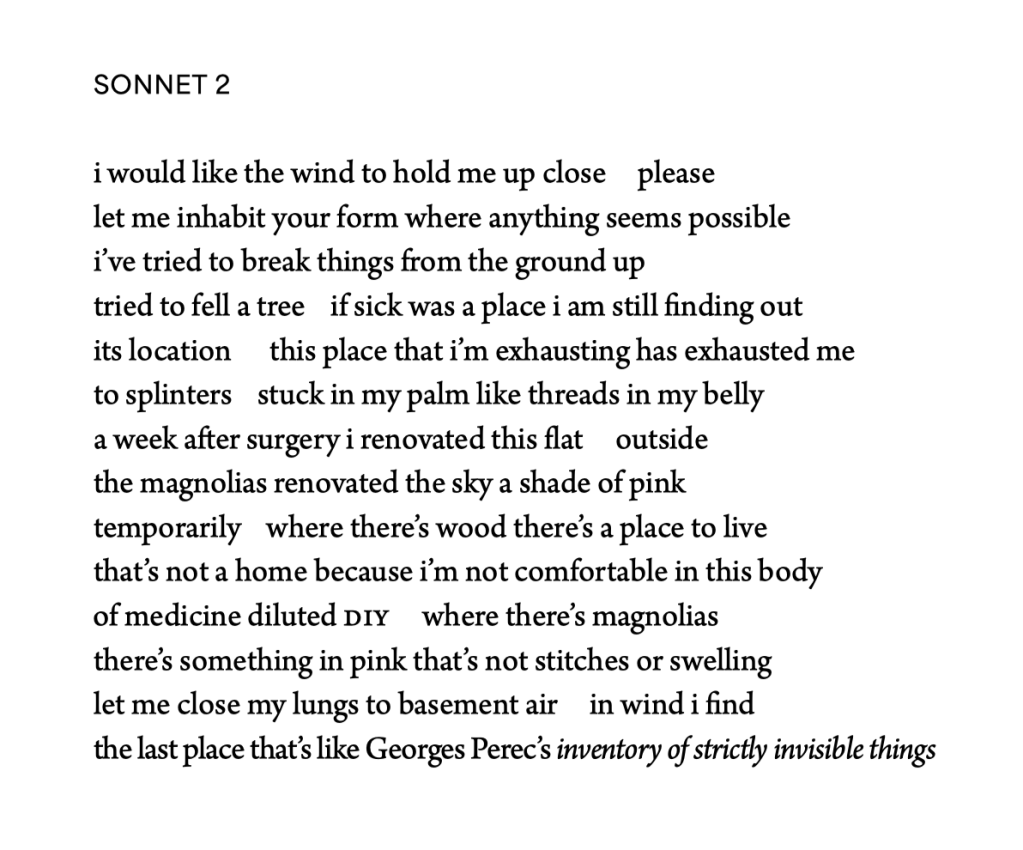
I like that line “please / let me inhabit your form where anything seems possible” which reads to me that when you are young and talented and given a health scare, maybe anything becomes possible, especially in poetry, and the old fears of playing it safe are thrown away because you have real fears like cancer, losing one’s life, that make other fears like the fear of trying new things, especially in one’s writing, feel quaint in comparison.
This is a sentiment I read into these lines: “My body is unfamiliar. I have no energy, no body mass, no sleep, or the ability to make language with my body. I am homeless too. Better not to give the tumour a permanent place to call home.”
November, November by Isabella Wang, out now with Nightwood Editions this Fall, is a brave, risk-taking book pushing a reader to think about poetic structure, of love and loss, of time left, and although I don’t know if everything works all the time, maybe things do not have to, especially when you are a poet facing one’s own mortality, and your mind is racing, and the only thing you know how to do is write, get it down on paper, and keep going.
A sophomore poetry collection is hard to write for anyone, and I think given the things Isabella Wang has been through, and choosing to write five long poetry sequences instead of more simple, safely established forms, shows a poetic human consciousness fiercely determined to be more than a list of symptoms, more than a living ghost in a medically-diluted body, more than the sum of her grief for dead poet friends; in fact, to be more, no matter the cold and the long dark that lies in store beyond November for all of us.
Chris Banks is an award-winning, Pushcart-nominated Canadian poet and author of seven collections of poems, most recently Alternator with Nightwood Editions (Fall 2023). His first full-length collection, Bonfires, was awarded the Jack Chalmers Award for poetry by the Canadian Authors’ Association in 2004. Bonfires was also a finalist for the Gerald Lampert Award for best first book of poetry in Canada. His poetry has appeared in The New Quarterly, Arc Magazine, The Antigonish Review, Event, The Malahat Review, The Walrus, American Poetry Journal, The Glacier, Best American Poetry (blog), Prism International, among other publications. Chris was an associate editor with The New Quarterly, and is Editor in Chief of The Woodlot – A Canadian Poetry Reviews & Essays website. He lives with dual disorders–chronic major depression and generalized anxiety disorder– and writes in Kitchener, Ontario.
 The Woodlot