lovingly reviewed by rob mclennan
In Which We Replace
Garbage With Love

This place is famous for love, all brands
& standards. We who come here know love

is a verb, & we love with open hands.
On the road in, on the rock, in the falls,

we leave love wild, leave it wet & within
reach. We love without calculating or quitting

or letting up. We taste love, tumble in it, break it
open on the rock. We bleed from love

and come back with more. We light love on fire,
breathe it in, leave it like a small hot wish

when we go. But we will learn, or leave,
or get careful, so come look now:

We are fresh with love, & the days go by
like open windows.
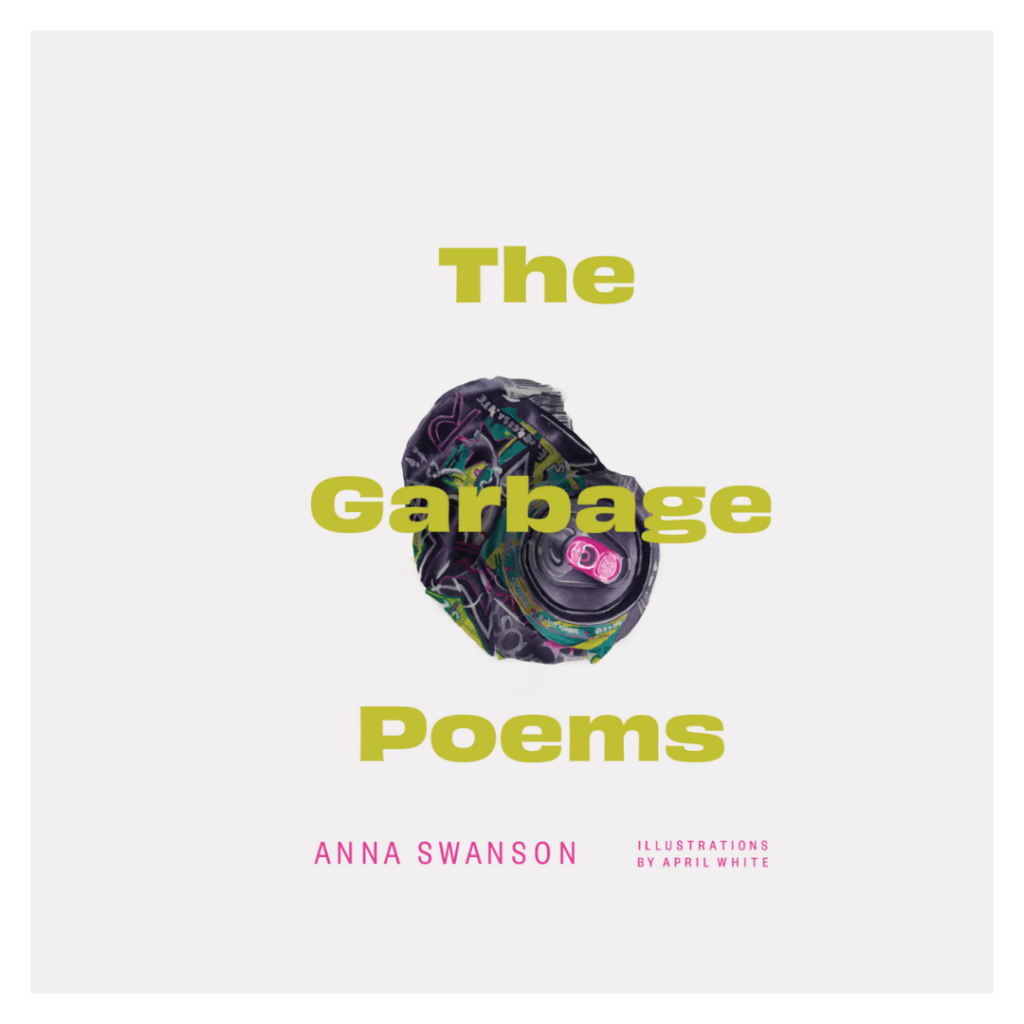
St. John’s, Newfoundland poet Anna Swanson’s second full-length poetry title is The Garbage Poems (Brick Books, Fall 2025), a book that follows her full-length debut, The Nights Also (Toronto ON: Tightrope Books, 2020), which itself won both the Gerald Lampert Memorial Award and a Lambda Literary Award. The poems that make up The Garbage Poems are composed, as the whole collection is framed, via prompt, utilizing the accident of finding abandoned refuse (and language) at various locations to prompt and propel her poems, with the resulting short narrative lyrics set into sections based upon where such materials were gathered.
“All words (except titles) from garbage collected at a swimming home in Flatrock, NL.” offers the subtitle of the first section, “Flatrock,” or the section “Big Punch Bowl,” that adds that “All words (except titles) from garbage collected at Big Punch Bowl Pond near St. John’s, NL.” The use of such a particular prompt is reminiscent of Carin Makuz’s The Litter I See project, which began a decade ago by asking Canadian writers to compose prose or poetry using the prompt of a photograph of trash, wherever it might have been found or abandoned.
The Garbage Poems is organized into six geographic sections—“Flatrock,” “Punch Bowl,” “Big Punch Bowl,” “Roblin Lake,” Cape Broyle” and “Beachy Cove”—each of which also include a short pre-offering of “SOME DEFINITIONS,” as well as two curious asides, the poem “I Am Writing a Spell for Your Nervous System” and “Nothing Is Wrong, I Tell Myself,” set between the second and third sections. The collection also includes the further complexity of lush and lovely illustrations by award-winning artist April White, providing such counterpoint that it becomes blurry as to which of the two is accompanying the other, providing such a wonderful balance of visual and textual prompt.
Swanson’s poems articulate such lovely bricolage, stitching narratives as a collage of subject, accumulation and language, stitching narratives from found materials into reason, logic, story. “We are not sorry. We are / the ice that will not melt,” writes the ending of the poem “For the Boys Cliff-Jumping / by the Memorial Stone,” “the special extract in the root beer of not aging, / the sparkling under-king, the carbonated wet dream, // the premium formula good stuff. We are, / at a price you do not know, // at any price, / this.” Swanson crafts her articulations with the building blocks what is lost, set aside, discarded, writing youthful hijinks and Queer desire, flailing about and feeling invisible, set aside or silenced; writing what is seen but not noticed, what is noticed but not fully understood, and how each object, each story, is changed through the process of looking. As the poem “For the Two Girls in the / Lower Pool, Kissing” offers: “You know the cost of caution / is always more.” She writes her narratives as a sequence of coming-of-age, of coming out, of attempting to find and be found instead of feeling, being, lost. “Call it form,” she writes, “sure, these limits, // this room of too few words whose walls / I hit first, before my own faltering.”
Through the use of found materials and language, Swanson builds her collages as a sequence of lyric studies, connecting material to location, and articulating her short narratives with material she might otherwise have never used, providing the opportunity to disrupt and challenge her own natural rhythms to stretch her poem-muscles, and explore lyric possibility. There are stories she wishes to explore, to tell, and these challenges upon her writing help provide new ways of looking at what, and even who, might otherwise have been abandoned. As the three-page poem “Nothing Is Wrong, I Tell Myself” ends:
And across the flooded lake, the exuberant
nasal haranguing of the geese,

it me, it me. It me, that original cry
lit the face of the first mirror

when we climbed with new feet
out of whatever held us, wet

and indistinguishable. Indistinguishable as we
once were from each other and the world, no gap

between to be monetized and leveraged.
But monetized and leveraged,

swimming in terms and conditions,
how now do we look back at the flooding

lake, at the garbage pile and let ourselves recognize
ourselves, let your small voices be filled—

a rising up, a song. A song: it me.
It me, grieving.
rob mclennan’s latest collection is the book of sentences (University of Calgary Press). A further, edgeless, appears next spring with Caitlin Press. He is the current Artistic Director of VERSeFest: Ottawa’s International Poetry Festival.
 The Woodlot