by Chris Banks
—When will we arrive?
—You’re already here.
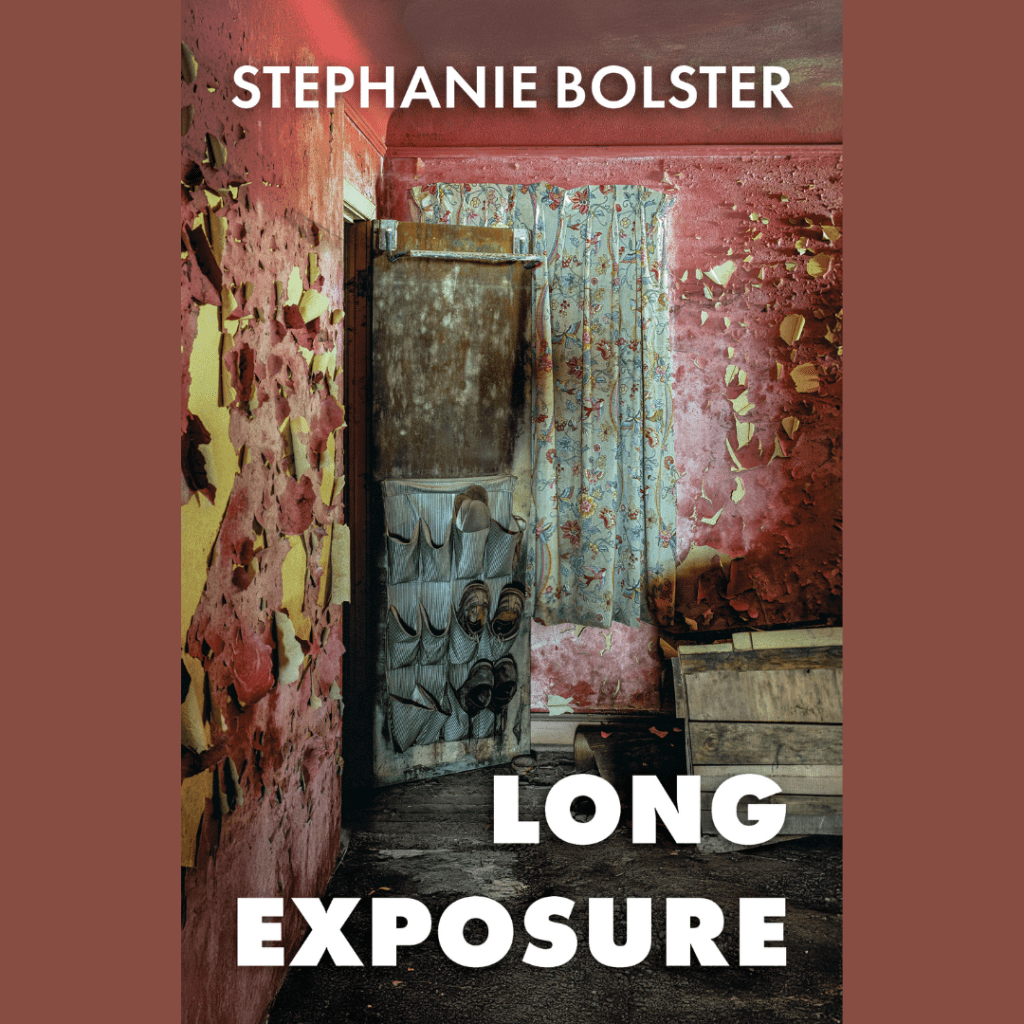
Long Exposure by Stephanie Bolster, out with Palimpsest Press this Fall, is both challenging and ambitious for it does not read like the tight shorter lyrics which Bolster is known for, nor is it a modern epic tied to that particular tradition. The collection takes most of its inspiration from the photography of Robert Polidori, a photographer who meticulously photographed New Orleans in the wake of Hurricane Katrina, and Bolster’s fascination with those photographs becomes the strong base of Long Exposure. The book is interesting to read and really stretches the poetic imagination and one’s empathy as the book rolls along with short descriptive passages, bits of dialogue caught by camera crews, snippets of disaster reporting, allusions to the Chernobyl disaster 1986, New Orleans and Hurricane Katrina 2005-2006, Japanese internment camps 1942 BC, and the Fukushima Nuclear Disaster in 2011.
There is no set structure as Bolster’s poetic “lens” is meant to contain the enormity of those events, from the minutiae of passports and jammed bags, red dresses, dead fridges and stained mattresses to more upsetting images of dead dogs, bodies stuck in mud, cars on top of houses, and houses collapsed on cars, flood ruined rooms and FEMA trailers. Because Bolster is attempting to keep the aperture of her long poem wide, as wide as time and poetic form will allow, her lines which are both short and long look less like most contemporary poetry, and more like she is synthesizing elements of photography–space, contrast, exposure, depth of field, etc.
It was hard to choose work to except for this review as it is a book-length poem, but I did like this particular passage which feels like Bolster’s mantra for writing Long Exposure:
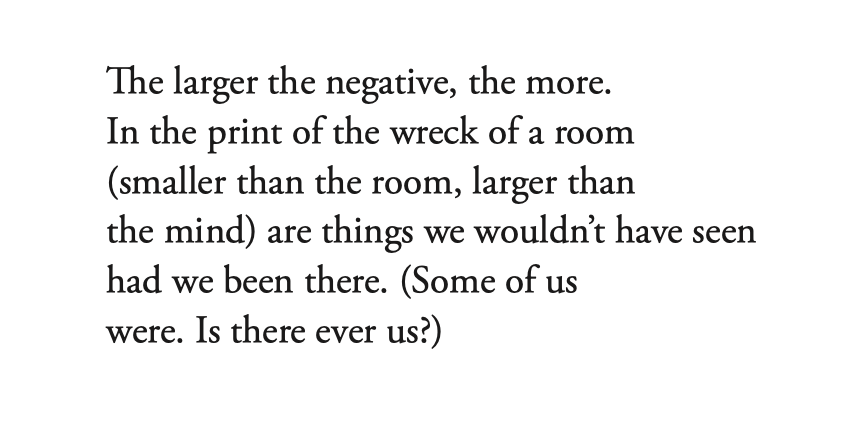
This feels like an honest appraisal of witnessing the aftermath of Katrina through the photographs of Robert Polidori. “The larger the negative, the more” line feels like it’s not just talking about the more detail one can fit into a particular photographic frame, but also the more emotion, more empathy it elicits. The photograph in question is representative of both climate devastation but also human tragedy, focusing our attention on these things which might get lost in the sheer magnitude of loss and ruination had we been there. That last rhetorical question feels like its asking if we have a shared human responsibility both to witness and to act when ecological disasters and human devastation become commonplace. It cannot become commonplace ,Bolster seems to say.
The poems are rich in poetic detail and almost mirror the dissociative doom-scroll we are subjected to in our daily newsfeed, but Bolster slows it down, writes it down, so we can see the processes of a human mind that, at once, wants to do something about the state of our planet, but also wants to protect itself from the horrors of that same witnessing. At least, I get this feeling from this particular passage:
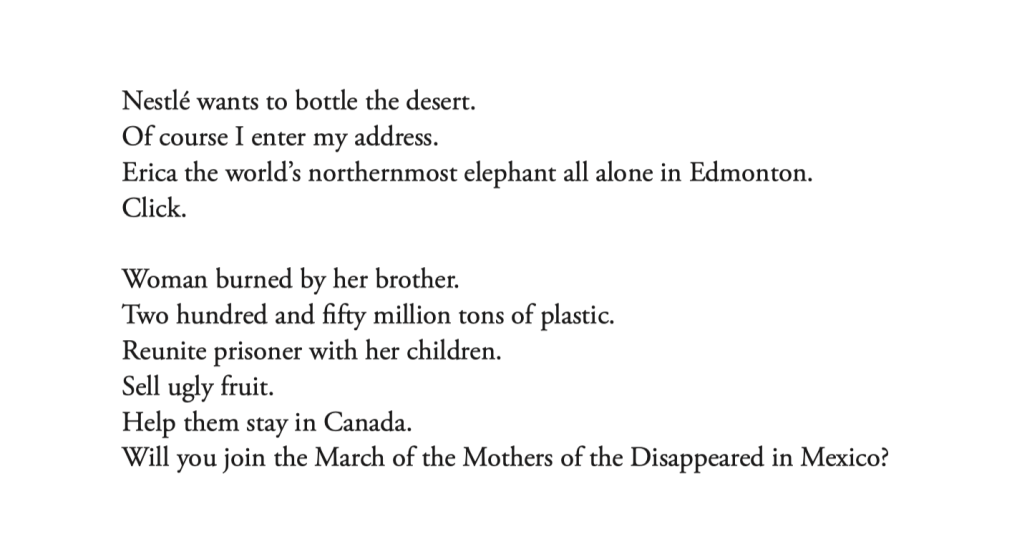
In a time of great environmental crises, unprecedented multi-national corporate greed, endangered human rights and grass roots social justice activism and disappeared foreign nationals, one can only do what one can do which is sign a petition, witness the atrocities brought about by the human race, interrogate one’s own actions and inaction, and keep going. For Bolster, she chooses to stay with the images of Polidori’s photographs, and the uncomfortable feelings they engender, and she wrote this book-length poem.
Ironically, while reading Bolster’s long poem, I began thinking about how to try to contain it, to wrestle it down, as it feels quite uncontainable. Any passage I except from the totality of the whole book feels just like that: a passage and not the long exposure, that commitment to read the whole collection Bolster is seeking from her reader.
So I have resigned myself to the fact that this will be a shorter review than usual which will end with me saying go read Long Exposure by Stephanie Bolster for yourself, and then go look up Robert Polidori’s photographs of Katrina’s aftermath, and then reacquaint yourself with the Chernobyl and Fukushima nuclear disasters, and then ask yourself, do we even know what the hell we are doing?
In Long Exposure by Stephanie Bolster out this Fall with Palimpsest Press, the poet succeeds to write a book length poem, where many fail, by using the photographs of Robert Polidori as a strong base which extends to juxtaposing New Orleans and Katrina with Japanese Internment camps in BC in 1942, then with the Chernobyl and the Fukushima nuclear disasters creating a wide-lens “picture” of the various ecological and human failings of the Twentieth and Twenty-first centuries.
The poet Bolster synthesizes the language of poetry with that of photography, of newspaper historical documents and television reportage, leaving her readers both to interpret and then to confront their own reactions to this devastating, concentrated, at times fragmentary and at other times immense long poem which offers no easy answers. The language within Long Exposure offers only a brave, experimental long poem aesthetic seeking to match the immensity of the disasters, both human and ecological, it places within its aperture.
Chris Banks is an award-winning, Pushcart-nominated Canadian poet and author of seven collections of poems, most recently Alternator with Nightwood Editions (Fall 2023). His first full-length collection, Bonfires, was awarded the Jack Chalmers Award for poetry by the Canadian Authors’ Association in 2004. Bonfires was also a finalist for the Gerald Lampert Award for best first book of poetry in Canada. His poetry has appeared in The New Quarterly, Arc Magazine, The Antigonish Review, Event, The Malahat Review, The Walrus, American Poetry Journal, The Glacier, Best American Poetry (blog), Prism International, among other publications. Chris was an associate editor with The New Quarterly, and is Editor in Chief of The Woodlot – A Canadian Poetry Reviews & Essays website. He lives with dual disorders–chronic major depression and generalized anxiety disorder– and writes in Kitchener, Ontario.



 The Woodlot
2 responses to ““Weather Is Not Our Friend”: A Review of Stephanie Bolster’s Long Exposure (Palimpsest Press, Fall 2025)”
[…] in the last month, I have read and enjoyed Stephanie Bolster’s latest book length poem Long Exposure which felt like a long ceremony of witnessing as the poet looks at the various environmental crises […]
LikeLike
[…] Read the entire review here: Weather is not our friend: Long Exposure Review […]
LikeLike