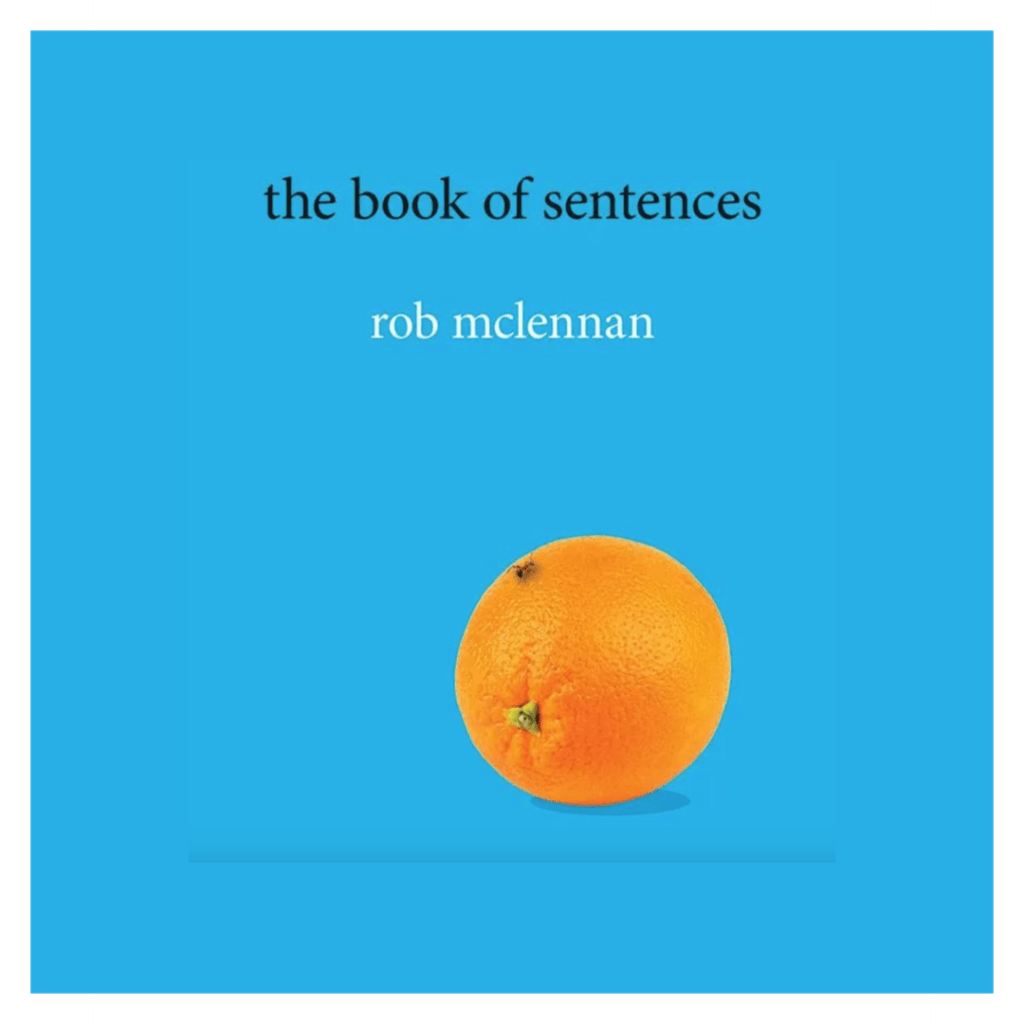
by rob mclennan
I don’t hold too much stock in ideas of the muse, instead seeking the attention of craft. The working class farm-lad in me, I suppose: writing as simultaneous muscle and study, a blend of document and pure sound against and through meaning. Sometimes one needs to simply repair the fence, milk the cows, put up a new building. One doesn’t have to get all abstract about it.
The composition of the book of sentences (University of Calgary Press, 2025) began in 2019 and ran two years into the Covid-era, stretching out as our small quartet-plus-cat remained home, home, perpetually home. During those last few months of 2019 and into the first Covid-era spring I was thinking about poems, but also not really. I was thinking about poems, in-between caregiving my father occasional weekends across his final months through Amyotrophic lateral sclerosis, and the onset of Rose, in her second half of grade one, shifting attendance from in-person to online. Aoife still sat as a preschooler, then.
Throughout my father’s final sixteen months, I had developed a writing routine of alternating between my own work and poetry book reviews: a weekend attending him while sketching out reviews, before two weeks at home on my own work, and then back to a further farm weekend of reviewing. It was hard to write creatively amid his requirements, so I simply focused my time on reading and sketching out notes for later revision, once back at my desk. I saw a full year of this until Covid lockdown, when my anxiety landed directly into the pandemic-era creative non-fiction project, essays in the face of uncertainties (Mansfield Press, 2022): the first one hundred self-isolated days, as the crisis threatened to distract from work, so I made crisis the work. One hundred days from start to finish, almost as a kind of blip in my writing, attempting to return to poems once that project exhausted.
I spent that summer sketching out poems, occasionally inflating a backyard wading pool our young ladies ran around and through, wet footprints across the stretch of our first floor, from bedrooms to hallway to living room to kitchen.
Sentences, across the length and breadth. With that first Covid-September, as both our young ladies began online school in earnest (grades two and junior kindergarten, respectively), Christine attended work mornings in our sunroom, converted into her home office, as I sat in the living room, with notebook and pen, and a stack of reading. Rose in grade two, at the dining room table, a few feet away. Rose required an ear, but Aoife, in junior kindergarten, an eye. Once their first session ended at 10:30am, I would have forty minutes back at my desk before rising to prepare our young ladies’ lunch, and Christine would take over in the living room for their afternoons.
Routine is how I get work done. Routine is how I get anything done.
the book of sentences follows a trajectory begun with the book of smaller (University of Calgary Press, 2022), pushing book-length thought across a structural, accumulated whole. A book-length suite, if you will, akin to what I was attempting with paper hotel (Broken Jaw Press, 2002): after years of working the long poem, I wanted to see if I could sustain the same extension of thought across structure and tone but through an accumulation of shorter, self-contained poems. I wanted poems that could live on their own, but didn’t necessarily have to. I wanted a collection that held together as a tighter unit, akin to a suite, but utilizing the space and staggers and hesitations of the extended line.
In comparison, World’s End, (ARP Books, 2023), a book I composed prior to the book of smaller, feels more piecemeal. Can a book-length suite be considered a long poem, or at least a coherent unit of thought? paper hotel and the book of smaller: similar attempts to think more broadly about the long poem, or at least the book as unit of composition, although with some two decades of space between composition.
I was thinking about density, attempting to weave various strands together into poems with heft, with narrative thickness. I wrote threads including the late San Francisco Renaissance poet Jack Spicer, my repeated mantra from his Book of Magazine Verse (White Rabbit, 1966). “I am going north,” he wrote, as part of “Seven Poems for the Vancouver Festival,” “looking for the source of the chill in my bones.” I was thinking about sentences: the prose sentence, the lyric sentence. A variation, perhaps, on those loping, coyote lines of the late Andrew Suknaski (1942-2012), poet of Wood Mountain, Saskatchewan, or the extended thought-lines of Ottawa poet Monty Reid.
Most of my six months leading up to the openings of this collection had been carving out short stories, although I could feel that tickle at the back of my head, itching to get back into poems, attempting to discern something different from the cluster of poems I’d composed the year earlier, “Book of Magazine Verse,” although that gathering, through Aritha van Herk’s editorial suggestion, later became absorbed into the book of sentences. “Book of Magazine Verse” overtly plays off Jack Spicer’s infamous book, composing poems with titles that aimed towards particular publications, whether or not they ever properly landed. I composed poems for FENCE magazine, Arc poetry magazine, Parenthesis and № Press, with titles as a mix of target and red herring, utilizing as jumping-off points that often allowed the poems further leaps.
Sometimes I wrote directly to the geography of where the publication was located; other times, I would do something else entirely. I submitted to journals that might have rejected their poems, but I had no interest in subsequently reworking those poems for submission to another journal. They were what they were. To tear out the title would have been to tear out the roots; the poem might have been ripped to shreds. And didn’t Spicer compose poems to publications that might never had considered him?
Back when we were still in our early twenties, Franco-Ontarien playwright Louis Patrick Leroux pointed out that French-language poets in Canada hadn’t the same culture of the little magazine as their English-language counterparts, so most French-language poets ended up composing book-length poems. They didn’t have to carve up their books for journals. I find that difference in evolution fascinating; what might English-language poetry across North American have looked like without the little magazine? Would our books, our poems, have evolved along similar lines? What else might those differences have provided, in terms of the evolution of literary culture? The poems, as Michael Ondaatje once paraphrased Spicer, can no longer live on their own as can we.
So: we send poems to journals, for all the reasons we do such. For attention, for publication, for the possibility of a token payment. For a copy of that particular print issue. For the chance of engaging a wider community, and a larger conversation in and around writing. We send poems to journals, so why not aim those same poems? Not as a matter of self-compromise, attempting to write in that style, but a matter of directing. This poem was written for you. Can’t you see? “A year into lockdown, pandemic,” offers my “Four poems for my fifty-first birthday,” composed across that second Covid-era March break, “an unexposed stretch. As a raw nerve, // housebound. The silence / of this great noise.”
So many of my considerations are rhythmic, structural. Throughout the onset of that second pandemic summer I was reading and rereading Rosmarie Waldrop, Valzhyna Mort and Etel Adnan. The shapes and the cadences, the turns and twists of phrases. The ongoingnessess of their lyrics. I was thinking about how language and politics are articulated, and the bare bones of one word and one phrase against another. The conscious elements of how language is structured, and how it propels the action of thought; or is it the other way around? My poems emerge through both reading and living: a collaboration between what kind of architectural or rhythmic or tonal concerns I have at any given time, and my materials-at-hand.
What did we do that day, what am I distracted by or what did I read? I am thinking about sentences; I am thinking about the prose poem, I’m thinking about friends and social concerns and civil rights and the language of street names and the ecological precipice as our two small children go rushing past. Writing is built out of words, out of language, and out of my immediate. Through the structure of language, sounds emerge and form meaning. What am I on about, here?
from the book of sentences (University of Calgary Press, October 2025)
-rob mclennan

Autobiography

1.

Intimation, and the whole
of the poem. Ringo Starr: his early morning meander

in A Hard Day’s Night (1964), a scene originated

as the young lad too hung over
from the night prior

to do much else. One knows the language,
and the frame of reference. Love and terror; the body

and our means. This long tidal reach, across
forty-five navigation locks. The possibility

of leaving everything intact

is overwhelming.

2.

Invasions, glance. Rhetorical, amid
the constant shift. Embanking floodplains,

a triptych of valley, gateway,
estuary. The Tower of Babel, and

the full weight

of cultural history. Some greyhounds
can sink

like a stone.

3.

Rarified: capturing the shadows
of a wordless art. Beatlemania. He walked the day’s breath,

the glint of light on the cut. Britain’s shoreline
of liquid history: this medial

muddy

watercourse. Ringo Starr, with each
dense step. Strolled solo, monochrome

and sepia, his perambulation

along the River Thames towpath,
the embankment in Kew, Surrey. The Neolithic page,

horizon. One of the very best
in London.
rob mclennan’s latest collection is the book of sentences (University of Calgary Press). A further, edgeless, appears next spring with Caitlin Press. He is the current Artistic Director of VERSeFest: Ottawa’s International Poetry Festival.
 The Woodlot