reviewed by Chris Banks
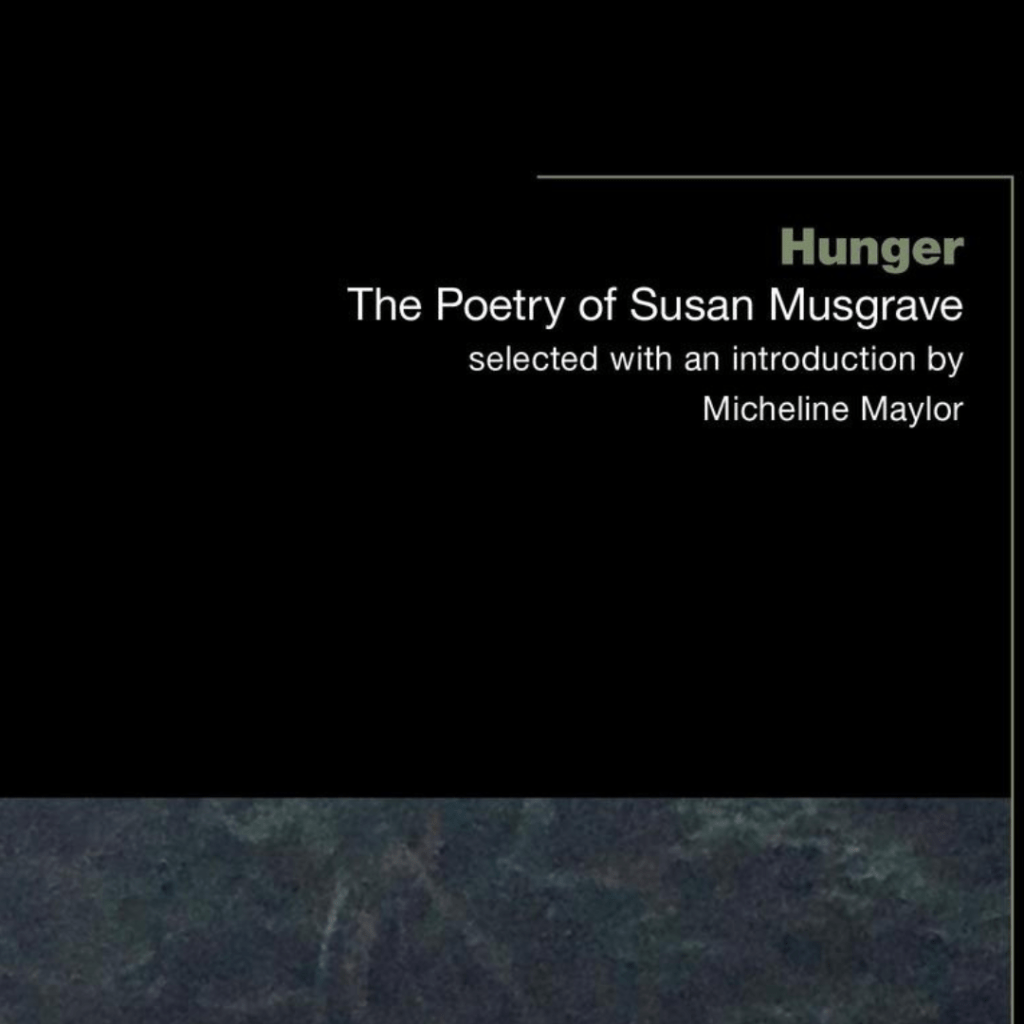
Micheline Maylor writes in her Introduction to Hunger: The Poetry of Susan Musgrave (WLU Press 2025), that Susan Musgrave’s poetry is, “personal, intimate, confessional, esoteric, and infused with a sadness that develops over time. Later in the same introduction, Susan Musgrave herself sums her life in one word: sad. But amongst the poems, the sadnesses and the losses of a husband and a daughter, the years past and the years ahead, the Canadian poet Susan Musgrave still chooses poetry which for a poet is a way through the damage and the darkness.
Micheline Maylor calls her Introduction in Hunger Damage Makes Things Interesting which is a quote by Douglas Coupland that Susan Musgrave has Sharpie-inscribed on a broken piece of wood in a cabinet. You could amend this to Loneliness Makes Things Interesting. Solitude. Loneliness. Losses. It’s a platitude to say these things often make for great poetry, and as I write this, I think of Susan Musgrave living on the northern shores of Haida Gwaii, what must feel like the edges of the world, and its hard not to think of other poets like Jack Gilbert in Greece, or Leonard Cohen’s monastic existence on Mt. Baldy, and I wonder if poets choose solitude, or if solitude chooses the poet.
When I was in my twenties, I read all of Susan Musgrave’s poetry. I found copies of Songs of the Sea-Witch andGrave-Dirt and Selected Strawberries in used bookstores. I was able to even sit with Susan Musgrave after she gave a poetry reading at The Bookshelf in Guelph, ON, (this must have around 1991), and she was both candid and generous with the university students that sat smiling and asking her questions.
What strikes me now about her poetry from back then, is the weight of her family losses, the weight of carrying that experience, which comes across in the last four books which have been collected into Hunger: The Selected Poems of Susan Musgrave. The poet Donald Hall who lost his wife Jane Kenyon to cancer once wrote, “Your presence in this house is almost as painful and enormous as your absence.” Only a poet could write something so profoundly lucid and true.
Back to Musgrave, she has a gift with titles like “Understanding The Sky” or “The Noise a Skeleton Makes Trying On A New Body”, but for the first poem I have excerpted for this review I have chosen the poem “True Love” with its deceptively simple title:
True Love

          No remembering, no forgetting:
          The secret of true love.
                               -Zen saying

As if you were to fill
a shapeless bowl with stars
and wash clouds in it until
your sorrow begins to drift away
from this world of remembering,
and the forgetting. As if you were

to hear the teardrops of the smallest
insects falling on the leaves of the crucifix
lilies along the riverbank: you know
everything is weeping, so why
when you weep you think you are alone?

Listen to the voiceless words,
the shore giving thanks for the sea.
I went with my grief but when I reached
the rivermouth the ocean said,
take me, instead, take me.

As if this robe of mist I wear
makes me any more noble
or more humble than the smoke
from your campfire, laughter
rivering the heart. Who is beloved, who
in the wind? As if the shape
of the bowl can be round in one moment,
square the next. The grass still bends
the way the wind goes.
I really find this an enigmatic poem, and I especially like the Zen saying at the beginning. I also like the idea of “everything is weeping”, that loss is literally everywhere we look, “so why / when you weep you think you are alone?” Good question. But as much as the imagination persists, and can make a “shapeless bowl with stars”, or can imagine, ”the shape / of the bowl can be round in one moment, square the next”, the loss of loved ones still bends the way the wind blows, like the grass, and you have to wear the weight of those losses, even if the presence of those losses appears to others “like a robe of mist”. At least, this is how I read this poem.
Another poem I really burrowed into by reading, and rereading, is “Exculpatory Lilies” which combines themes of family, love, addiction and death. Here are the last two stanzas:
And where I picture them still. Each new day
above ground is a hard miracle, you wrote;
I hung on every miraculous breath you took
as I stood outside your door at night, dying
to hear you breathe. In the end, it wasn’t me

you turned to, but God: wasn’t love meant to be
more pure than faith, more sacred and enduring?
These days I lean heavy into the wind
and the wind’s blowing hard.
These last two stanzas of “Exculpatory Lilies” really speak to me, to my own history of mental illness and alcoholism, especially the idea of a new day above ground being “a hard miracle”. I believe that in my blood and my bones. Readers can also empathize with the idea of the poet standing outside a door, listening to a loved one’s breathing, which is now mere memory , and the loved one is gone. This is the simmering essence of this poem. Is love more sacred, more enduring, than faith? I certainly think so, and at least to me, the ending of this poem kind of conjures the ending of the first poem I excerpted “True Love”, with the poet leaning “heavy into the wind / and the wind’s blowing hard.”
Grief, loss, death, solitude. It can be a lot to bear, and the death of a husband and a daughter is “all a bit much for anyone to take” as Susan Musgrave herself says in the Introduction to Hunger: The Selected Poems of Susan Musgrave (WLU Press 2025). To end this review, I have chosen a short passage from the title poem “Hunger” where Musgrave writes, “The worst kind of pain is to miss someone you’ve never known, and worse, never will.” We grow in time; consciousness stretching out. We become new people, hopefully for the better, but the dead stay dead. We miss them, the people they were, but also who they would continue to become. Musgrave has found her hard earned wisdom amongst the pain and the grief of losing loved ones, amongst the sadness that is resident there, but in writing poems, one can touch the past briefly, remember love endures despite the grief, and in that solitude find some renewed sustenance to continue to live.
Chris Banks is an award-winning, Pushcart-nominated Canadian poet and author of seven collections of poems, most recently Alternator with Nightwood Editions (Fall 2023). His first full-length collection, Bonfires, was awarded the Jack Chalmers Award for poetry by the Canadian Authors’ Association in 2004. Bonfires was also a finalist for the Gerald Lampert Award for best first book of poetry in Canada. His poetry has appeared in The New Quarterly, Arc Magazine, The Antigonish Review, Event, The Malahat Review, The Walrus, American Poetry Journal, The Glacier, Best American Poetry (blog), Prism International, among other publications. Chris was an associate editor with The New Quarterly, and is Editor in Chief of The Woodlot – A Canadian Poetry Reviews & Essays website. He lives with dual disorders–chronic major depression and generalized anxiety disorder– and writes in Kitchener, Ontario.
 The Woodlot