by Chris Banks
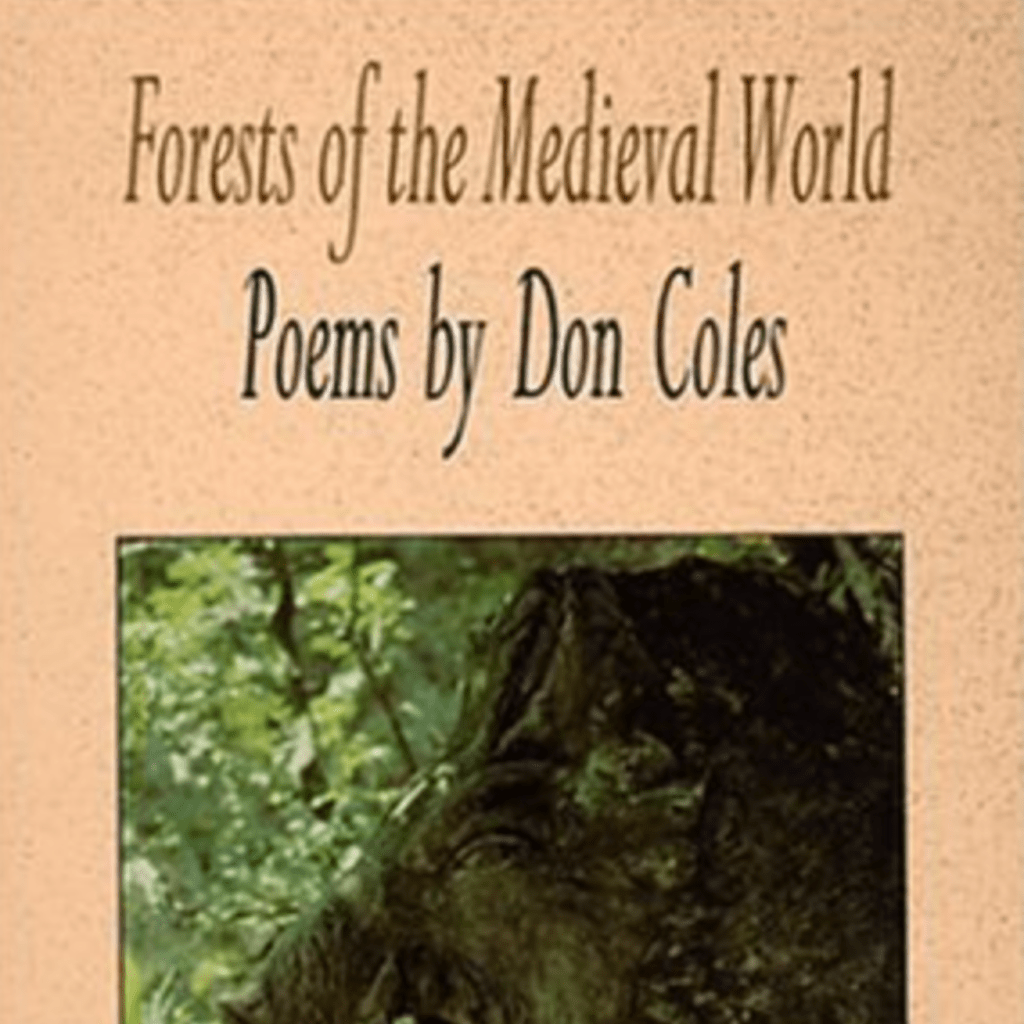
Sometimes poetry books find you at different times in your life, and Forests of the Medieval World: poems by Don Coles is one of those books for me. It was published in 1993 by The Porcupine’s Quill when I was twenty three years old, and I remember purchasing it right away. I remember being told Don Coles was a poet’s poet, which I don’t think I understood back then, but when I did read it in my Twenties, I remember I was really struck by the rigorous enjambment, the allusions to history, to time passing, and how slim the volume really was, barely twenty four poems, although some of the poems are quite long.
I’m not sure I really learned anything from reading Don Coles in my Twenties. I was too young to absorb some of the more technical aspects of Coles’ poetry, but recently I pulled Forests of the Medieval World off the shelf where I have not looked at it for decades, and began rereading it. Suddenly, I was struck by the clarity of the poems, or as Coles writes in a poem called Untitled, “I awoke with with a feeling of clarity, a feeling diaphanous as / a lake at dawn, as clichéd as that but undismissable, the / lake itself then spreading out before me.” Wow, this is such a terrific opening even with the word “the” hanging on the lip of its line which always reminds me of the Canadian poet-critic Michael Lista who likened people ending a line with “the” as having toothpaste on one’s face. Somehow, it works here, though. And the word undismissable? Poignant, intentional, individualistic.
There are other great lines in Untitled like, “you knew your life should always have been / like this” or “Whatever / was special in me had not been dulled by use or / exposure or by being thought about. This was the main thing.” Maybe its because I’ve become older too, and I’m feeling like an old Warhorse about writing poems, that lines like these ones that once would have pushed against me like a warm breeze, but gone around me in my youth, now sink in. And the ending? “ I was waiting for the images to start. There were no / books, nobody had ever died, the first wave would soon / think itself in from the lake.” That last line has had me thinking about it for hours now.
There are many terrific lines in Forests of the Medieval World just like these last ones. For instance, “every image makes / a special offer when it knows / you decided against it the first time”, or from the same poem “Someone Has Stayed in Stockholm”: “ this is / something I think about a lot and which / words cannot soothe. Although you can / fall into places deeper than language can’t you? Yes. He has.” I love how this ending feels so open, and genuine, generated by the bald-tire truth of “ this is something I think about a lot” rubbing up against “there are places deeper than language” one falls into which feels profound, philosophical, deeply romantic.
Many of the poems run over three pages, so I’m not going to except any of the longer pieces from Forests of the Medieval World, but I thought I would point out maybe the last poem of the book which is called “Self Portrait at 3:15 am”. Here it is in its entirety:
A skinny old party in a too-big suit
has just turned the lights on
at a quarter past three. What
does he do now? Where is everybody?
He is just realizing nobody has told him
how to be as old as this. Another way
of putting it: nobody has taught old age
how to enter him. He’s wondering
why has he painted himself into this room
which so obviously has got only
a few minutes left in it. Just inches
below the paint’s surface in that canvas
over there the shadowy damp breasts
of that woman remind him of something.
Was it worth her while, once, to love him?
He remembers a night-fulcrum –
those breasts swaying close over his eyes
again and again, half the night it seems,
coming over like moons, his mouth too
was continually amazed. He always knew
descriptions of happiness must remain illegible
but you can stay close to it if you don’t move,
can’t you? No you can’t. These did, though –
glistening from his own young mouth, too;
an hour’s immortal even if a life isn’t.
What a terrific poem! And maybe I am just realizing it now, at fifty five, when I no longer blush at descriptions of love-making, or when I am dipping a toe into old age myself (when now, I can park in the “senior’s parking spot” at my local Rexall pharmacy if I so desire). I, too, look at myself in the mirror sometimes, and think how did I get this old?”, but never have I thought of myself as “A skinny old party in a too-big suit”, maybe because I am no longer skinny, but certainly I can relate to the idea of being “an old party” when I look at the bags under my eyes and whatever 90s black The Lemonheads t-shirt I seem to be wearing at the time.
Nobody has told old age how to enter me either, but I’m sure it will get there in time.
Finally, I love how the poet remembers time sort of stopping, not existing, when remembering the passion of the couple in the past, while simultaneously time moves on, beyond memories, giving weight to that final line: “an hour’s immortal even if a life isn’t.”
There are always a plethora of new collections, new poetic voices, to be read every publishing season, but its always good to look back beyond five years, or even twenty years, and pull an old slim volume of poems like Forests of the Medieval World by Don Coles off your bookshelf and not just rediscover what you liked about it the first time you read it–the tercets or the long-limbed poems like “Puberty”–but also you realize you have reached an age that allows you to more deeply appreciate a book like this one, written by a master poet grappling with age, and time, and memory, and language’s imprecise ability to say what must be said, but what other tool do we have that even comes as close?
If you have a copy of Forests of the Medieval World: poems by Don Coles, go read it. If you do not, go hunt down a copy for yourself. You won’t be disappointed.
Chris Banks is an award-winning, Pushcart-nominated Canadian poet and author of seven collections of poems, most recently Alternator with Nightwood Editions (Fall 2023). His first full-length collection, Bonfires, was awarded the Jack Chalmers Award for poetry by the Canadian Authors’ Association in 2004. Bonfires was also a finalist for the Gerald Lampert Award for best first book of poetry in Canada. His poetry has appeared in The New Quarterly, Arc Magazine, The Antigonish Review, Event, The Malahat Review, The Walrus, American Poetry Journal, The Glacier, Best American Poetry (blog), Prism International, among other publications. Chris was an associate editor with The New Quarterly, and is Editor in Chief of The Woodlot – A Canadian Poetry Reviews & Essays website. He lives with dual disorders–chronic major depression and generalized anxiety disorder– and writes in Kitchener, Ontario.
 The Woodlot