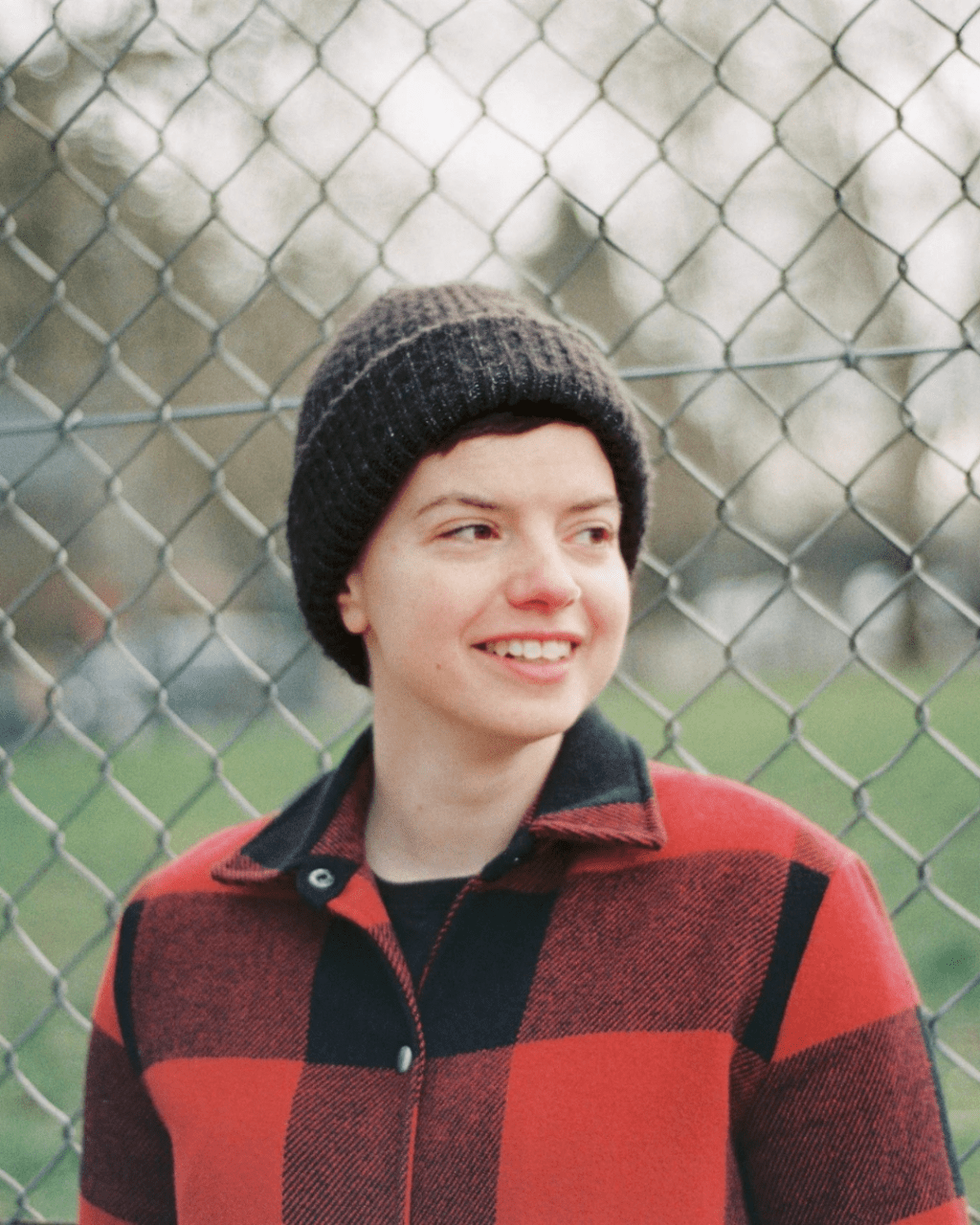
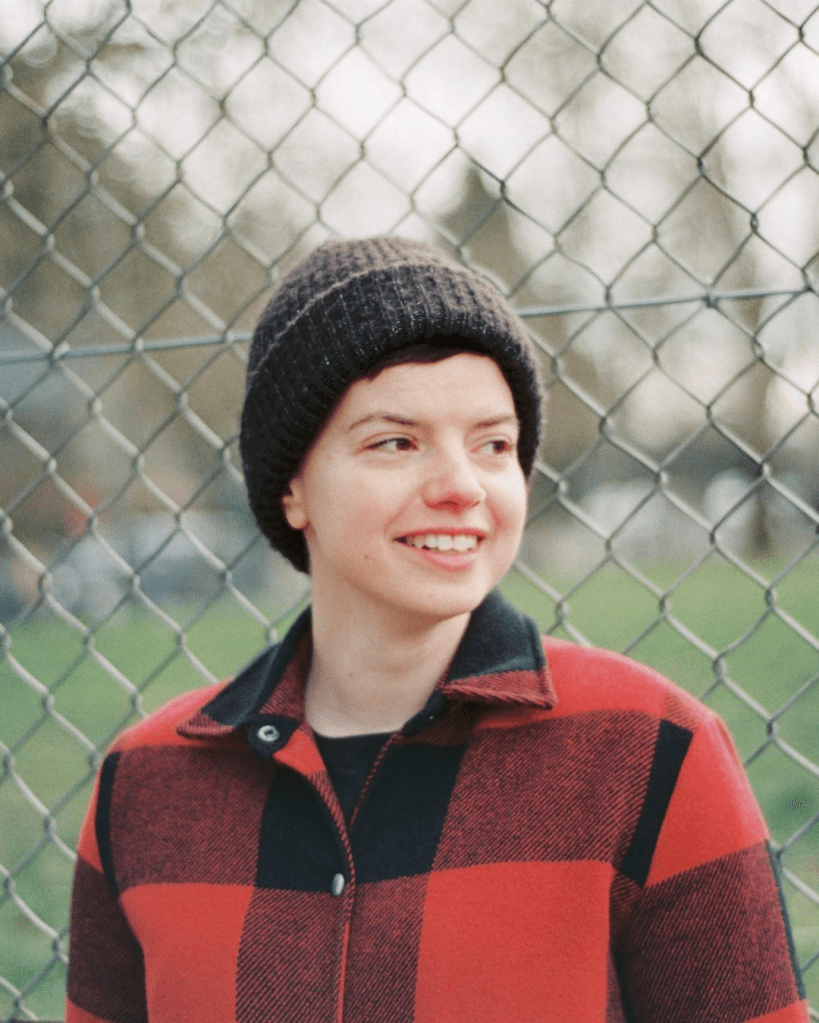
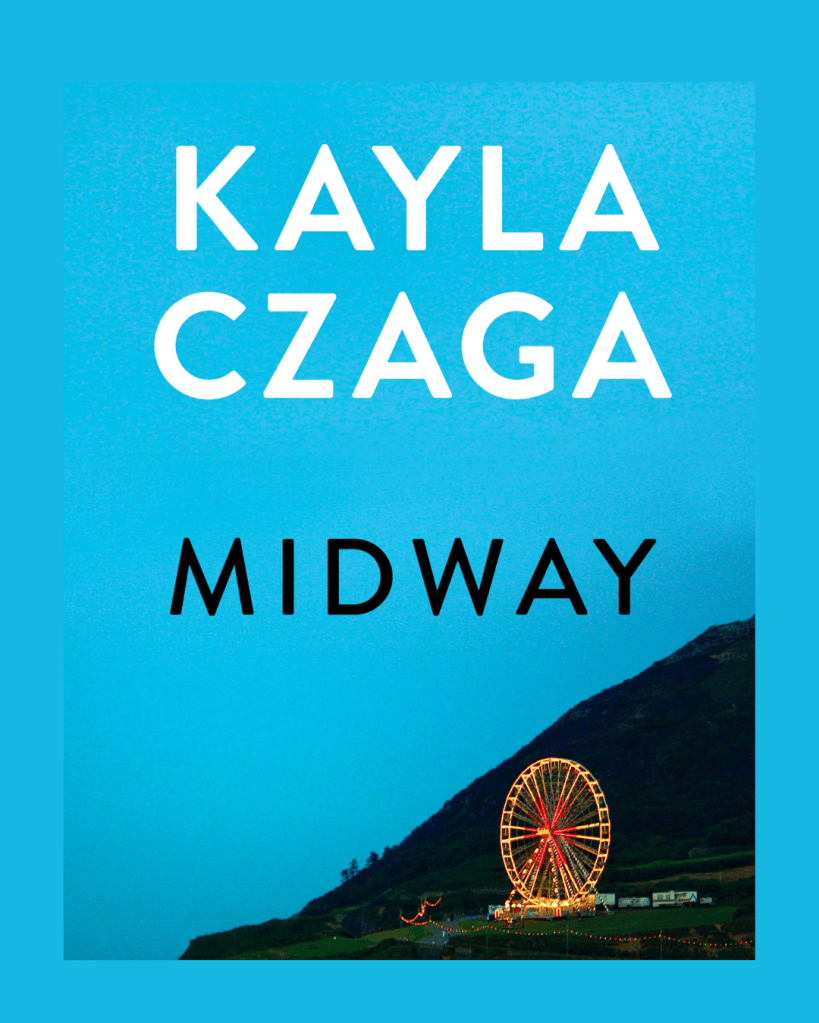
Interviewer Savannah Crabb talks with Canadian poet Kayla Czaga about her poetry collection Midway, a favourite here at the Woodlot!
Savannah Crabb: Hello Kayla! I am so excited to discuss your third poetry collection, Midway. I’ve been captivated by the relentless humour, honesty and heart of your work since reading your 2014 debut, For Your Safety Please Hold On, and I’m thrilled to see these qualities return and flourish in this new collection, released in April of last year.
If we could start at the roots of your love of poetry, I’d love to hear about Kitimat, BC, which as of the 2022 census had a population of less than 9,000. What effects do you think living in such a small town has had on your poetry? And do you still feel these effects in your writing, now that you live in Victoria?
Kayla Czaga: I was bored in Kitimat a lot, though I suppose that can be the case for kids who grow up in larger communities as well. I was the only child of two older parents, so the house was quiet and there wasn’t very much to do. Eventually I joined a few clubs (art, yearbook, the SCA, and—for a brief stint—tae kwon do), but I remember there being a lot of blank time. I read a lot of books, whatever came across my path, mostly not “great works of literature,” but bestsellers, science fiction and fantasy. I stared into space a lot. I daydreamed, and journaled and made up stories about the things around me. I still try to give myself space and time to read, dream and “do nothing” because it lets the poetry come into being.
SC: That’s beautiful! I think a lot of us writers can feel guilty for these spaces where we “do nothing” and forget that we need to be doing “nothing” before a “something” can happen; before the raw material for a poem occurs. Although the inspiration for poetry is often nearby if we look closely at that which, at first glance, may seem simply mundane.
A lot of the poems in Midway revolve around unpacking stories and hidden meaning in everyday objects, such as suitcases, metal detectors, Pizza Pops and peace lilies. When examining these kinds of objects through poetry do you often find themes, ideas or sentiments within them that surprise you? Or do you typically find what you’re looking for?
KC: Objects can be a great way into telling stories and talking about people—you get to zoom in on the thing and out, or adjust the angle and the focus, which can create interesting movement and texture throughout a poem. I’m also interested in inventories of lives, cataloguing, sorting through it all to determine what’s important and what isn’t. With the poem, “Baggage,” I knew that describing the suitcase would lead me to talk about my father’s immigration and our divergent lived experiences, but I was still surprised by a few of the twists and turns the poem took. I had no idea where “The Peace Lily” would take me, I just liked the way “The peace lily I bought at Thrifty Foods for $4.99 taught me something about beauty” sounded. The rest of my process was about digging into the “peace lily” to discover why it felt so charged. I usually notice myself being drawn to an object and have to spend some time thinking and writing through that attraction. When I’m lucky, the thinking results in a poem.
SC: Certainly, if an object seems to be trying to say something to us, or about us, we as poets better try to listen! Looking at another object poem, one of my favourites in Midway, “Self Portrait with a Pizza Pop,” you write, “at any age, what I feel is real even if it does not exist.” I think this line is so validating of the fluidity of emotions, thoughts and identity that so many of us experience in the awkwardness of being a person. Did you write this line, or this poem, or this book, thinking about such validation?
KC: Thank you! That poem is one of my favourites as well. My editor, when he read it, said, “Only you could write this poem,” which made me feel incredible. I wrote “Self Portrait with Pizza Pop” because I had wanted FOR YEARS to write about the food I grew up on, which was mostly junk. The cliche “you are what you eat” kept running through my head. I often feel like I’m not a Serious Writer—whatever that means—because my work is full of everyday things, pop culture and sometimes literal garbage: condom wrappers, Polly Pocket dolls, Winona Ryder. I know I write about other things, love and art and grief, but I often feel like a silly weirdo who’d rather talk about vampires who work at the mall than the archaic torso of Apollo.
In Midway, I found myself growing more accepting of my supposedly “unserious” focuses, trying to affirm what I feel and have felt, to make it real. That line surprised me when I wrote it, but it really is a truth I’ve been trying to hold onto. One of the reasons I read poetry is to find out what is real. Sometimes what is real is a falling apart bath toy shaped like an octopus (Rob Taylor) or being a gas station attendant (Dorianne Laux) or getting high and playing video games (Raoul Fernandes) .
SC: I asked this question with the validation of the reader in mind, but I like that you took it in the direction of self-validation. Speaking of the “unseriousness” that you mentioned, this collection, which is centered around the loss of your parents, is also infused wonderfully with humour and light. In “The Sadness of Marge Simpson,” we read, “I packed my dad’s urn in a box with plastic cactuses/and laughed when I found it.” How do you balance these two tones within your writing? And what is your perspective on the importance of this balance?
KC: I get the humour and lightness around death mostly from my parents. My mom did actually hand me my dead father’s hairbrush and say, “go grow yourself a new dad.” Humour is a deflection technique, a way of avoiding it, or releasing some of the tension, but also the juxtaposition can make the grief and the darkness feel even darker and more poignant. Because of the way I was raised, it doesn’t feel genuine for me to keep a straight face through a poem, to only be sad or one note.
SC: In “I Go Back to November 1989,” you depict your parents on the day of your birth with such intimate clarity. While reading it I felt like you must have been a conscious adult in the hospital room witnessing this scene in order to illustrate it with such precise and loving detail. But of course you wouldn’t actually remember this moment! How much, if any, power do you think poetry has to reinvent people or events in our lives? Would you say these reinvented moments are in some ways as “real” as the remembered ones?
KC: I don’t think there are any real moments, only reinvented ones. Memory is a very limited tool for recording what is “real,” if we’re talking about the objective truth. But objective truth isn’t what interests me in poetry—I read it to connect with a speaker and their experience, to see the world in new and sometimes blatantly false ways. Metaphors are lies! My love is not a red, red rose. Souvankham Thammavongsa, in Cluster, has a great poem in which a speaker is looking at a photograph from childhood. The speaker thought things were one way, but the photograph reveals they were different. I wrote that poem because I wanted to see those people in that scene, as a gift to myself, and because I really liked the Sharon Olds poem that inspired it. And now it is real, though it isn’t. In my head, I see my father smoking outside the hospital and then dragging his wet boots down the hallway to my mother’s room, though objectively the scene doesn’t exist.
SC: That’s very insightful. Memories are fickle and intangible, but their meanings can be made tangible or “real” as we certainly feel they become in your poems. In your poem “Thirteen Years” you write, “At the time, I wrote tiny poems / stripped to nouns and verbs, a kind of writing / someone might admire but never love.” What do you think is needed beyond nouns and verbs to create something to love in a poem?
KC: A poem of nouns and verbs could be very loveable, but the speaker in “Thirteen Years” was stripping her poems as a way to hide, to get smaller and avoid being seen. It was an aesthetic of cowardice and fear. I only started writing poems that I loved and that resonated with others after I became braver.
SC: Now that this book has been out for over a year, do you have any new perspectives on these poems? Are there any changes you would make to them now? Do you have a favourite poem in this collection (besides “Self Portrait with a Pizza Pop”) and has it changed over time?
KC: In some ways, I feel like I overshared, that I said too much, or put too much on the page. It has been a difficult book to tour for what it brings up in me and what it sometimes brings up in audiences. That said, it felt important to write and I don’t think I should have written a different book. What I love about the collection is its variety. I like that I wrote a very short poem about fishing with my dad and a really long poem about Celine Dion. I felt like my range in the types of poems I can pull off expanded significantly with this collection.
SC: I certainly loved the wide array of emotions invoked by the range of poems here. Your fishing poem, “Coho,” made me feel nostalgic and filled with longing. Your Celine Dion poem, “The Power of Love,” made me feel a lot of things, but mainly an aching gratefulness for love.
When reading Midway, readers are brought to see and know your mother and father through your wholehearted renderings of them. In completing this book, have you found poetry to provide any kind of answer to healing?
KC: I wanted the book to be more of a personal balm. I thought, “Oh, I’ve finished my grief book and now I can move on,” but the journey has been a lot more complex, which is probably better. I am really glad I have the poems from all my books to remember my parents and other people and the things I’ve experienced or invented. Recently, I was reading through For Your Safety Please Hold On and there were things in it I’d forgotten about completely. The poems bring them back to me.
___________________________________________________________________________________
Kayla Czaga is the author of two previous poetry collections—For Your Safety Please Hold On (Nightwood Editions, 2014), and Dunk Tank (House of Anansi, 2019). Her work has been short listed for the Governor General’s Award for poetry and the BC and Yukon Book Prizes’ Dorothy Livesay Poetry Prize. Frequently anthologized in the Best Canadian Poetry in English series, her writing has also appeared in The Walrus, Grain, Event, The Fiddlehead, and elsewhere. She lives with her wife on the traditional territory of the Lekwungen people, the Songhees and Esquimalt nations.
Savannah Crabb is an English Literature student at the University of the Fraser Valley. She has had her poetry published in the Louden Singletree literary magazine. She lives in Chilliwack with her mom and two cats, Otis and Hobbes.
 The Woodlot