
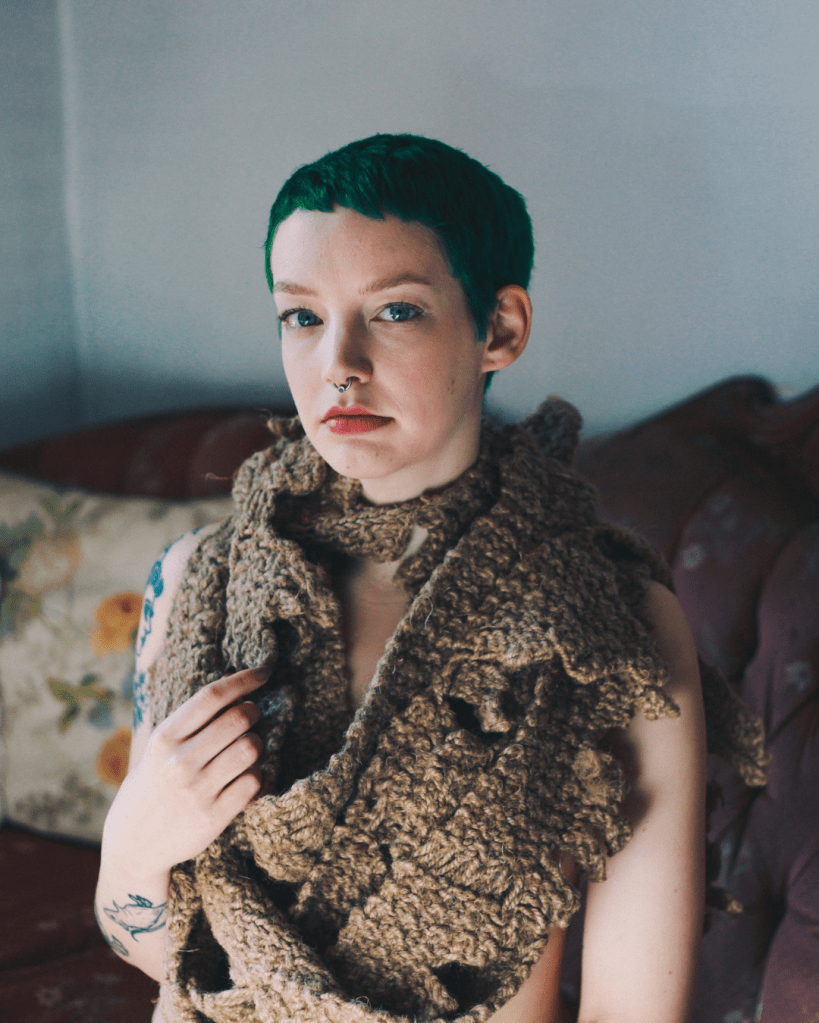
Interviewer Hannah Chernoff talks with Canadian poet Jessica Bebenek about her poetry collection No One Knows Us There.
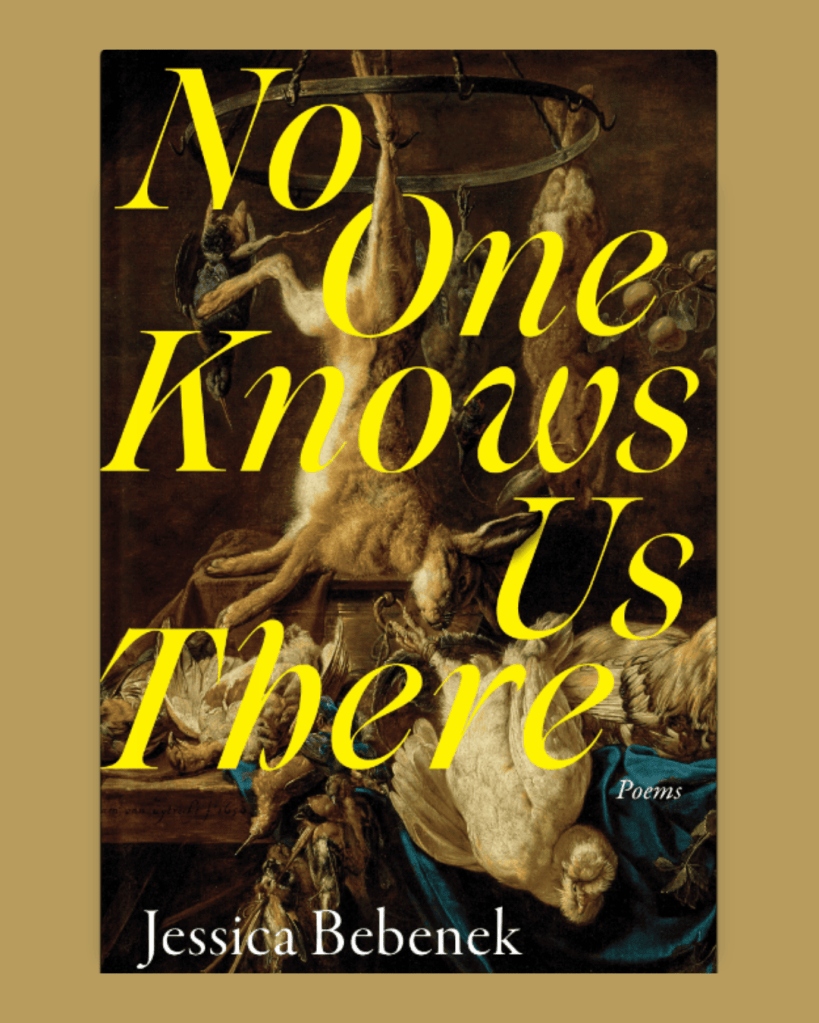
Hannah Chernoff: No One Knows Us There is a poetry collection about living in the face of dying. In their review of your collection, the poet CAConrad states that it “gave a beautiful living frame for the great vanishing trick of life.” Additionally, the description on the back of your collection summarizes your book as “a keen examination of trauma evolv[ing] into a striking celebration of the inevitability of change.” Could you talk a little about what led you to create this collection?
Jessica Bebenek: Writing is for me, foundationally, a practice of processing my emotions, working through the often harsh and random experience of being alive. Many of these poems, especially those in the first half, were written during or just after my grandfather passed away. While, in the moment, they were pure processing, I was able to come back to them much later and shape them into something legible to other readers.
Once I had been writing around my grief for a while and realized that I might have a collection, I did consider my hopes for the manuscript. What did I want people to get out of reading this book? What did I want it to do?
Around that time, I was involved in the poetry community in Toronto and had met poets who shared their suffering bravely, brashly, allowing me to realize that I was not alone in my own suffering. These poets were people courageous enough, when asked how they were, to not simply say “Fine.” I realized that I wanted my book to be a work of unabashed honesty in line with their bravery, one which comforts the reader in the way a mirror comforts—reminding you that you are still there, you have survived. My hope was, and still is, that people who are grieving will read No One Knows Us There and find consolation and kinship in the pages.
HC: Can you talk a little more about the process of writing No One Knows Us There? When did you first start working on it?
JB: I began working on the collection around 2014, writing much of the first half of the collection in a great spurt of grief and creativity. Shortly after, I moved to Montreal to pursue a Masters degree at Concordia, focusing on interdisciplinary poetics and leaving these poems to settle. It wasn’t until around 2019 that I returned to the poems in earnest, considering them now as a collection.
Over the intervening years, I had organically written poems here and there which reflected where I was at—working on healing from grief and engaging more with spiritual practices including Buddhist meditation and nature-based witchcraft. I was also deeply inspired by Indigenous worldviews, gradually learning, as a settler, how to be a more respectful neighbour while living on stolen land. These themes eventually coalesced into the second half of the book which, I realized, needed to be a response to the first half.
I couldn’t feign integration because there was no integration within myself. My past, deeply wounded self still existed there on the page, and I was unwilling to fold these older, ragged poems into the new, more polished work I was creating. Rather, I realized that I needed to honour this divide and began to write poems which were in direct conversation with the earlier poems. This need is what led to the five rewritten poems in the collection, as well as the several poems entitled ‘Trust’.
HC: That is so interesting! The way the poems build, connect and engage with each other was a highlight of the book for me. I think this was why I struggled to identify a favorite poem in your work; it felt like to take one out and study it individually would rob it of so much of its impact. In your book k2tog, you explain that the collection came from a preoccupation with the “calls and responses” of female poets speaking and communicating with each other throughout time. No One Knows Us There is divided into two parts in which poems from the first section are rewritten. Is this a continuation of that preoccupation? Can you speak to the power or usefulness of this as a technique?
JB: That’s a really interesting connection that I hadn’t consciously realized before! In my knitted poetry works, I alternately celebrate or criticize canonical figures from the past by experimentally ‘translating’ them into textiles, knitting patterns, performances, etc. In No One Knows Us There, there is a similar preoccupation, but I think that here it has more to do with time and exposing the lie of its rigidity.
A major influence on me while writing the collection was Robin Wall Kimmerer, especially her book Braiding Sweetgrass, in which she describes time as being more similar to a pond than a river; a circle, not a line. I bring this idea into the second iteration of “Hospice”, the poem which opens the second half of the collection. Here, I’m attempting to introduce readers to the way this half of the book will stand—with one leg in the past, one in the present, and perhaps one finger pointing towards the future.
H.C: Reading your work, you seem to have an emphasis on the tactile and the physical body. I notice that you often start with an establishment of the body, a physical action or movement (“I draped the mirror,” “we got shit-faced. Crawled,” “When I stroked/your arm,” “to pick at your lips,”). You then use this to bring the reader into the more emotional or abstract content of the poem. I’m thinking of the first poem “Hospice” which starts with the line, “Here is what happened: I took a walk.” You go on to describe three walks before introducing a fourth walk that turns the action of walking into a metaphor to bring the reader into the heart of the poem. “I lied. There was a fourth walk, but it confused itself/with heartbeat, the brain instructing the lungs to pump/within a vacuum.” With this the reader is pulled from the literal and external and brought into the internal. Did you do this intentionally? If so, are there any other specific strategies or tactics that you use when writing?
JB: For me, writing is not only a matter of expressing my thoughts through words, but an inherently embodied process. As in my knitted poems above, as well as in my collage and bookbinding, I consider myself to be a thoroughly interdisciplinary poet, very often dragging the different mediums in which I work under the inviting umbrella of poetry.
I think you’re right, though, that this emphasis on the tactile does come through in my purely lyric writing. I experience physical sensations strongly and so I can’t help but include them in my writing. As you noted, they are often the introduction into the poems because they are the introduction to myself into my own thoughts and emotions. I feel, and then I deduct what I am feeling.
From a craft perspective, I do intentionally keep this impulse in my poems when editing because it is the kind of writing I like to read. I often have trouble grounding myself in a written work if there is not a visual element for me to grasp onto amongst the ideas. I prefer to both read and write ideas which are expressed through embodiment, setting, and plot, even in a poem. It’s just what clicks for my brain. I’m glad to hear that it clicks for yours too.
HC: It definitely does! Moving from the visual to the acoustic: embodiment, feeling and sensation are also closely aligned to music. You have two epigraphs in this collection, one at the beginning of each section. These epigraphs are both song lyrics, the first from “Real Death” by Mount Eerie and the second from “Atoms” by Nana Grizol. You also state in your Notes that your poem, “Trust” nods in its final line to the song “The Morning of Our Lives” by Jonathan Richman & the Modern Lovers. Poetics and music have a lot in common. Can you speak a little bit about your taste in music and how it impacts your own lyrical writing?
JB: The folk-punk genre, to which both Mount Eerie and Nana Grizol (and, to a lesser degree, Jonathan Richman) belong, has been deeply influential to me since my early days as a poet. These artists have a brash, DIY musical aesthetic which is reflected by the plainspoken voice I use throughout much of the book. They (and I) pull from the folk genre, infusing their work with rich, vulnerable storytelling and musical simplicity; and from the punk genre, an embracing of ugliness. They are unafraid to address heavy topics like trauma and oppression, which I’ve likewise attempted to do (though more on that in my next collection, currently in-progress.)
I realized early in my career that I was covering up truth with beauty in my lyric voice, and folk-punk musicians gave me the courage to go beyond. I admire these artists’ ability to look the horrors of life square in the face and speak them aloud. They help me to feel less alone, which is likewise my greatest hope for my own writing.
HC: I definitely see this courage as an element of your own writing! There are various moments where you sit in the discomfort and don’t shy away. Continuing with the subject of influences, the‘About’ page for The Centre for Expanded Poetics, where you work, housed at Concordia University, describes its purpose as studying, producing and “linking poetics with other arts and fields of formal inquiry (e.g. architecture, design, textiles, the sciences)” and emphasizes its interest in the “interdisciplinary.” Beyond your workplace you have also engaged in this in your own projects, such as Place: A (Re)construction which blends architecture, textile, politics and history. You also produce knitting performances which blend the theatrical, the poetic and the textile. In both cases you acted as a sort of ‘translator’ who was working with already established material (the Place Ville Marie skyscraper, T.S. Eliot’s “The Waste Land” etc.). I wonder what impact, if any, this has on your writing process?
JB: I see all of the artforms in which I create as being intertwined—language, textile arts and papercraft. All are mediums of communication, though historically used by people of vastly differing genders and social standing. I am forever fascinated by the split of these artforms I love into hierarchies of ‘art’ and ‘craft,’ ‘male’ and ‘female,’ ‘original’ and ‘reproductive.’ In works like ‘“Place: A (Re)construction”’ and “‘The Waste Land’,” I am actively trying to tear down these divides, revealing overlaps and biases. Perhaps, more subtly, too, in No One Knows Us There, as you observed, through its many tactile and sensuous descriptions.
Before I began working at the Centre for Expanded Poetics a decade ago, I felt guilty for feeling inspired to work in multiple mediums, thinking that I had to specialize in order to succeed. Working at the CEP, especially facilitating collaboration between artists from different mediums, has allowed me to feel such freedom to work in an interdisciplinary way. Now I feel proud of the way I create—not as a specialist in any one medium, but a specialist in the intersections.
HC: Within each of these mediums of communication, there are several options for sharing a work. Take the print medium, for example. You have published several chapbooks and zines before, but No One Knows Us There is your first published poetry collection. You are also a book maker. Did the process of putting a full book together surprise you? Was getting published by a trade publisher similar at all to this?
JB: I am very passionate about chapbooks & zines, as well as the surrounding micro-press and self-publishing community. I published eight chapbooks & zines before No One Knows Us There and I am proud of them all, just as I am with my full-length collection. For me, micro-press publication is not just a bridge to a full-length book, but actually my favourite way of sharing work. Chapbooks are small enough to make a strong, cohesive collection (maximum 48 pages), affordable, and often beautifully handmade.
One thing I did prefer about working with a publishing house was the passionate publishing team at Book*hug. It was such a pleasure to be able to deeply focus on the writing while the team was handling book design, printing, promotion, and sales. Going back-and-forth with an editor was also new to me and I loved the process. Jacob McArthur Mooney absolutely got what I was going for with the collection and was such a support throughout the editing process.
I would say the greatest thing about working with Book*hug has been the reach my book has had. By collaborating with the team, my book has gotten into the hands of so many more people than I could have managed alone—including you! For a DIY-er, this was a bit of a revelation.
HC: Your previous work has engaged with canonized poets such as Ezra Pound, T.S. Eliot and Sylvia Plath. Why do you think it is worthwhile to engage with the works of poets from the past? Relatedly, in No One Knows Us There you borrow lines from and refer to more contemporary poets such asKaren Solie, Liz Howard and Jack Gilbert. Can you speak a bit about these poets and how or why they made their way into your work?
JB: I think that, as writers, we are all deeply influenced by the writers who have come before us—our literary ancestors, but also everyone and everything we read. I was reading Solie, Howard and Gilbert as I wrote No One Knows Us There and so it felt natural to incorporate their influence into the book explicitly.
My focus on relationships and interconnectedness comes largely from learning about and observing the natural world, but also in my hopes for our global future. I hope that we will be able to create societies which are more equitable to human and non-human life, and these politics infuse all aspects of my existence, including my artmaking. If we are all as interconnected as we know ourselves to be, then let us make our lineages not only visible, but celebrated.
This manifests in the content of the poems, but also in the form itself. As you wrote above: “to take one [poem] out and study it individually would rob it of so much of its impact.” Not only does the book speak to all the poets whom I have read, but also to itself—to my past self and, hopefully, to a more healed future self.
HC: To close this interview I want to ask, what is next in store for you and what new influences are you engaging with in your work?
JB: This Winter I will be attending the Banff Winter Writers Residency to work on my next collection, Writing for Men. It’s a collection of experimental, interdisciplinary works of poetry around themes of misogyny and sexual assault, incorporating mediums including risograph printmaking, mass-postering, zines, interviews, transcriptions and even a customer satisfaction survey. Despite (or because of) the heavy subject matter, it is already a collection with a lot of absurdist humour.
Lately I’ve been inspired byThe Compleat Purge by Trisha Lo and Read Me by Holly Melgard—collections by two poets who really understand how to use absurdity to make a point. After working on No One Knows Us There for years, living in quiet grief and holy healing, I am looking forward to adopting a more playful tone, one which is petty, silly, maybe even a little mean.
____________________________________________________________________________________________________
Jessica Bebenek is an interdisciplinary poet, bookmaker and educator living between Tiohtià:ke (Montreal) and an off-grid shack on unceded Anishinaabe territory. Bebenek’s writing has been nominated for the Journey Prize, the Pushcart Prize, the CBC Poetry Prize, and in 2021 she was a finalist for the Bronwen Wallace Award for Emerging Writers in Poetry. Her recent chapbooks include You Don’t Get Out Much (2024), I REMEMBER THE EXORCISM (Gap Riot Press, 2022), and What is Punk (2019). Her debut full-length poetry collection, No One Knows Us There (2025), was a finalist for two Quebec Writer’s Federation awards. @notyrmuse www.jessicabebenek.art
Hannah Chernoff is an undergraduate English student at the University of the Fraser Valley. She resides in Abbotsford, BC, on the traditional territory of the Stó:lō (People of the River).
 The Woodlot