by Chris Banks
The American poet Galway Kinnell said, “To me, poetry is somebody standing up, so to speak, and saying with as little concealment as possible, what it is for him or her to be on this earth at this moment.” When I think about this statement, I’m thinking of poets laying bare not only their own experiences and selves in a poem, but language too, saying the right words in the right order, with little embellishment. An inevitability of phrasing, if you will.
Well, for me, there are few Canadian poets who embody that idea more in the last twenty-five years than the Canadian poet Russell Thornton. Russell Thornton has been shortlisted both for the Governor General’s Award and The Griffin Poetry Prize, and his poems are clean-edged, vivid and plain, syllable-taut and permanence-wrapped, elemental and steely-eyed. His poems look easy, but also feel philosophically complex, and when I read him I hear little wisps of Philip Levine or Jack Gilbert or Cesare Pavese, especially when he invokes poems about prostitutes or panhandlers, Night Bus patrons and police cars, but really, it is Thornton’s own voice we hear most of all in these poems, probing, teasing out the intricacies of human existence, and all of it without a loose thread of extra words, or an ounce of superfluous emotional weight.
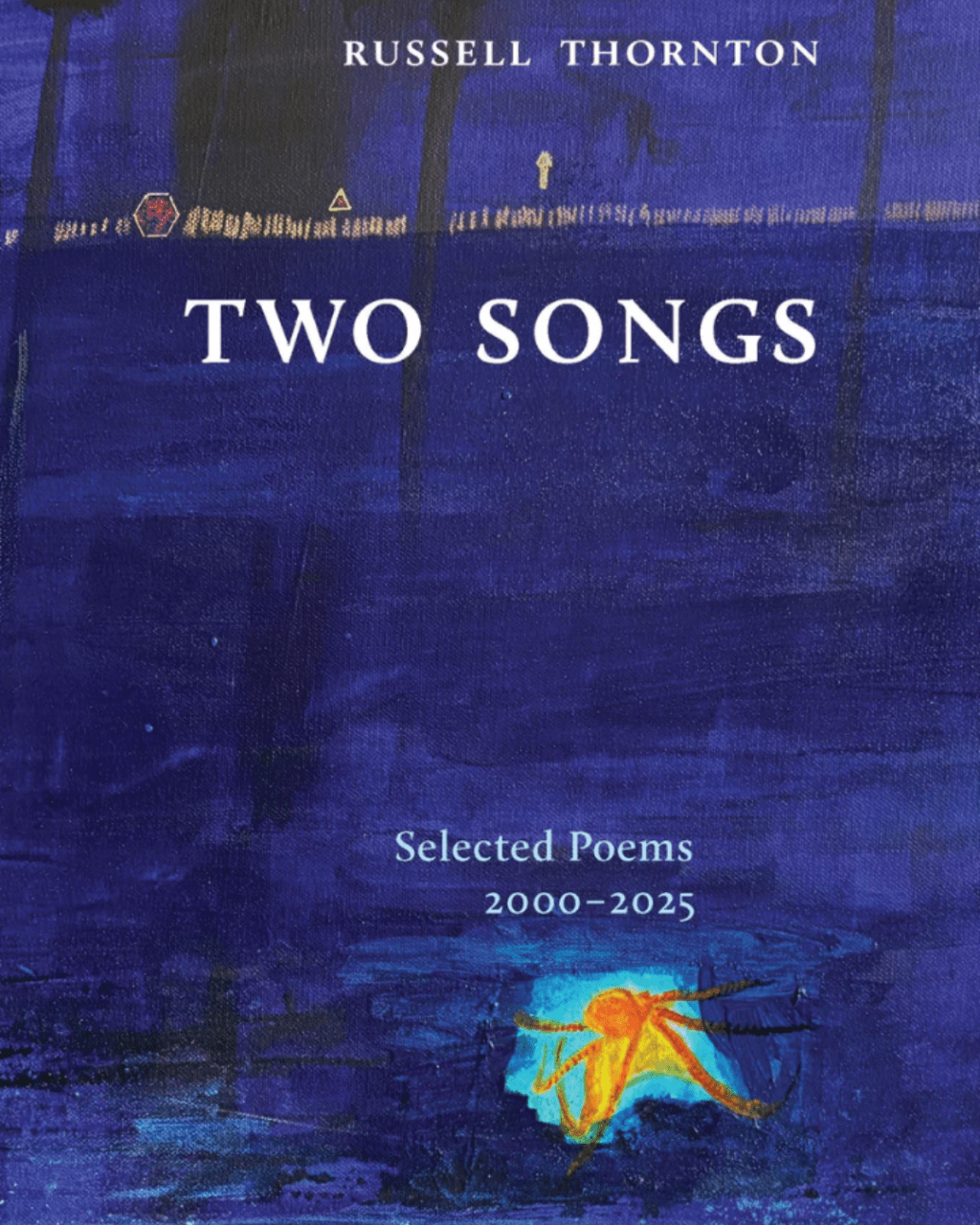
For poets of my generation, Thornton’s poetry collection House Built of Rain, published in 2003, was a revelation. For me, that is a perfectly realized book, and Thornton has just moved from strength to strength since that book. I also love how that particular collection introduced rain as one of Thornton’s triggering subjects, which has been a through-line, too, when reading his new Two Songs Selected Poems 2000-2025, out now with Harbour publishing. He says in one poem, “The rain will be a stranger / and will speak to itself through you and me.”
Russell Thornton’s new poetry collection contains the best of his entire oeuvre, and as I read through its pages, the places the poems inhabit come to be as important as the ideas and experiences they communicate: Greece, the Aegean sea, Rome, Lima, and of course, Vancouver with its container ships and unyielding rain. Thornton has the lightest of poetic touches in terms of the lyricism he employs. He speaks of “the sea’s mysterious lit wine of touch”, “the fiesta of the white, molten-looking stars”; seals are “driftwood, or worn buoys”; a heron “a tent suddenly assembling itself and in a split instant collapsing and assembling itself again.” Thornton’s images are often deeply elemental, essential even, and very, very precise.
Few in Canada would write a line like, “the strange pain of happiness in the summer grass” other than Russell Thornton.
So, yes, I’m sort of a superfan, and have been for twenty years, and as such, it is hard for me to pull out only a few poems to highlight in this poetry review, but I thought I would start with a poem called “Fifteenth and Lonsdale” from his 2006 collection The Human Shore. Here is the poem in its entirety:
Within the low heavens, I glimpse shadowy, rough garments
of cedar, hemlock, and fir, within the garments,
the mountain in its clinging-soil and deep-rock guise.
I turn and go when one light clicks red and one light clicks green.
The two other people here at the lights, who go in step,
pressed together in the damp cold, are each other’s sweet pain.

I look up again—suddenly I know nothing except
that the mountain sits there secretly transparent as rain.
That it sees us. That it flirts with us. That it is a person
containing all the experience we can ever have.
That it is a pure signal. And whatever the two alongside me
are saying quietly to each other, they were made to say it.

The mountain sits dressed in dark green trees, endlessly clear,
and clear and endlessly dressed in trees. It never ceases
turning our gazes back to us—it has no prophecy other than this.
The man who lays his blanket down on the sidewalk
and spends the day nowhere but in the rain—I turn to him.
I remember again that I was born here, that in my life

I have gone to and fro along the hem of the mountain—
with the others at every corner, wearing my own garments
made of the trees. If we speak, it is because the gods who travel
to the gods who remain need places to live. The man, mumbling,
asking for change, has always been a lover. The street mist
as it dribbles out of his pockets is a mist of numberless names.
This is a wildly imaginative poem, and deeply rooted in Vancouver, British Columbia. I love the idea of the Mountain being a person wearing garments of “cedar, hemlock, and fir”, but it also being a kind of signal, just a much different one than the traffic signals, the constant stop and go grid of streets some city planner dreamed up decades ago. But what is the Mountain signalling? To keep oneself connected to Nature? To the present moment? To the timeless quality of the rain falling in the air? This is a poem, at once, about the city and its inhabitants, but it is also deeply invested in the primordial strangeness of the Mountain looming in the background, the speaker suddenly realizing he has lived his whole life “along the hem of the mountain” and so, too, the panhandler who “out of his pockets is a list of numberless names.” I read this poem, and I imagine, the nameless city inhabitants living and dying “nowhere but in the rain.”
Like in the poem above, most of Thornton’s poetry is animated by his narrative imagery, but also his philosophical complexities, and readers feel this throughout Two Songs Selected Poems 2000-2025. However, Thornton has collected many, many sonnets, as well in this collection, showing his interest in the form, and his sonnet “Pitcher” which is both economical and profound showcases something else: Thornton’s deep imagism mixing with light surrealism.
Entering her parents’ house in secret,
finding a pitcher of ancient design
sitting on a plain wooden shelf. Knowing
that moment in the dream that she has died
and time has passed. No one having told me.
Then going with the pitcher in my hands
out into the vague street. Great energy
beginning to flow through me. The smooth loop
of the small handle. The quick curve and gleam
to the base. The soft plummet at the mouth.
The dark space within will urge me on now
and I will see that it is desire vast
and wild as death, and it hid here before
it came to break me, and is filled with her.
I have read this poem many, many times, and for me it does so much with an object like an old pitcher sitting in a basement cellar upon a plain wooden shelf. At first, there is a really furtive quality to the first line “Entering her parents’ house in secret”, but then by the fourth line, we are given to understand this is a dream, and the “she” is someone who has passed away. The real delight of this poem is not the concrete details of the pitcher—”the smooth loop / of the small handle. The quick curve and gleam / to the base”–-but what the pitcher contains which is a desire for the speaker’s friend, or lover to return, a desire which “came to break me, and is filled with her.”
In a poem called “Memoir” later in the collection, Thornton writes in the first lines, “In my memoir I will write about dust. / I will begin with the dust in the basement where I had my room”, the dust being all that remains of the past, of “a thousand thousand things”, but in this poetry collection Two Songs Selected Poems 2000-2025, out now with Harbour publishing, Russell Thornton has written a memoir more “rain” than “dust”, and that motif of rain falling throughout the book is a symbol of deep introspection, of time’s renewal, and of emotional release. I love Two Songs Selected Poems 2000-2025 by Russell Thornton more than these words can express, and it will have a place of special significance on my bookshelf. An unflinching, poetic triumph!
Chris Banks is an award-winning, Pushcart-nominated Canadian poet and author of seven collections of poems, most recently Alternator with Nightwood Editions (Fall 2023). His first full-length collection, Bonfires, was awarded the Jack Chalmers Award for poetry by the Canadian Authors’ Association in 2004. Bonfires was also a finalist for the Gerald Lampert Award for best first book of poetry in Canada. His poetry has appeared in The New Quarterly, Arc Magazine, The Antigonish Review, Event, The Malahat Review, The Walrus, American Poetry Journal, The Glacier, Best American Poetry (blog), Prism International, among other publications. Chris was an associate editor with The New Quarterly, and is Editor in Chief of The Woodlot – A Canadian Poetry Reviews & Essays website. He lives with dual disorders–chronic major depression and generalized anxiety disorder– and writes in Kitchener, Ontario.

 The Woodlot