reviewed by Colin Carberry
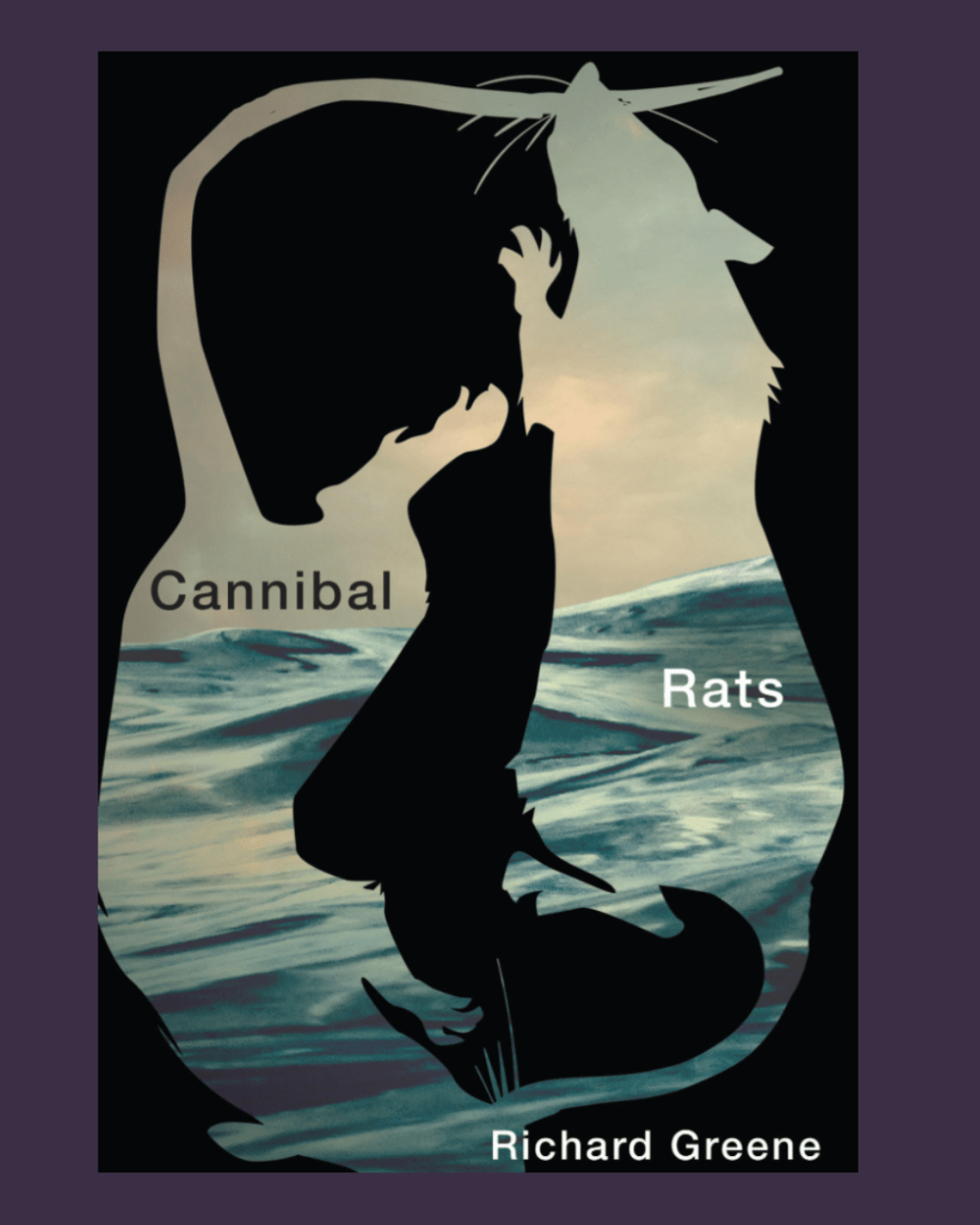
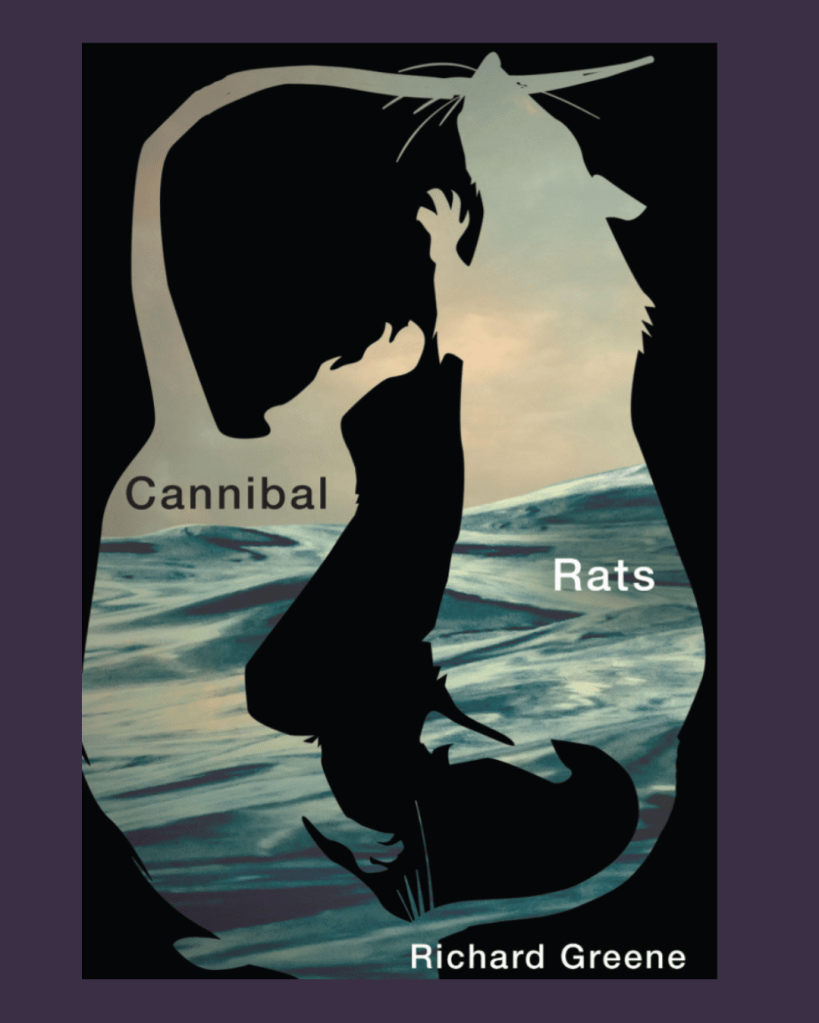
Written in rhyming verse (an unusual and risky choice in today’s poetic climate), ‘Cannibal Rats’, the opening track of Canadian poet Richard Greene’s latest book, gets us off to a great start and sets the tone for the rest of the book. (I use the word ‘track’ because the fifteen poems in it, divided into VII sections, give the sense of an album of extended soulful, bluesy interludes that often riff on similar, interconnected themes: grief (the word is used seven times throughout the text), the loss of friends and family members, intense and sustained bullying, divorce, exile and dealing with prostate cancer, even if it has gone into remission). Technically assured and tightly constructed, the poem induces a tone of blended melancholy, introspection and gentle ironic humour, and it’s genesis is rooted in the media frenzy surrounding the Lyubov Orlova, a creaking 4,251-tonne Arctic and Antarctic expedition cruise ship that was abandoned in St. John’s Harbour by the vessel’s owner in 2010. When it finally left the harbour three years later, as it drifted towards Ireland, it was described in lurid headlines as a ‘cannibal rat-infested ghost ship.’ Greene identifies with and sees something of himself in the doomed ‘ghost ship’:
Revenant myself, I may not cavil
about how art and memory unravel,
followed my chances on the mainland,
got tenure, found the tax-payers’ open hand,
and am now a Jonah where I was born
But if he enjoys a comfortable, tenured life now in central Canada, punctuated by holiday visits to his first place, St. John’s, he remains ‘confused by both the fog and the foghorn; / returning to my peculiar Nineveh’—and he lays no claim to having gleaned any essential or special knowledge during those years teaching and writing in Toronto: ’I have no message: I’ve just been away.’ The poem concludes with the following parsed, carefully constructed lines, and the concluding iambic couplet connects the ages with our strange contemporary online existence:
The Irish papers loved the rodent fiction
and supposed it landing soon in Galway,
full of cannibal rats looking for new prey.
It joined all that history of drowned fleets
without song or poem but a million tweets.
‘Hurricane Season’ sees the speaker return to a Newfoundland he no longer feels fully part of; he finds his old surroundings drab, depressing, ‘downgraded’, but like a ghost who returns to what was familiar in life, he is drawn back by the old salt tug of what he once considered home: ‘Transparent among the empty tables / I’m the ghost. The system’s been downgraded.’
Greene’s (poetic) debut, Republic of Solitude: Poems 1984-1994 tended towards the spiritual, featuring intense interior flights derived from loneliness and an undefined yearning for something more, while largely avoiding uncomfortable and painful aspects of his upbringing in Newfoundland. But, like Heaney, his vision evolved from viewing existence through the prism of ‘cathedral windows’ to gazing out ‘single panes / of glass to hold against the wind’—and seeing things he had previously overlooked or refused to face, as if for the first time:
Years ago, I left these streets and their troubles,
the top-floor rented flats with single panes
of glass to hold against the wind, and clapboard
flaking more each year down to the deep stains
of wood rained on and rotting. The harboured
self in a place it clings to—all my life
I will see the shouldering hills, the Narrows,
that gathers beneath all that the heart knows…
But since then he has added a number of skills to his poetic toolbox, including an uncanny ability to narrate an event, paint an authentic picture of a scene or place, and employ dialogue, often a phrase of two, which he deftly weaves into the tapestry of the poem. It was no surprise, therefore, when Boxing the Compass, won the 2010 Governor General’s Award, and with the release of Dante’s House (2013), written entirely in terza rima, a notoriously difficult form to work in due to the relative dearth of rhyme endings in English, when compared to Italian or Spanish, Greene continued in a similar ‘new formalist’ vein. The topic of influence is tricky in Greene’s case: Heaney casts a shadow, as do Longley and Mahon, and (I believe) Tony Harrison, among many others. Then there are dear deceased poet-friends, such as the great literary master Kildare Dobbs, to whom Greene dedicates ‘You Must Remember This’, which he wrote in hendecasyllabics (rhymed couplets of eleven syllables), Dobbs’ favoured poetic form: ‘You were, I think, prisoner of memory— / always that sad business of the ivory: / Empire claimed you, sent you ‘out’ to Africa / to be a magistrate in Tanganyika, / but you did time over someone else’s trophy, / two long tusks. It was bitter then being free / and thought an ingrate.’ However, in this book, his most personal yet, he faces previously unresolved issues dating back to infancy and his formative years, as well as other personal and global traumas, head on. This return to and digging around in his upbringing brings with it raw pain, anger, resentment and loss, but also a good dollop of catharsis. The words grief, ghost, loss and suffering appear multiple times throughout the text, but we also find the words ‘mending’ and ‘forgive/forgiveness.’
‘Next’ tackles the physical disintegration and loss of his ‘poor mad mother’ (perhaps unconsciously echoing a line of Auden’s lament for Yeats: ‘Mad Ireland / hurt you into poetry’?), who ‘with a glee beyond explaining / set us all against one another, and yet, when the fun of that faded, / had suffered more than we did.’ But in Greene there is no desire for vengeance or a moment of reckoning that will make up for his suffering at her hands. In the powerful long poem ‘Thole’, he seeks to ‘understand’ the root of his mother’s suffering, whom he describes as ‘…by turns compassionate / and malicious.’ The speaker identifies a tragic event in her childhood that helps him understand and, therefore, at least in part, ‘forgive’, his mother’s cruelty to him and his siblings: ‘Nothing after was wholly right again: / an infant brother coughing and in pain / took some part of her into his small grave / when there was no power in an Ave / or in St Jude to comfort him or quell / his lungs.’ In the second last section of the poem, he stands by her coffin and paints a poignant scene: ‘Tonight, almost no one / kneels by the coffin as she would have done, / the young indifferent, the old unbending ̶ / I utter only a prayer for mending.’ (The later word is also used in the final lines of ‘Broken Spoke’, a poem about divorce, revealing the speaker’s desire for healing, inner peace and a measure of catharsis.) Around the middle of ‘Thole’ the fortifying shade of Heaney is invoked in order to comfort the speaker in his dark hour: ‘Enduring Seamus spoke of time to ‘thole,’ / the bearing of what love may not console. / The call comes and, with it, recollected strife; / I should not grieve the death but the whole life…’
There is a lot going on this poem, and I suspect it will become a staple in future Canadian poetry anthologies. The speaker not only faces up to his mother’s mental issues and the impact they had on him, but also bullying so intense, from teachers and classmates during his schoolboy years, that they ‘broke’ him. The adult speaker has finally found the emotional strength and technical tools to face the ‘Hell’ of those times, remembering, rather ominously, when he used to gaze ‘…for hours through ‘a back window / towards a single spruce’s darkening bough’:
Memory closes on winter schooldays,
on thuggish teachers and schoolyard affrays
that broke me in those seeming endless years,
just fear and separateness, though seldom tears.
I gazed for hours through a back window
towards a single spruce’s darkening bough.
Numbers stood undivided on the page,
never finished, and always at that age
there would be Hell to pay tomorrow.
She helped as her own troubles would allow:
trips to see the teacher, then the principal,
stern, black-suited, well-read, ineffectual,
who spoke of ‘rough-housing’ in the schoolyard—
that meant a punch in the jaw if caught off-guard,
a kick in the nuts, a stiff strangling pull
by the collar, a flung stone that caught my skull.
The concluding poem, ‘Reenactors’, which accounts for almost half the book, features a speaker who is facing cancer treatment. Haunted and horrified by scenes of war and suffering across the globe, especially the resurgence of MAGA—which he sees as the continuation of the American Civil War—he embarks, by car, on “a modest journey of contradiction” across parts of northern United States. Stops, somewhat reminiscent of stations, include battlefields at Gettysburg and Shiloh, the childhood home of Yogi Berra, the remnants of a World’s Fair, a shrine to Chuck Berry, a Benedictine Abbey, a border crossing on the St. Croix River, and Gros Morne National Park. The poet’s battle with prostate cancer is also a theme that is explored, here and there, throughout the book, but in an fashion so oblique that the reader hardly notices. He weighs his own personal calvary against the daily struggles of folks caught up in current and past wars and catastrophes as well as ordinary America folks caught up in a potential civil conflagration: ‘What right have I to talk of falling Rome? / I’m a foreigner with privileges. My home / is north and east, but who’s ever away / from America?’). In a statement he emailed me, when prodded for a few words about the poem, posible the longest he has written to date, he writes: ‘It is a political poem, but, since, as Auden says, “poetry makes nothing happen,” it becomes, in part, a reflection on how music, dance, visual art, poetry, and, above all, the blues confront sorrow and oppression. There are, I suppose, big claims hidden in all that. The poem is less sure of itself.’ Don’t mind the last line of the quotation: Greene is a master poet and the poem is plenty sure of itself – however, behind the poet’s bon mots and seemingly cheery disposition contained within the tightly bound confines of his supple verse there is an undefined and chilling sadness. Since the takeover of the government of the world’s most powerful state by a certain agent-orange-hued gentleman and his shady billionaire friends Greene believes the world had been corrupted to such a degree that whatever scant innocence was there before will not return. It’s quite a statement:
An imagined line isn’t much defence
against a mad emperor who has come
back from exile and is beating the drum
of civil war. I have made my gesture—
it began with longing for my own cure,
which has come, I think, but the world’s
hope is less now
However, set against this depressing sentiment, we find, towards the end of the final section of ‘Renactors’, the following somewhat upful (to quote the Rastafari) summation of the healing, consoling power of art—the one panacea left to the powerless when things go south:
…What if a few chords
on an old guitar or the low chanting
of some psalms becomes the last hiding
place of what is just? To shape into a rhyme
or a run of notes what was best in our time?
The old people knew more about sorrow
than we do, and they found ways to throw
their broken hearts into song and story.
We’ll just have to thole. There’s always art—and Johnny Walker (‘Each day I put my worries in a box, / then round the evening with whisky on rocks.’). I find that many of the latest books by ‘name’ poets, Canadian or otherwise, disappoint. You look at the blurbs on the dustjacket, read the overhyped press release, note the poet’s latest gongs: then you begin to read and are left feeling deflated and cheated. This is not the case here. Greene has written a cracking volume filled with poems you wish you had written yourself, poems that entertain, and illuminate what used to be called ‘the human condition.’ Everyone in Canada knows who he is, but with the publication of Cannibal Rats he has just gone and earned himself a global audience.
Colin Carberry is a writer, translator and reviewer. He was born in Toronto, raised in the Irish Midlands, and is now living in Linares, Mexico, where he runs his own ESL academy. His work has appeared in numerous journals, newspapers and anthologies worldwide, including Poetry Ireland Review, Cyphers, Exile: The Literary Quarterly, The Irish Times, The High Window, Jailbreaks: 99 Canadian Sonnets, The Fiddlehead, and The Antigonish Review) and in three poetry collections, and his poems have been translated in many languages. His Selected Poems, Ghost Homeland (Scotus Press, Dublin), was translated into Bangla and published in Kolkata, India, in June 2024.

 The Woodlot