reviewed by Kate Rogers
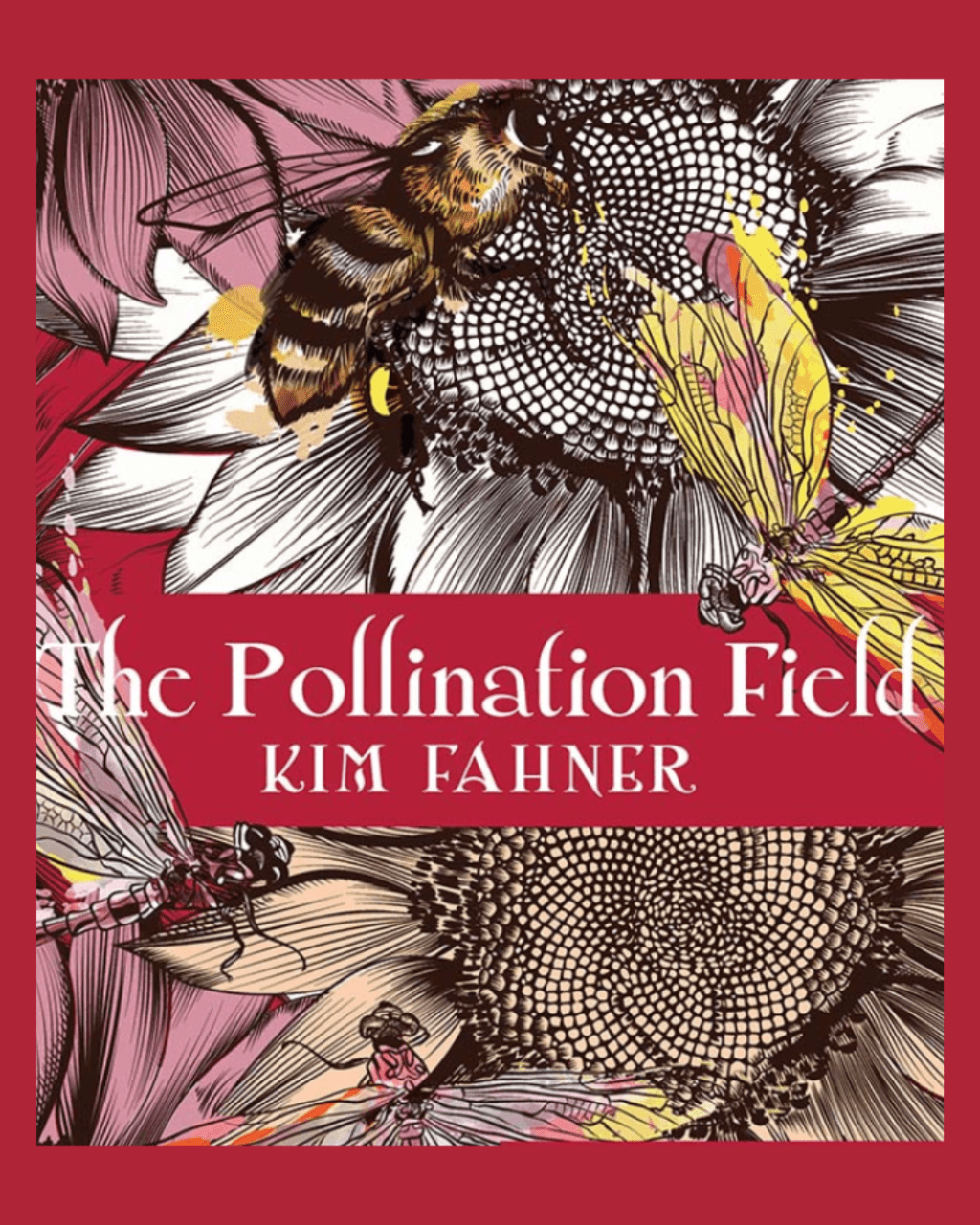
Kim Fahner’s The Pollination Field draws us into a sensory, sensual world of small creatures and sprawling landscapes. Its emotional range is just as broad, evoked by encounters with bees, dragonflies, butterflies, bluebirds, squirrels, flowers, lakes, forest, the Canadian Shield, coast lines, and the sea. We start small with bees, but are quickly overwhelmed by them along with the main character who literally loses herself to a swarm of bees. It adopts her as its queen, and covers her completely. The Pollination Field is a tale of loss, grief and transformation. Poetic prose, free verse and form poetry express evolving emotions, and the process of transformation.
Although she welcomes the bees at first, soon the speaker loses control. How will she regain her autonomy? Hovering throughout the bee poems is belief in “telling the bees”—an ancient Celtic practice which treats bees as wise members of community who must be told of the deaths’ of family members. Kim Fahner’s speaker tells the bees of loss again and again throughout this collection. (At the end of the book, Fahner elaborates on the meaning of “telling the bees” in her helpful Notes section.)
The first poem in the collection, “A Bee in the House” functions like a prologue. The bee “buzzes, like a simple housefly, / but then with a baritone that conjures a bagpipe’s drone / as it gets closer to panic—not able to find its way home. //
A day of hours later, silenced, it falls to the hardwood floor, curled into itself like a strange semi-colon—a pause—punctuated by stillness, antennae shivering in a breeze.” The speaker attends to the bee and welcomes it as symbol of good luck.
“A Bee in the House” is followed by the expansive, erotic poetic prose of the “First Tale: The Queen in the Bee-Loud Glade”. The speaker wonders when bees first arrived in Northern Ontario, at what stage in the evolution of that landscape, its “fault lines moaning and sighing as they mated roughly, splitting nickel from copper long before there were mine shafts sunk into deepest depths of earth by human hands?”
We meet “a forest dwelling woman, sitting “cross-legged on a patch of lichen, all blue-green and wet with dew and longing.” Her elemental quality attracts the bees, “carved into (and out of) the earth and air. … drawing ferns around her hips and boughs of cedar across her breasts. She was rooted.”
The swarm adopts the woman, greets her as their queen, and their host. In “The Greeting,” Part iii) of the “First Tale: The Queen in the Bee-Loud Glade,” she is “sculpted, frozen, captured” by the swarm. In Part iv) It laces itself “gently in living garlands around her neck, breasts, torso,” dressing her in “a gold Egyptian collar of moving wings, humming…accompaniment to her heartbeat.” They feed her “wax and honey” and weave her eyes shut. She is transformed, barely breathing.
In Part v) “A Lesson from the Bees,” the speaker experiences the bees’ cocooning her in wax like her skin being kissed, “tiny licks like lightning.” She comes to understand the bees, to realise that she has become both their queen, and the hive. The bees thrum persuasively, but soon the speaker realises her mouth has also been covered in wax. She is losing her autonomy. On the edge of the glade, the townspeople watch, confused by her transformation. They recruit a beekeeper to rescue the woman in the “honeycomb sarcophagus.”
After smoking the bees, and carefully uncovering the speaker’s mouth, the beekeeper breathes his breath into her. She responds with a gasp. After she emerges from her wax covering, the bees ask their former queen if she will remember her intimacy with them. The townspeople are bemused.
In the collection’s next section, “As For You Dragonfly”, the speaker has regained her voice, but seems to wonder about the cost of the beekeeper’s mouth-to-mouth rescue: “You took the breath from me” she asserts. The expression reminds her of her Irish heritage, but also conjures a woman “at the feet of a man when she is either in love, in lust, or broken.”
“Mary Magdalene had an easier time, kneeling on sand instead of hardwood, saying rosaries around her trauma,” the speaker asserts, awakening to the dangers of being rescued. In “Inside Out” we realise with horror that she is being stalked. Living in a “claustrophobic snow globe” she looks out at the man in “a car parked at the curb, idling where [he] ought not to be, hovering and peering in.” In “Routine” the speaker reminds herself to make sure the keys have not been left outside.
Loss is already exhausting, and then there is the isolation of the pandemic. In “Covid Inventory” the speaker lists lost things: “the smell of garlic browning in a pan / a friend who vanishes into a pandemic bubble / …the taste of citrus on my tongue.”
And in the midst of that isolation a “Watercolour memory” drifts in. In “Man, Sleeping on the Living Room Floor” the “unlocked door did not equal / honest mind, open heart, sanctuary’s trust.” We see the speaker’s vulnerability again with this transformation of a beloved person into intruder.
The speaker needs distance, both emotional and literal, to free herself. In “Bee at Sheringham Point Lighthouse”, a handsome man parks his car on the side of Highway 14, strips to his waist. He balances precariously on pebbled, storm-spent rocks. The speaker’s longing for the strong physicality of a man sculpted, naked, is intense. Wide shoulders. Strong arms. In the poem repetition of man and lighthouse makes them seem interchangeable.
A bee has returned to be the speaker’s guide again.:“One bloom, and one bee that lingers near it…thank the bee for its bounty. Let it hover, buzzing.” It seems to warn the speaker,
“Remember this: the lighthouse comes before the man. The man is not the lighthouse, even if he shines so brightly.”
In the poem “Itinerary” the speaker warns the dragonfly, “Transformation / is instinctual”, yet “illogical”.
In the final four sections of the book we spend more time with the bees, their mating dances, their gyrations in push-up bras, “fuck-me stilettos, the fishnet stockings, // those tight / leather shorts” (Mating Game, Part IV of Second Tale: Queen Bee, Mother of All). We meet the drones, “salivating and longing”.
In the section, The Pollination Field, and the poem “Misery Bay Monarchs,” we witness vulnerable Monarch butterflies prepare for migration. Will they arrive in Mexico “on the Day of the Dead” the speaker wonders? Also, in The Pollination Field, we watch brown bears going extinct in Ireland and in “Husk”, we see beetles pinned to cork and “museumed.” The speaker’s grief is expanding to include grief for the natural world, victimised by humanity since our earliest days on earth.
In the section “Telling the Bees” we meet “Skellig Michael”. and “monks like honeybees—industrious, steadfast, and keen—” “hoping to find heaven / in honeyed prayer.” In “Your Soul Is A Bee” the speaker instructs a woman, “lay yourself down in that field, / as if giving yourself to a lover—opened, free.” An “old woman passing on the road sees [her] there, / just before dawn. Watches a tiny bee exit your mouth.” The poems in this section are shorter and more spare, showing the evolution of grief.
“Cortege”, the penultimate section of the book, consists of deeply felt, spare poems of loss, the most moving poems for the speaker’s mother. For instance, in the poem, “In the Bag I Brought Home from Palliative Care on the Night My Mother Died” we are privileged to witness “the memory of her voice when she was well, singsong / and Ottawa Valley descended; her laugh, pealing // like a bell…”; “a blue-lined recipe card with a note about chicken and / dumplings”; her brown eyes; long graceful fingers on hands that played / songs from West Side Story.”
In “The Sadness is on Me” while the speaker packs up her mother’s clothes, “fossilised cloves” in her “mother’s orange pomander / mummify any suggestion of decay or loss”. Her perspective continues to evolve. In the book’s final section, “Third Tale: Coda—A Bee Reflection” the speaker tells herself, “Try as you might, you will get stung”…” “Trying to avoid being stung is pointless.” I recommend this beautifully written collection and its lyrical negotiation with the grief and loss which visit us all.
Kate Rogers won first place in the subTerrain magazine Lush Triumphant Contest for her five-poem suite, “My Mother’s House.” Her poetry also appeared in Where Else? An International Hong Kong Poetry Anthology. Kate’s poem “The Giraffe-bone Knife Set” was short-listed for the ROOM Magazine Poem of the Year. She is a former director of Art Bar, Toronto’s oldest poetry series. Her poetry collection Baba Yaga and the Girl Who Ate the Rope debuts with Frontenac House in April 2026.
 The Woodlot