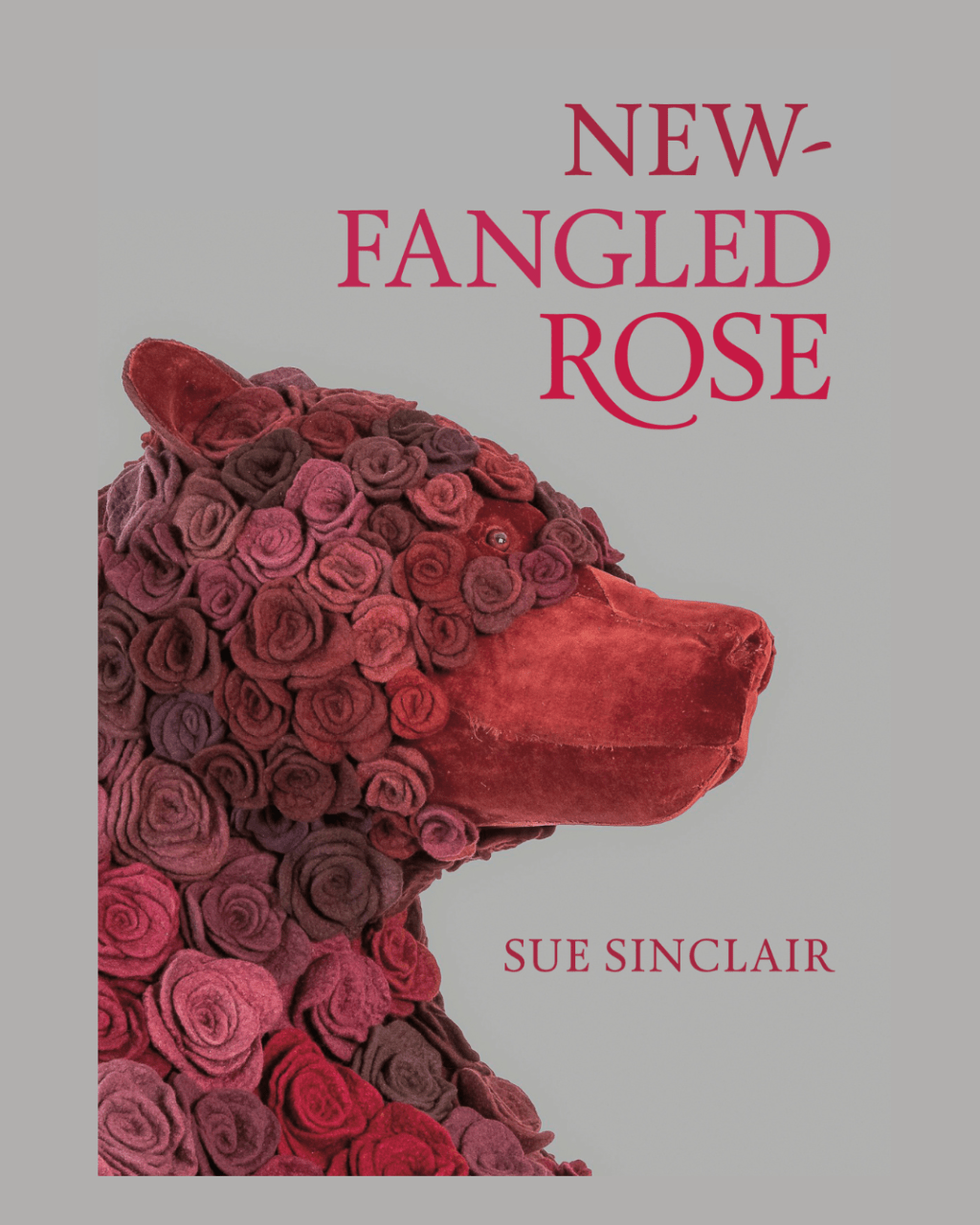
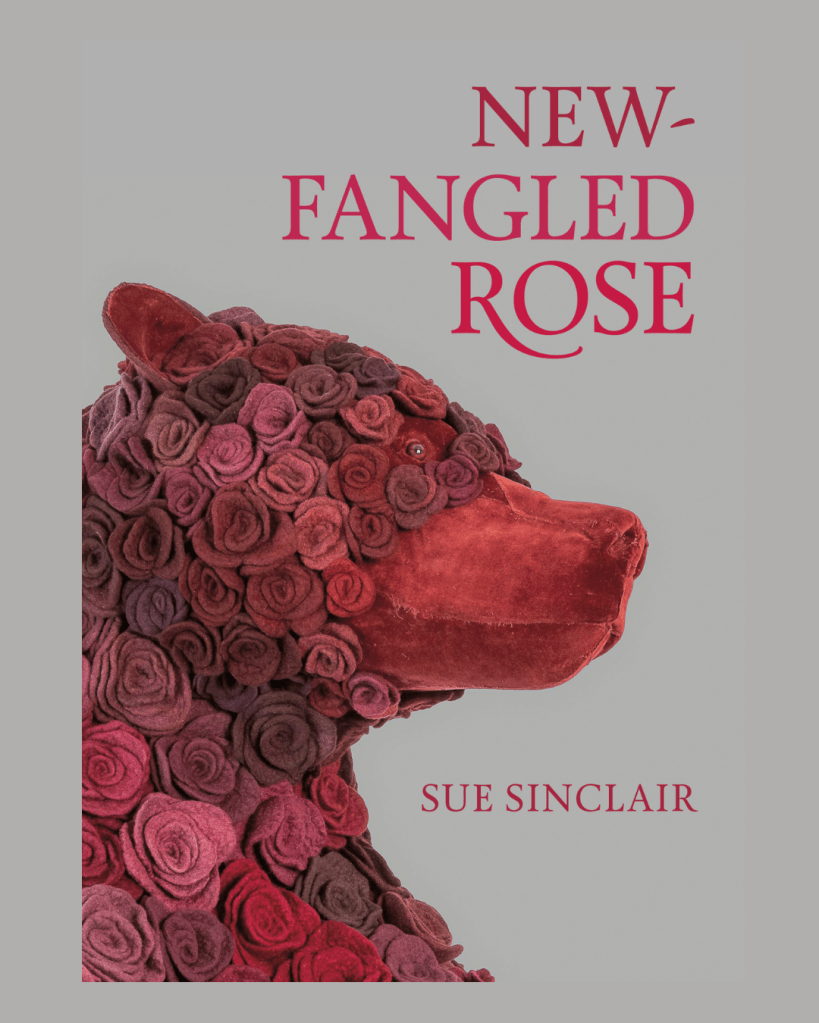
reviewed by Chris Banks
In her poem “The View From Nowhere”, Canadian poet Sue Sinclair writes, “maybe I’ve become time itself, / which is what, do you think? A feature of consciousness? /Of perception? An aspect of love?” These lines really struck me as I prepared to write this review about Sinclair’s new poetry collection New-Fangled Rose, out with Goose Lane Editions this Spring, especially the idea that poets are men and women thinking in time. That we must use our senses to apprehend what is real, and that includes beauty, and the mind sifts all of those sensory perceptions into some sort of unified self. There are allusions to Plato and to Kant, and underlying the poems about Robo-Bees, or a river blinking its “multitude of eyes”, there is a real restless, searching intelligence trying to apprehend “the Great Everything from which we are poured”.
It’s a lyrical interrogation of self and world. And love. And beauty.
I have been a fan of Sue Sinclair’s poetry for two decades, and she writes brilliantly in the lyric mode. “Light drops from the sky like knives”, and the flicker of fire-flies is a “spastic echo”. There is wonderful synesthesia in lines like “rabbits nibble the cold like lettuce”, or the scent of roses “unrolls itself like wallpaper”, or the especially prescient line: “seeing is my mother tongue.” Sinclair is trying to get at the “something-more we feel inside things”, the hidden “petals crammed inside the buds” of truth and beauty. Wherever they may be found.
The poet Sinclair writes prose poems, short lyric poems, longer meditations, but the philosophical connections between self and world is a through-line connecting the entire collection. There is a real confidence in Sinclair’s voice that relies on her senses to pronounce the moon a “silvery half-self”, or when talking about an ordinary crab-apple, to conclude “the ideal self runs into the flesh’s bitterness / and stutters”. These deeply philosophical poems are a little reminiscent of the great American poet Ruth Stone, and Sinclair is able to “prune” her poems into short lines like Stone, but she also lets her poems bloom across a whole page. It is as if the poet Sinclair is looking for the authentic in her poetry– i.e. a place where self and world are momentarily conjoined through sensory perception– so abstract ideas like “Justice, Love, Truth” join us in our “bodily predicament.”
Look at the poem “Beauty Like Pressure Applied to a Wound” whose title I just love, and the speaker’s consciousness in the poem seems to apprehend beauty and truth, at least momentarily, by focusing on the sensations around the speaker: specifically, the ordinary or maybe not so ordinary details which make up one’s life.
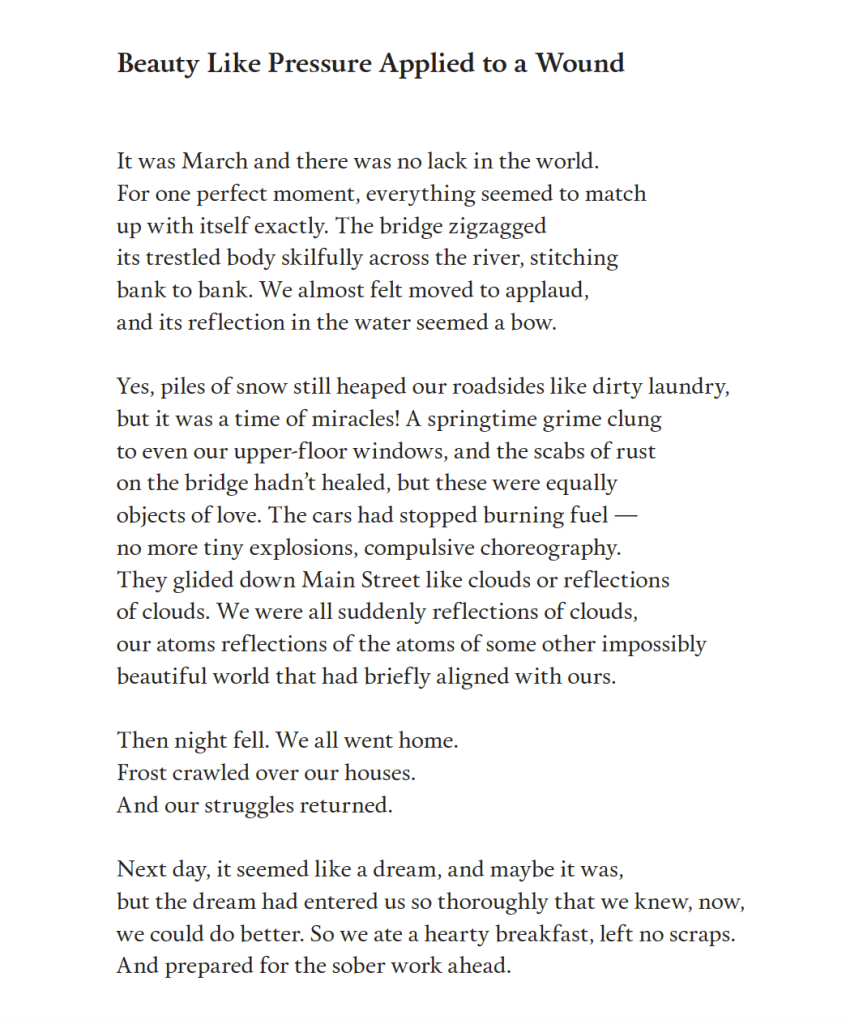
This is a terrific poem and I love the synergy in the lines, “We were all suddenly reflections of clouds, / our atoms reflections of the atoms of some other impossibly / beautiful world that had briefly aligned with ours.” The juxtaposition of the cloud’s physical reflection upon the Earth with that inner sensory reflection our consciousness gleans is a holy thing in this poem, and comes as close to apprehending some underlying permanence in this life, even if the feeling fades once “Frost crawled over our house. And our struggles returned.”
Apprehending beauty might seem “like a dream” amidst the grittiness of ordinary life, but it is literally these type of metaphysical moments which make life meaningful, and, at least to my atheistic self, make the only paradise we will know this one, or as Sinclair says in a different poem: “heaven is a kind of energy stored in our cells.”
Another poem I quite liked was the poem “Return” which appealed to my own experiences of growing up in small-town Ontario, but the same themes of building relationships with others, and finding a connection to the outside world through the self’s apprehension of the beautiful amid the mundane is again taken up here:
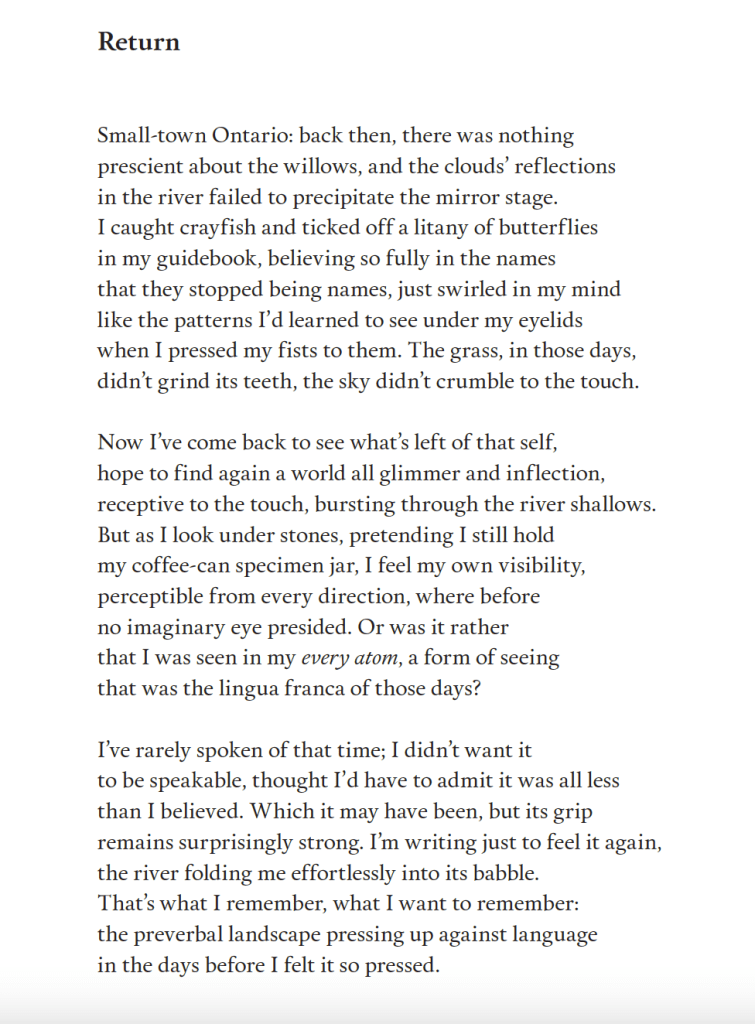
This is a breathtaking poem, ands it takes me back to the 1970s when I wandered the vacant lot beside my house with a butterfly catcher, too, and like the speaker of this poem, I, would also see patterns “under my eyelids / when I pressed my fists to them”. Childhood is the Edenic place from which we are eternally exiled, a place where that bond between self and nature is at its strongest, where we can “see” the world and the world sees us without the traumas and travails of the flesh “looping” memories and anxieties and existential warnings to us.
New-Fangled Rose by Sue Sinclair out with Goose Lane Editions is a richly rewarding, lyrically engaging, and philosophically precise collection of poems which delights in glimpses of beauty, large and small, and navigates the precarities of self-consciousness with both seriousness and a reverence for our ordinary lives, ultimately revealing we are part of a world which shows little of its true self on the surface, much like those bright red petals of a rose tightly pressed inside the bud.
Chris Banks is an award-winning, Pushcart-nominated Canadian poet and author of seven collections of poems, most recently Alternator with Nightwood Editions (Fall 2023). His first full-length collection, Bonfires, was awarded the Jack Chalmers Award for poetry by the Canadian Authors’ Association in 2004. Bonfires was also a finalist for the Gerald Lampert Award for best first book of poetry in Canada. His poetry has appeared in The New Quarterly, Arc Magazine, The Antigonish Review, Event, The Malahat Review, The Walrus, American Poetry Journal, The Glacier, Best American Poetry (blog), Prism International, among other publications. Chris was an associate editor with The New Quarterly, and is Editor in Chief of The Woodlot – A Canadian Poetry Reviews & Essays website. He lives with dual disorders–chronic major depression and generalized anxiety disorder– and writes in Kitchener, Ontario.
 The Woodlot