

reviewed by Chris Banks
Elizabeth Bachinsky’s Real Grownup out now with Nightwood Editions, Spring 2026, is as much about family storytelling as it is stanzas; reckoning with one’s past as it is realizing you are no longer that girl “awake, crumpled there, like a pile of flung rags / Among friends, laughter, a campfire burning”. Except, of course, you are. In some ways, you are still are all those past selves. The troubled teenager, the daughter, the young mother, the wife, the family member in recovery, the writer-poet-teacher.
The cover design of Real Grownup speaks to all these selves encapsulated inside the poet as it depicts Matryoshka dolls, i.e. Russian nesting dolls, smiling brightly, while sinking into an ocean of what? Memories? Family history? Certainly, there are poems about Bachinsky’s mother, and her own role as a mother, and poems about her daughter, and all of these poems “nest” within the poetry collection, but this is also a volume about coming to terms with yourself, all your selves, and certainly I can empathize as some who is a writer, and in recovery himself.
Bachinsky’s triggering subjects abound in this book-father, mother, daughter, rebellious teenage self, dead ex-boyfriends– and the details she puts down in her poems are as important as the details she carefully leaves omitted. Bachinsky writes prose poems, free verse poems in quatrains and non-uniform stanzas; skinny little poems and wide-ranging poems that take over multiple pages, but the story-telling is always there, the poet’s appraising eye, looking at tender moments like the birth of a child and more uncomfortable memories like one’s teenage hell-raiser years. The poet seem to be saying in these poems: what value do these selves and memories hold for me now?
Or maybe the real question is: why do these moments in the past hold so much sway over us in the present? Maybe it is because we try to become better people for those of us who sift the past, or who find ourselves in recovery. Maybe it is because we love, and we care, and we want to change. Easy does it.
An early poem in the collection called “Astrophysicist” is a tender memory of Bachinsky’s daughter as a toddler learning language. It is a family memory, a private one, but one that shines brightly in the poet’s memories. Here is the poem:
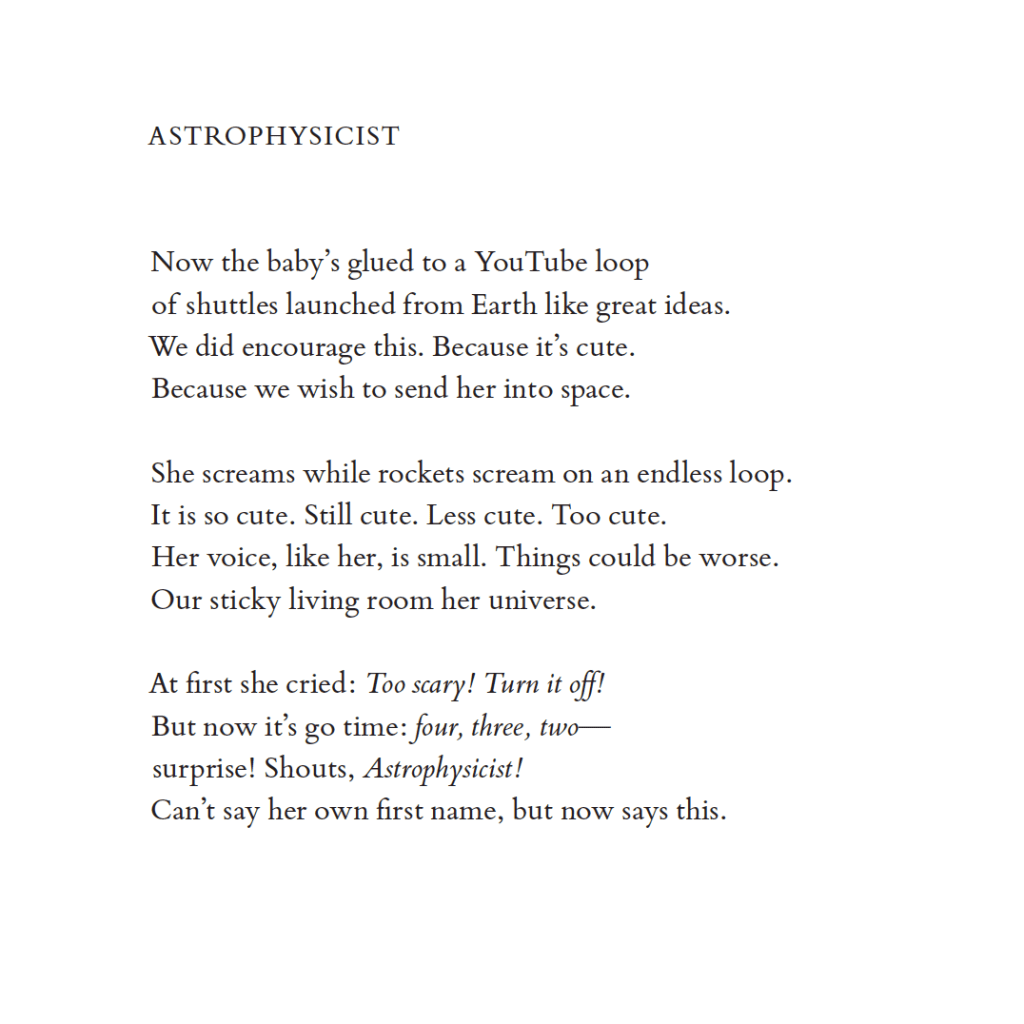
The first stanza is really interesting, almost mundane, with the baby “glued to a Youtube loop / of shuttles launched from Earth like great ideas”, and maybe there is a little guilt or feeling of being an over-tired parent for propping the child in front of Youtube (my own daughter at that age watched “Barney Zoo!” endlessly), but its really the last lines of the first stanza that stick in my heart: “Because its cute / Because we wish to send her into space.” We want to save our children from this world, and its horrors, shelter them from all harms, except we can’t. The second stanza makes it clear we only have one home, and it is this one, so we might as well make it as comfortable and comforting as we can: “Things could be worse. / Our sticky living room her universe.” In the last stanza, the baby daughter realizes, maybe for the first time, the world, our world, is a scary place, but then there is the delightful details about the baby saying “Astrophysicist!” before her own first name. The wonders of language, the wonders of love, keeping the darkness at bay.
Another poem from the collection is called “The Christmas Stocking” and within it, we are treated to a poem about family memories, a lost Christmas stocking, and time, specifically lost time, swirling, conjuring the poet’s own childhood before her father left, and upended the family home.
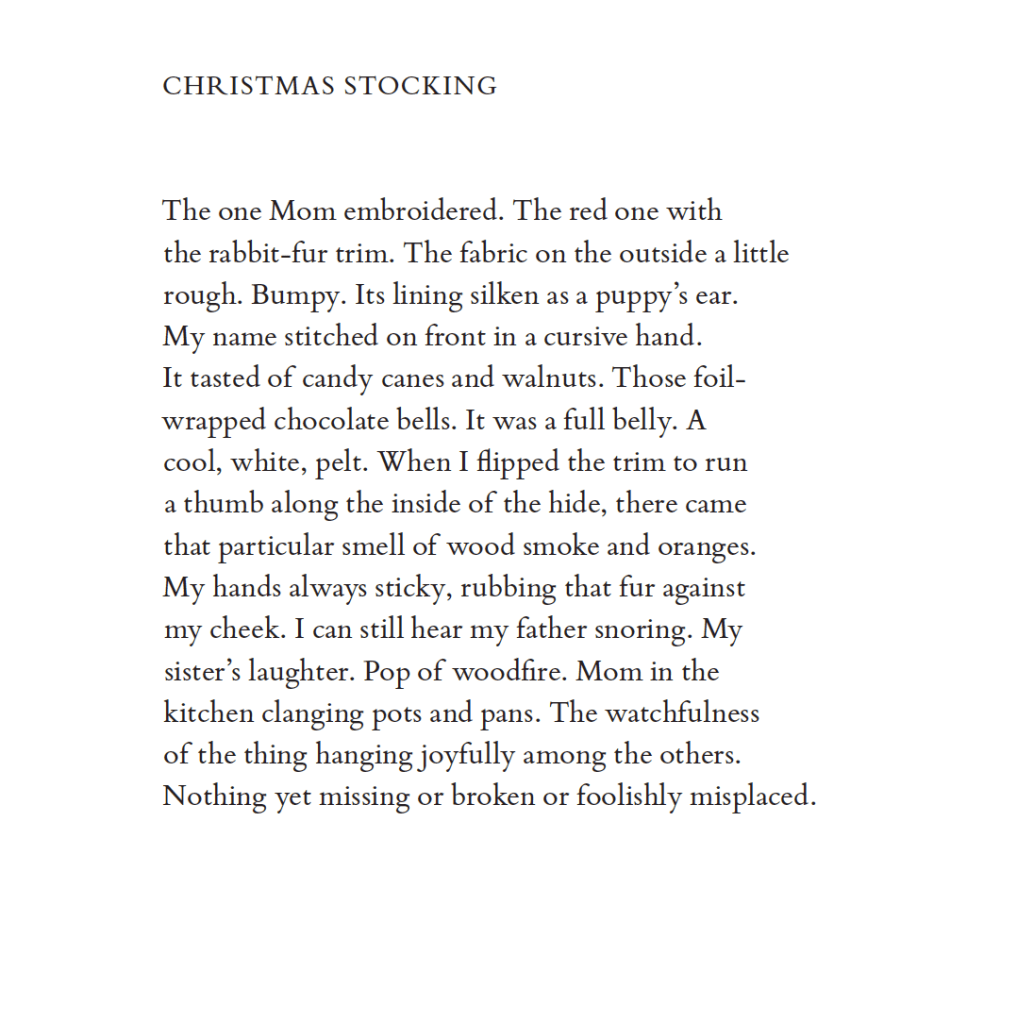
By writing about the past, or in this case a lost Christmas Stocking the poet’s mother made her, one can reclaim the lost item, at least in the time of the writing and the reading of this poem. I love the descriptive details which manifest the lost stocking: “”It’s lining silken as a puppy’s ear.” and its “cool, white, pelt”. But it’s really the ending lines which create all the implied family drama in the poem: The watchfulness / of the thing hanging joyfully among the others. / Nothing yet missing or broken or foolishly misplaced.”
There are poems about a troubling older ex-boyfriend in the poet’s teenage years, poems about an uneasy relationship with a distant father, understanding one’s mother as an adult, but I think I’ll shift away from these as these stories feel intimate, almost private, as if they are only the poet Bachinsky’s to tell, so I thought I would end this poetry review by quoting a little from her poem “Easy”:
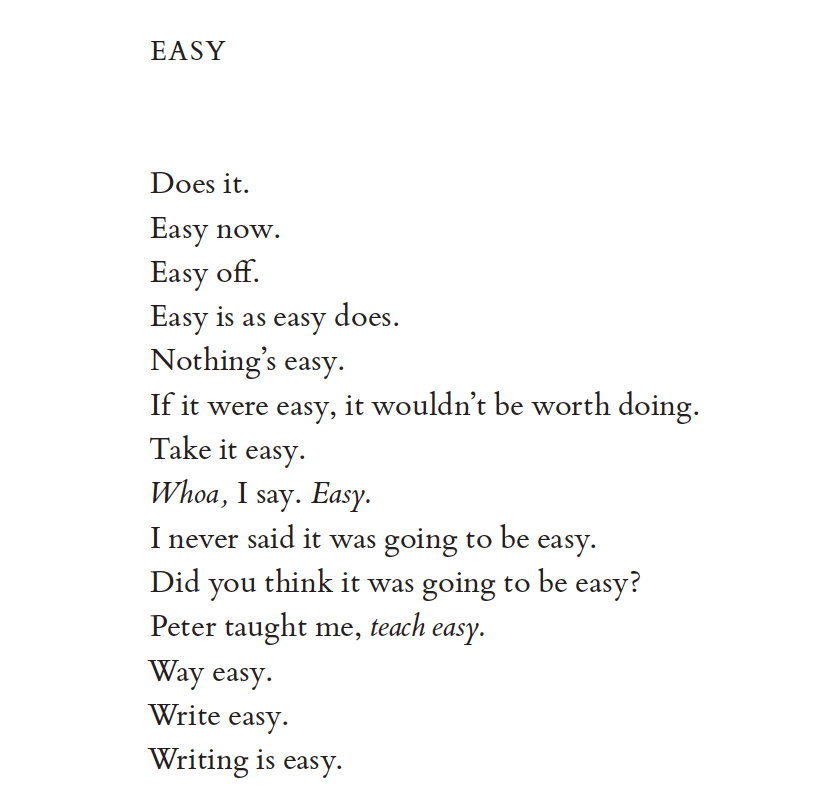
Is Writing easy? Yes, except when it isn’t. I love the “winking irony” of the title, and the opening “Easy does it” which is a well-worn AA saying for those of us in recovery which always seems to be flexible enough to help us out of all sorts of “grownup” predicaments without booze. I love the fun and the world play that this poem takes up, and you’ll just have to read the rest of the poem which takes a very serious turn, to understand the poem’s real message which is this: there is nothing easy about memories.
In Real Grownup (Nightwood Editions, Spring 2026) by Elizabeth Bachinsky, the poet reflects on her life, her past, the loves, the messiness, and everything in-between which makes for terrific reading, but for the poet these poems are also about making peace with one’s memories, one’s family history, and trying to be a responsible, emotionally regulated person/parent approaching the middle of one’s life–even if that requires you saying “easy does it” under your breath sometimes. Maybe that is the most grownup thing of all.
Chris Banks is an award-winning, Pushcart-nominated Canadian poet and author of seven collections of poems, most recently Alternator with Nightwood Editions (Fall 2023). His first full-length collection, Bonfires, was awarded the Jack Chalmers Award for poetry by the Canadian Authors’ Association in 2004. Bonfires was also a finalist for the Gerald Lampert Award for best first book of poetry in Canada. His poetry has appeared in The New Quarterly, Arc Magazine, The Antigonish Review, Event, The Malahat Review, The Walrus, American Poetry Journal, The Glacier, Best American Poetry (blog), Prism International, among other publications. Chris was an associate editor with The New Quarterly, and is Editor in Chief of The Woodlot – A Canadian Poetry Reviews & Essays website. He lives with dual disorders–chronic major depression and generalized anxiety disorder– and writes in Kitchener, Ontario.
 The Woodlot