Written by Tanis MacDonald
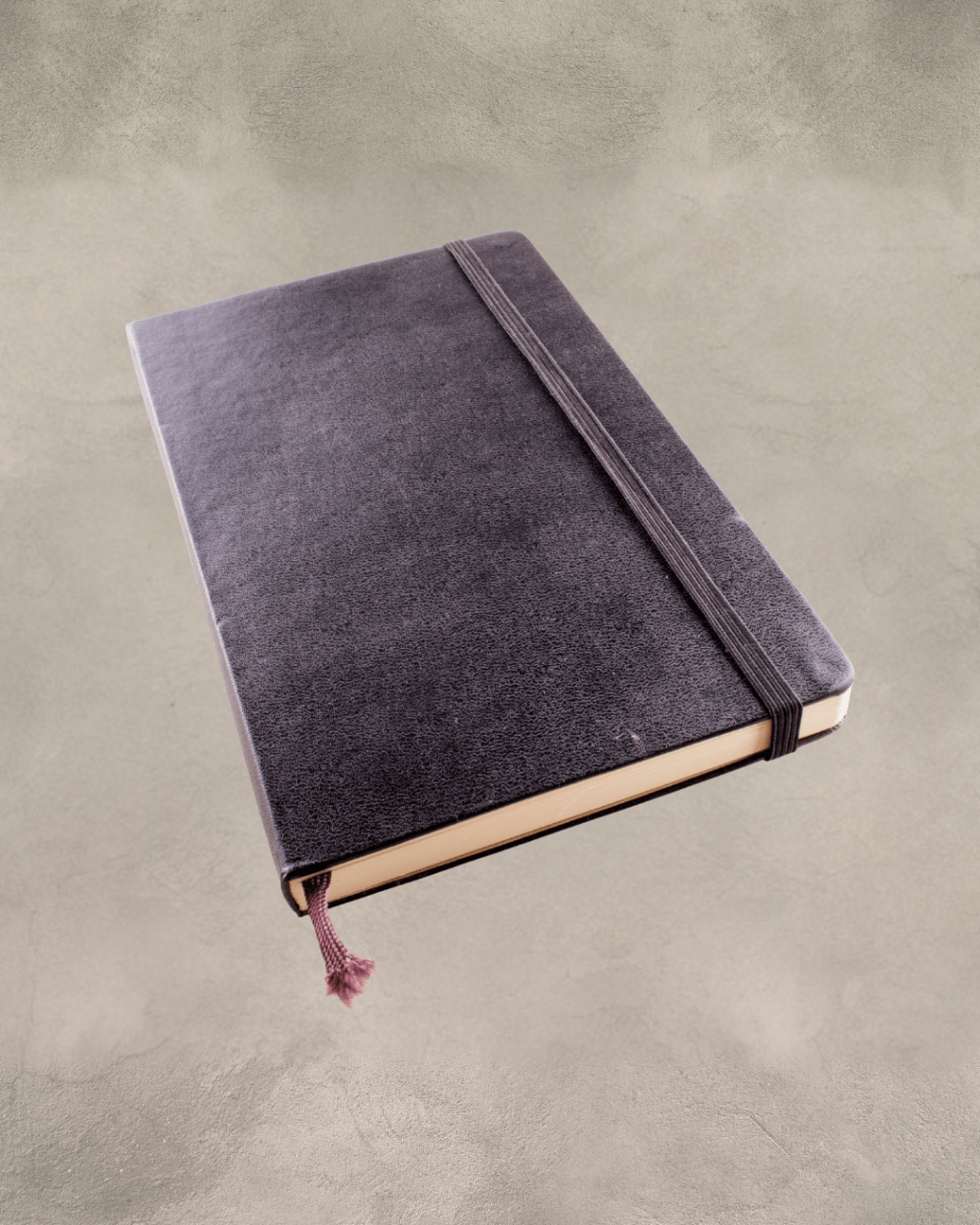
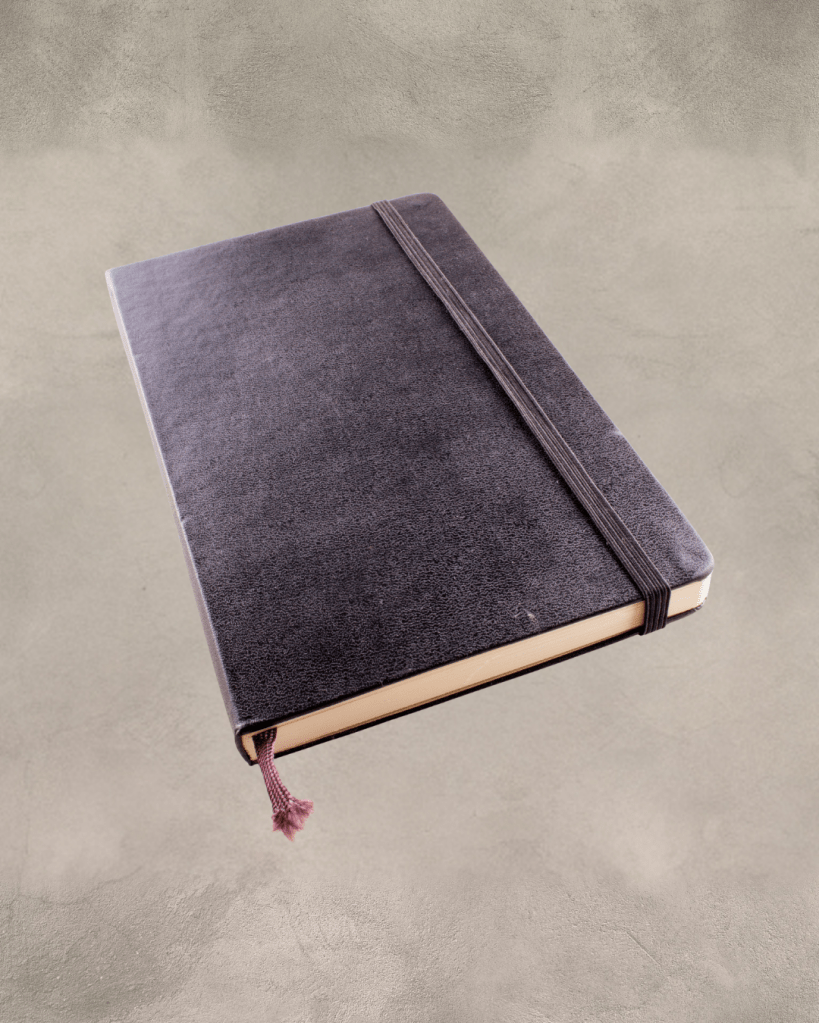
It’s old school, I know: maybe even the oldest of old schools. But I write ideas in an actual paper notebook that I maintain with the attention of a clockmaker. I am also attuned to finding and attracting blank notebooks at all places and times. A notebook is my favourite purchase when I travel, and as a result, I own many, in all sizes and styles and colours. They are how I imagine the future. Keeping notebooks makes me think about time differently. If I write in the book today, the entry immediately becomes the past, and then it possesses infinite futurity. When I return to the entry, in a few days or in five thousand days, it scintillates with a firefly’s luminescence.
A cultural history published in 2023, British author Roland Allen’s The Notebook concerns the evolution of portable jotting as “a history of thinking on paper,” as its subtitle declares, and is good reading for those us of us who, like Allen, “enjoy stationery a little too much.” I’ve owned Allen’s book for a few years, and I’m reading it slowly, the same way I read Melissa Febos’s Girlhood, because every chapter seems momentous in a way that makes me need to go for a very long walk after reading.
Poets need notebooks. We need to see the spread of associations and the offshoots of words and ideas. A lot of my notebook entries are shiny things that I collect like a magpie. Words to research, weird facts to look up, questions to keep in mind. Sometimes events or tasks to be transferred to the to-do list on my desk.
To keep a notebook is to begin without knowing. I found that in my June 2025 notebook. It’s the best relief to let go of having to know.
I have become such a convert to notebook keeping that when I am away from my desk, I use my tablet only for emails and online research and write exclusively in a notebook. This began in 2023 with my determination to refuse CoPliot access to my tablet. This shifted to a preference at the Elizabeth Bishop House in Great Village, NS. The heritage house is not equipped with Wi-Fi, and my two weeks there boosted my practice in thinking without the great shouting bark of the world in my ear. I barely used social media and wrote my way through two notebooks.
Keeping a notebook changes your brain. A 2024 study by Norwegian neurologists showed that handwriting stimulated the parts of the brain required for learning and for memory, what the scientists called “massive theta and alpha wave patterns.” I don’t know about you but I want my wave patterns to push and pull me. Stasis is overrated.
Notebooks are not filing systems, or at least, mine are not. Somewhere in one of my notebooks, there are preliminary notes for an essay about notebook use. But I can’t find it. And I cannot be fussed to dig for it, because I remember writing those notes and so does my hand and so do my theta waves. That has turned out to be more important than accessing the words I used to describe this essay in its nascent form.
As Oscar Wilde observed, everyone should keep a notebook in order to have “something sensational to read on the train.”
*
CA Conrad, that contemporary poetic genius and wondrous mind, routinely prefaces their published poems with paragraphs describing their process, often involving an exercise performed in public featuring a piece of art, protest, or street interview, among other methods. Conrad always ends these process paragraphs with a direction like “Take copious notes and then write the poem.” For me, the brilliant thing about Conrad’s description of process and note-taking is that the resulting poems – (read them for yourself and see what you think) – contain almost no discernible traces of the exercise. That is, Conrad has been both generous enough to share their process and divinely opaque enough to craft poems that reach well beyond the parameters of the prompt. I like to think that it’s all in the note-taking.
*
Here’s what I like in a notebook: a bendable cover, suitable for cramming into a pocket, a fully-packed carry-on, or a purse with snacks and a field kit jostling around the interior. It needs sturdy enough binding and paper to survive the chaos and keep offering up those black pages. In terms of covers, I like a plain beautiful colour and/or a whimsical illustration; Moleskines alongside Bear and Badger’s creatures and Bekking & Blitz’s florals. Whimsy is welcome so I don’t take myself too seriously; beauty is good so I can love returning to it. A notebook can’t be too beautiful, though, or too good for me to scribble in. And I do mean scribble: not elegant calligraphy, but a scrawl of handwriting that shows the judders of riding public transit, gloppy ink blots, my habit of printing and writing cursive in the same sentence (and sometimes the same word), not to mention awkward doodles of monster heads with huge teeth and birds with misshapen wings.
But you never know with whom you will find notebook solidarity. My hair stylist saw me taking notes and she confessed to being a notebook keeper. She said that she never used a notebook before buying the business, but now she found it an indispensable tool for day-to-day operations. She used to keep notes on her phone, but now the notebook helps her thinking across budgets and to-do lists, evidence that notebooks serve more people than just poets, though you’ll forgive me for thinking that poets have a special provenance with the small portable notebook.
In a Hamilton café, the server saw me writing and asked to see my notebook, and in the second before I showed them the cover, I wished my notebook was more impressive. I was writing in a palm-sized lined notebook bristling with goofy stickers, but when I held it up for their gaze, they treated it like it was holy and apologized for interrupting my “journalling.” I was surprised by both their reverence and their choice of verb. I was jotting down notes for a poem. I wasn’t journalling or “writing up my day” as David Sedaris has often discussed in his essays; my notes are scraps, clashy fragments, and word combinations that mean nothing to anyone but me.
While a judge for a youth poetry competition, I saw a winner in the ten- to twelve-year-old category clutching a pen and a multi-coloured spiral-bound book. I asked, poet to poet, if she was keeping her writer’s notebook with her at all times. She levelled a scornful look at me and said loudly, “This is a DIARY.” I understood. For her, the word “notebook” was meant for schoolwork; the diary was for her art. Our terms collided, but I could appreciate her need to differentiate.
While organizing my notebook collection last year, I discarded some early notebooks after reading a glut of painfully adolescent entries that I persisted in writing well past my actual chronological adolescence. I did not ritually burn them – though you’d be surprised how many people asked about that – but instead buried them deep in the recycling box and watched as the recycling collectors tossed the paper into their bin. That was ritual enough for me. A friend of mine was horrified when I told her, sure that my early voice was producing juvenilia gold, and I had to tell her that it really, really, wasn’t. The best thing I could do for the girl who wrote in those notebooks was protect her from eyes other than my own. The gold, such as it was, was in the doing: the dogged and often unlovely practice of getting my writing feet under me.
There’s a difference between “this is a picture of my mind and it’s SO embarrassing and private” and “this is a picture of my mind that is deeply amusing and weirdly fascinating.” What a relief to have arrived at the latter.
That young diarist-poet is 26 now, here in the future that is also the present.
*
Every April, during the NaPoWriMo write-a-poem-per-day marathon (which I have written about elsewhere on The Woodlot), my notebooks are my best source of ideas. And I’ve discovered that more often than not, my disjointed notes are enriched by their lack of context. The less I know about the circumstances under which I wrote the note, the freer I am with its use in a poem or essay.
A sampling in an undated entry, sometime in August 2023, I’ve written a single word: “duxelles!” A page or two later, a phrase I saw on a T-Shirt: “Family Moisture Farm.” In December 28, 2024, there’s a note about a plant: “the thrift flower appears on the three-penny piece.” On the facing page, a quotation from John Berger: “home is the return to where distance does not yet count.” (Later, I will misread my own handwriting and think I’ve written “to whose distance does not yet count” and start thinking about people as distant rather than places.) In January 2025, “Arguments for taxidermy: the long look that the dead allow,” something I remember Alissa York talking about, now popping up more than a decade later. In May 2025, a sentence: “This aphorism thinks it knows everything.” June 2023: “sciatic notch.”
These exist side-by-side with notes on readings and talks I attended, notes taken during Zoom meetings, or about phrases I overheard in public. Recommended books. Addresses in case my phone dies. Hand-drawn maps. Lists that go nowhere. Longer entries that don’t even try to wrestle with profundities or capture feelings. A notebook is no place to make sense.
Notebooks are necessary because poetry happens when you least expect it.
For years, on the many days I could not find two hours to sit down, draft a poem, and work steadily on it, or simply could not stand to look at a screen for another second, I could always find thirty seconds to make a note.
The result of this temporal inequity has been a cache of written material at my disposal, prompts from my past self ready for expanding in the present, a rich archive of my own mind through which to sift, my antlered history leaping the ditch into the meadow of the present.
A few weeks ago, I noticed the label on a pair of unobtrusive black notebooks – pristine, not a mark on the pages – that I had thrifted for $2.99. They were made by an Italian stationery company called Bieffe, and when I checked, I saw that the notebooks that I plucked off a shelf at Value Village with the hand-dyed red edges and a large reproduction of a multiplication table on the last page, would normally retail for $ 49.99 for three.
As my partner is known to say, “My gal likes a deal.”
A deal on beautiful notebooks: good.
Knowing that I’ll write all over them: priceless.
Tanis MacDonald (she/they) is a free-range literary animal and the author of the forthcoming Tall, Grass, Girl (Book*hug, Fall 2026), as well as Straggle: Adventures in Walking While Female and six other books. She has twice won The Malahat Review’s Open Seasons Award, in 2021 and 2025, and has written a poem a day every April since 2013. She is Professor Emeritus at Wilfrid Laurier University and a dedicated FaunaWatcher.
 The Woodlot