

By Chris Banks
I started The Woodlot: Canadian Poetry Reviews, Interviews and Essays two years ago, and so far we have published over sixty poetry reviews and over forty essays so although it is a little website that I could update more regularly, I see it as a success.
The Woodlot, to me, is an online “hub” where Canadian poets can come to read thorough, comprehensive Canadian poetry reviews; to read interviews with exciting Canadian poets, and to glean another poet’s thoughts on everything from poetic friendships to the Canadian Long Poem to conversations on what constitutes Canadian poetry to poetry as a kind of verbal “magic”.
It really is just me running the site, so I am always grateful when someone contacts me excitedly wanting to write a review of a terrific poetry collection they have read, or maybe they have a brand new essay about poetry and writing in notebooks (as Tanis MacDonald has this week) which is looking for a home. Submissions are always open here at the Woodlot.
I would also like to thank other sites that are doing a lot of the hard work of keeping poetry reviewing alive here in Canada. I’m thinking of places like The Miramichi Reader, and That Shakespearean Rag, The Seaboard Review of Books and The British Columbia Review, The Temz Review and periodicities: a journal of poetry and poetics; and, of course the many print journals still committed to publishing Canadian poetry reviews.
But now National Poetry Month is upon us, and if I am being honest, I’m feeling a little grey and dank of spirit, so I’m finding it hard to muster the necessary enthusiasm required to fully embrace it this year. I’m feeling a little physically and creatively “hollowed out” after a particularly brutal winter, and a busy school year teaching three sections of Grade 12 high-school English. I’m also writing a new collection of poems full of various formal and philosophical restraints so I’m feeling a little anxious about this new creative “voice” too.
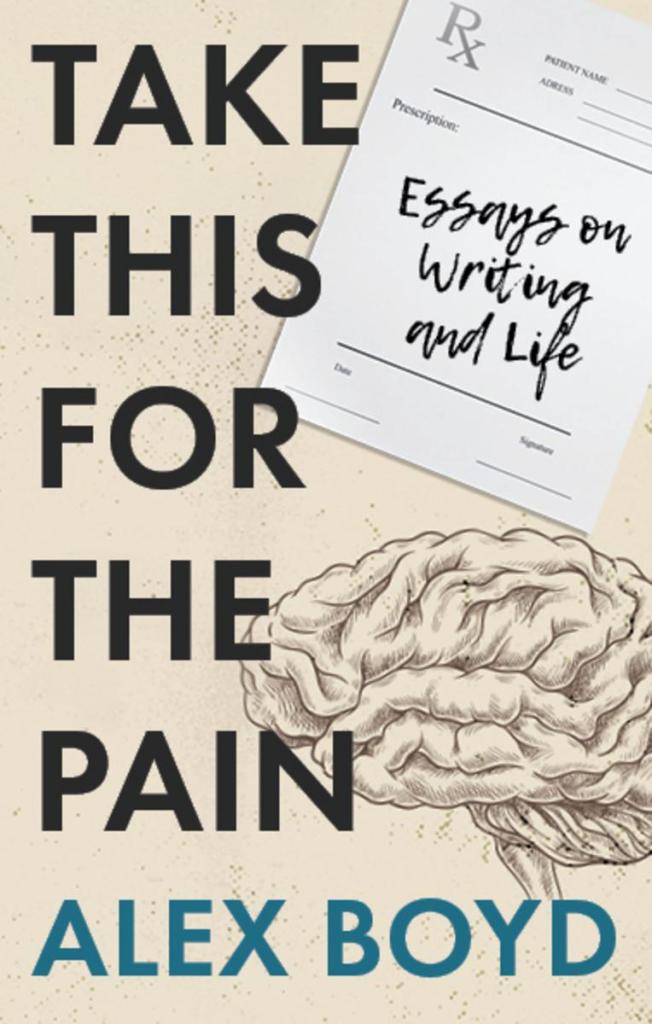
This is all to say I’m not the best choice to write an essay on Why Read or Write Poetry to begin National Poetry Month at the moment, so this year I will defer to the Canadian poet Alex Boyd who has a fantastic book of essays called Take This For The Pain: Essays on Writing and Life coming out with Palimpsest Press next month, and in his aptly titled essay “Why Read Poetry?”, he writes, “Love for poetry is sustained by a willingness to be unsure” (17).
This is the first sentence of Boyd’s essay and it brings me a lot of solace. I’m never really sure if people are reading the Woodlot, but I hope they are, just as I hope they go out and buy the Canadian poetry books under review to draw out their own conclusions about them.
Poetry is a really strange thing to be “good” at, and I say this as a poet in my Fifties that cannot build a deck, or change his tires on his car, or do any sort of quick math on the fly when figuring out a bill at a restaurant. I’m uncertain if having spent a great deal of my adult life reading and writing poetry has been the best use of my time, but Boyd’s essay has a remedy for that discomfort I am feeling. He suggests leaning hard into it:
Poetry may be concise and emotionally charged, but it has never become the popcorn of the literary world, simply because reading a book of poems means moving through a series of ideas and a requirement as a reader that you practice discomfort in small doses. It’s work to bump into a new perspective on every page, and even in prosperous times we rarely seem to display a lot of tolerance for uncertainty, never mind the times that are upon us now. But uncertainty is where ideas are born(18).
This is a lesson I needed reminding of today, and particularly this month. I write poems, like other poets, because I need to write poems. That’s it. That is my contribution. Also my reading other poets is a contribution to the wider poetry community. It is an exchange of ideas. A murmuration of words and thoughts and images exchanged between poet and reader. Uncertainty about one’s craft, or one’s reputation, is always there, but that is where “ideas are born” as Boyd has stated, which reminds me of something W.S. Merwin said in a documentary about his work that if you know too much about a poem ahead of time, it’s probably not going to work out, or it’s going to become prose.
Please enjoy Poetry Month responsibly and, by that, I mean read some new Canadian poetry volumes, read a few reviews of new Canadian poetry books, lean into a little uncertainty yourself, and try to write a poem that explores new ideas, new approaches. As for me, I’m going to go preorder Alex Boyd’s Take This For The Pain: Essays on Writing and Life as this has been the prescription for my own discomfort with National Poetry Month this morning. I’ll give the Canadian poet Boyd the last word here: “I’m not sure I think anything bridges the distance between people with more speed and accuracy than worthy poetry that happens to really speak to the reader”(19).
Chris Banks is an award-winning, Pushcart-nominated Canadian poet and author of seven collections of poems, most recently Alternator with Nightwood Editions (Fall 2023). His first full-length collection, Bonfires, was awarded the Jack Chalmers Award for poetry by the Canadian Authors’ Association in 2004. Bonfires was also a finalist for the Gerald Lampert Award for best first book of poetry in Canada. His poetry has appeared in The New Quarterly, Arc Magazine, The Antigonish Review, Event, The Malahat Review, The Walrus, American Poetry Journal, The Glacier, Best American Poetry (blog), Prism International, among other publications. Chris was an associate editor with The New Quarterly, and is Editor in Chief of The Woodlot – A Canadian Poetry Reviews & Essays website. He lives with dual disorders–chronic major depression and generalized anxiety disorder– and writes in Kitchener, Ontario.
 The Woodlot