reviewed by Chris Banks
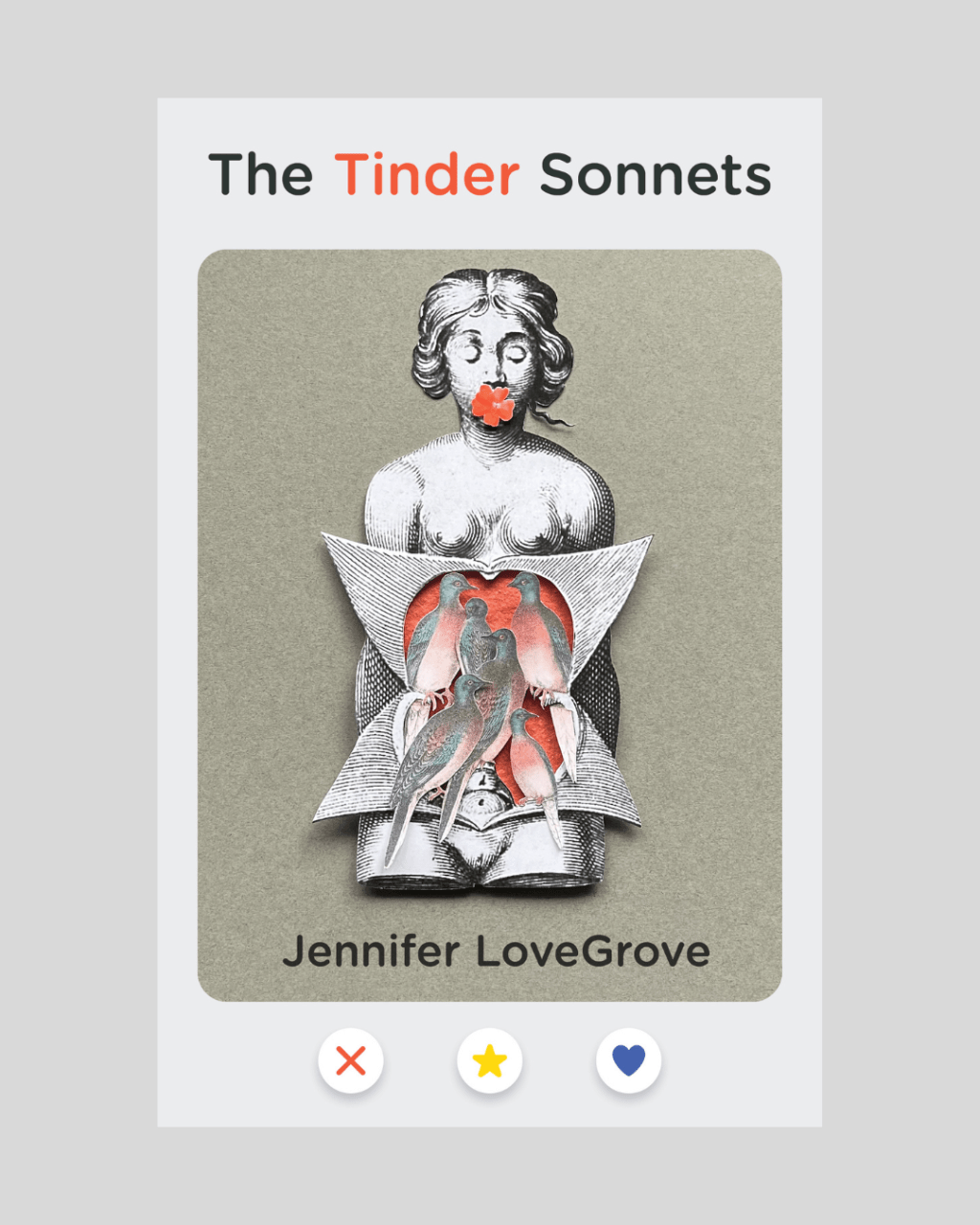
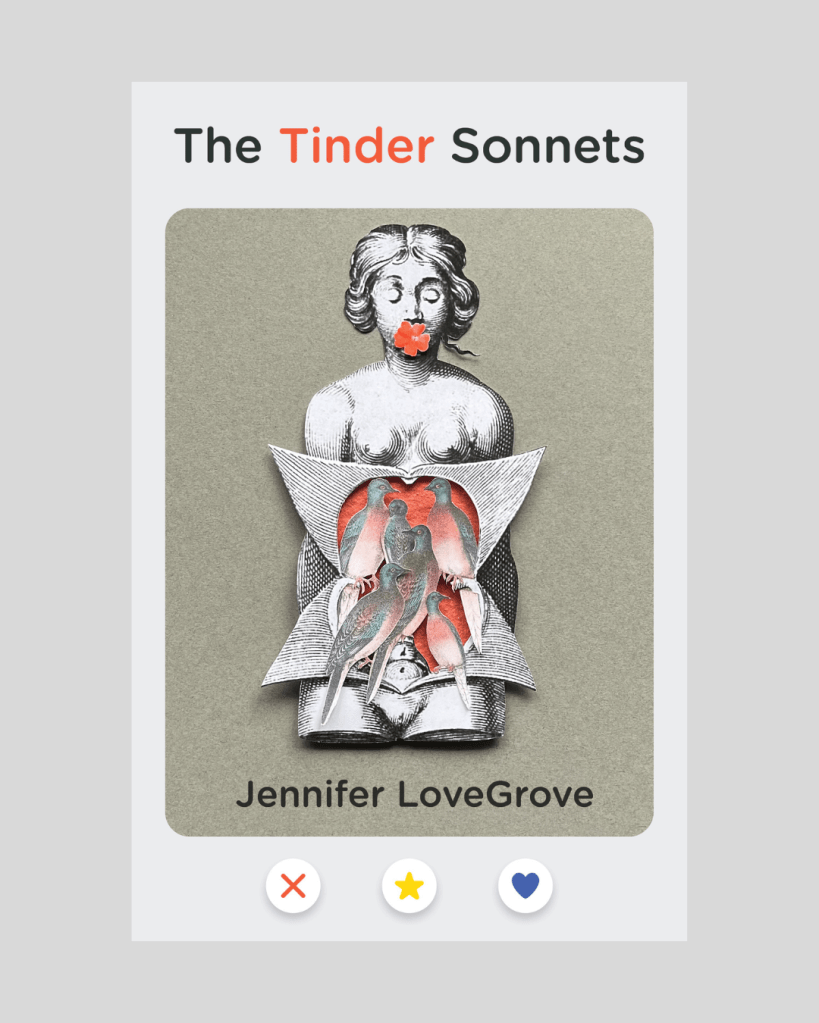
“The sonnet, like poetry, teaches you what you can do without,” said Diane Seuss who, after publishing her remarkable book of sonnets Frank a few years ago, has ignited a renaissance of interest in the poetic form, and this Spring season Canadian poet Jennifer LoveGrove has published her The Tinder Sonnets with Book*hug press, a book that is raw, autobiographical; and which expertly navigates trauma and memory and desire. LoveGrove writes in the Notes section at the back of the book, “Dating is fun until it isn’t. Mostly it isn’t. Writing isn’t fun until it is. This book may be the most fun I’ve ever had writing.” I couldn’t agree more.
I very much enjoyed this book, but fun is a word perhaps I would not associate with a book that makes the reader, part voyeur, part poetic sleuth, because what is really interesting about these sonnets–sonnets about body image, violent threatening neighbours, sexual kinks, toxic male behaviour and in short, modern dating and classic patriarchal “bullshit”–is as much the subject matter, but also what LoveGrove leaves out.
LoveGrove’s sonnets take the sonnet form very, very seriously, as they are 10 syllable, 14 line sonnets that stretch across 120 pages. If Diane Seuss’s sonnet form is a “barbed wire dress”, as one critic described it, LoveGrove’s sonnet form is an online dating profile; or maybe a “needlepoint” stitched with pricked bleeding fingers, or a redacted love affair, or an autopsy of modern dating culture, or even a cautionary tale.
The sonnet form may teach us what we can do without, as Seuss eloquently put it, but human desire also teaches us what we will put up with. LoveGrove’s sonnets teaches both of these things at the same time. The sheer breadth of experimentation with the sonnet form is maybe the real reward of LoveGrove’s book. There are redactions, experiments with sonnet cycles that use repetition of lines through several linked sonnets to–like the villanelle form–create thematic depth, emotional obsession, and shifting meaning. Part “peepshow” of LoveGrove’s recent dating travails; part masterclass in the “theory of omission” and the modern sonnet form, The Tinder Sonnets is an exhilarating read!
Take for instance, the first poem in the sonnet sequence “It’s always someone else’s fault” with its strict syllabic count and the implied Sisyphusean trials of online dating:
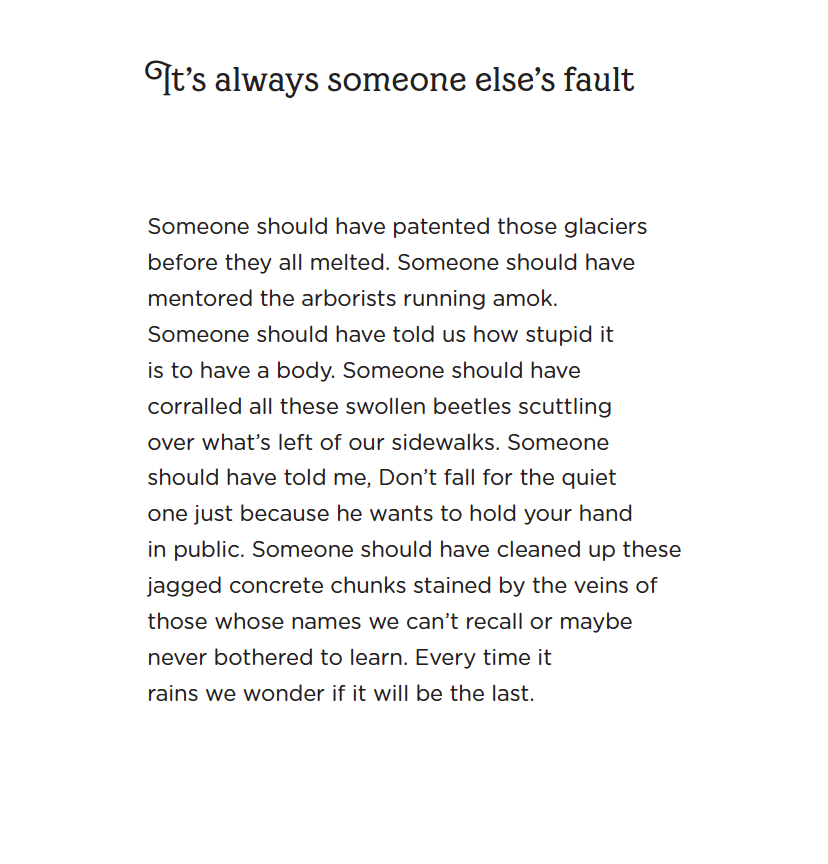
Here, the poet invokes the climate crisis in the first line suggesting a world out of control, one where even those obsessed with order like “the arborists are running amok.” Dating while parts of the world are on fire creates a quiet sense of dread and disillusionment in the poem which is matched by the next lines” Someone should have told us how stupid it/ is to have a body.” The beetles are also an interesting addition (are they an invasive species?), and then there is a whole dating history submerged beneath the lines, “ Don’t fall for the quiet / one just because he wants to hold your hand / in public.” I love the ending which invokes rain, certainly, but also makes it analogous, at least to my mind, to the drudgery and anxiety of first dates: “Every time it / rains we wonder if it will be the last.”
Another sonnet I quite liked plays with language in the way a photographer plays with depth of field. In this sonnet, LoveGrove talks about coix seed, but brings other things into focus through lots of allusions and word-play so the sonnet comes to encompass the trials of Job, beer fermentation, beauty self-care, and ancient currency:
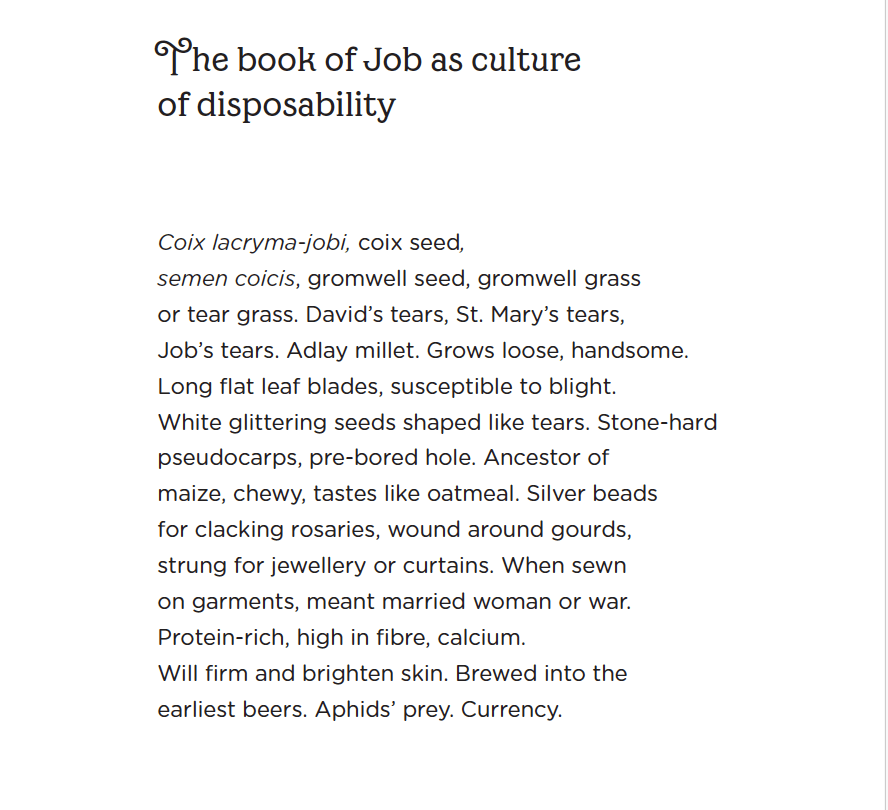
The repetition of “David’s Tears, St. Mary’s tears, / Job’s tears” creates a real rhythmic intensity in the poem, as do the lines “Stone-hard / pseudocarps, pre-bored hole. Ancestor of / maize, chewy, tastes like oatmeal”. Also, the coix seed’s versatility is praised here as if the speaker is envious of its resilience and adaptability which is seen as a natural balm or defense to the disposable culture the speaker finds herself navigating.
Honestly, there are over seventy-five sonnets in The Tinder Sonnets (seventy-five!), and they are full of raw, sexual imagery; punk, feminist syllabics; and allusions to other women writers like Maggie Nelson, Anne Carson, Toni Morrison and Miranda July just to name a few. The design work of the Book*hug team is gorgeous, and the poems deftly move between talk about the user fatigue of online dating apps and modern dating to speaking about women’s safety and harassment at the hands of men.
I don’t mean to gloss over “the spicy bits” of the poetry collection, or the misogyny creeping into online spaces and dating apps that these poems confront, but as a sonnet enthusiast, I’m really struck not only about how much emotional territory these poems seem to take up, but how those confessional moments meet and bump up against the constraints of a 10 syllable poetic line.
I really enjoyed Jennifer LoveGrove’s The Tinder Sonnets out now with Book*hug press, and I can not recommend this sonnet collection enough! It’s sure to be a “must read” this Spring!
Chris Banks is an award-winning, Pushcart-nominated Canadian poet and author of seven collections of poems, most recently Alternator with Nightwood Editions (Fall 2023). His first full-length collection, Bonfires, was awarded the Jack Chalmers Award for poetry by the Canadian Authors’ Association in 2004. Bonfires was also a finalist for the Gerald Lampert Award for best first book of poetry in Canada. His poetry has appeared in The New Quarterly, Arc Magazine, The Antigonish Review, Event, The Malahat Review, The Walrus, American Poetry Journal, The Glacier, Best American Poetry (blog), Prism International, among other publications. Chris was an associate editor with The New Quarterly, and is Editor in Chief of The Woodlot – A Canadian Poetry Reviews & Essays website. He lives with dual disorders–chronic major depression and generalized anxiety disorder– and writes in Kitchener, Ontario.


 The Woodlot