reviewed by Chris Banks
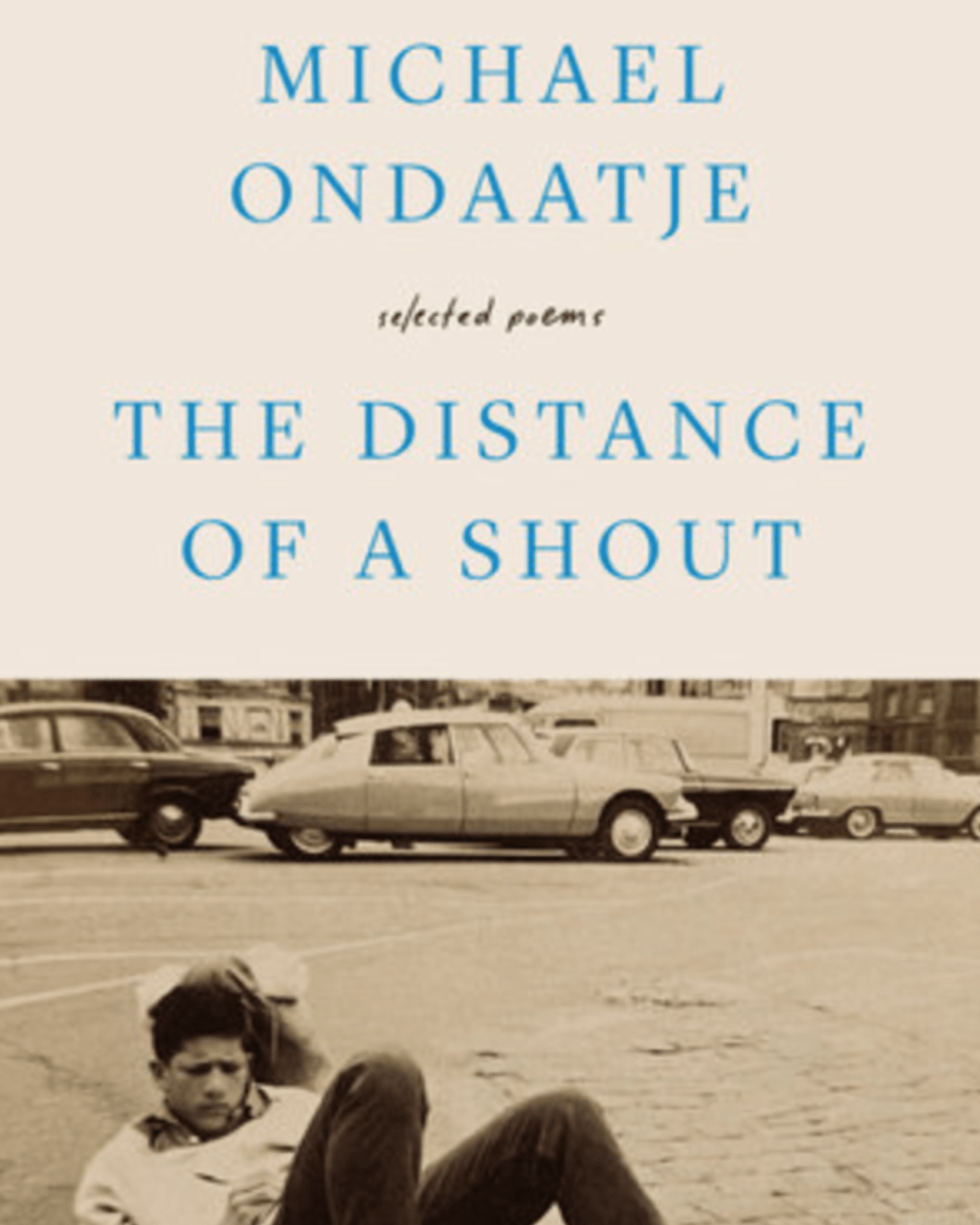
What does one say about a Canadian poetry icon, like Michael Ondaatje, that has not already been said? I grew up after the Canadian Nationalism fanfare of the 1970s, so I encountered Michael Ondaatje’s poetry well after he was an established poet and internationally renowned fiction writer. I remember first discovering a copy of an early volume called Rat Jelly at a family cottage on a rainy day when I was about fifteen, and, of course, later I tried to read all the poetry volumes Ondaatje wrote. I sought out Ondaatje’s early books in the McGill library in the 1990s, especially his first book The Dainty Monsters, but what is so interesting about The Distance of a Shout: Selected Poems is that it reads both like a carefully crafted legacy book, which I suppose it is, but it also, I think, lets slip the mask of the Canadian poetry icon a little to see the real struggle it took, over decades, to write a showstopper of a book like this one, and that struggle is the struggle all poets feel in their battle to shape and shave words into meaning.
Like good poetry, a ‘shout’ differs from normal speech, for it forces sounds, syllables, words and images from deep within the ballasts of our lungs, out into the open with a verbal intensity that not only conveys information but grabs a person’s attention. But a shout is also impacted by the environment it is said within, and for a selected poems written over five decades, that environment is impacted by both time and distance.
After reading The Distance of a Shout: Selected Poems, I think the primary concerns of Michael Ondaatje as a Canadian poet are the same ones the Canadian poet-critic Gary Geddes identifies in an essay on Ondaatje’s long poem “Tin Roof”: place, identity, writing, but I also think relationships, whether these are family relationships; being a part of a community of living and dead writers; or even the ‘erotic’ as Gary Geddes notes about “Tin Roof” in his book of essays Out of the Ordinary: On Poetry and Narrative.
I was really happy to see early poems included in this volume like “Letters & Other Worlds”, which begins with the devastating lines “My father’s body was a globe of fear” and “His body was a town we never knew”, lines that really emphasize Ondaatje’s gift with imagery, but also his command of personal story-telling. I used to teach Ondaatje’s “Sweet Like A Crow”, too, to my high school Grade Nine English students when talking about similes, so I smiled again to read:
Your voice sounds like a scorpion being pushed
through a glass tube
like someone has just trod on a peacock
like wind howling in a coconut
Like a rusty bible, like someone pulling barbed wired
Across a stone courtyard, like a pig drowning,
These excerpts feel hard-won, images deliberate and concentrated, lines so carefully rendered, that it must have taken an immense effort to build these poems toward completion. Going back for a moment to Geddes, the critic Geddes has called Ondaatje “a pioneer of the long poem in Canada”, and in The Distance of a Shout: Selected Poems we have excerpts from many longer works like The Collected Works of Billy the Kid and “Tin Roof,” the latter being linked to romantic odes by the poet-critic Geddes who states, “Tin Roof is a playful, if deadly serious, long poem. For those who know the poet, it is an invitation to reconstruct a stretch of that unofficial biography we call the narrative of self” which is a teasing thought I now extend to include Ondaatje’s careful curation of poems in this new volume of selected poems.
But what is ironic about thinking of Ondaatje’s poems as a kind of unofficial biography or “narrative of the self” is that he wraps his poems in so many different places, and myriad literary allusions–Yang Weichen, Billy The Kid, Thomas Morton, Dante Alighieri, Wallace Stevens writing in Connecticut–that it creates a kind of personal refuge, or personal “thicket”, to borrow a phrase from the American poet Jim Harrison, for the poet’s self to hide in, and thereby “cook down” his life to its essentials.
Certainly this is how I read this lovely excerpt from “Tin Roof” where the poet’s writing cabin becomes a kind of “thicket” at the edges of civilization where one might both lose and find one’s self:
The cabin
     its tin roof
a wind-run radio
catches the noise of the world.
He focuses on the gecko
its almost transparent body
how he feels now
everything passing through him like light.
In certain mirrors
he cannot see himself at all.
He is joyous and breaking down.
The tug over the cliff.
What protects him
is the warmth of the sleeve

that is all, really
I’m not really sure why out of the huge inventory of poems in A Distance of a Shout: Selected Poems, I have chosen this particular excerpt except perhaps because I love the idea of the “self” breaking down so one might better catch a little of the “noise of the world” which speaks to me of writing’s struggle, the intensity of poetic attention, and even hints at how often mental wellness and poetic composition can often be at odds in the line “He is joyous and breaking down” .
As much as it is fun and enlivening to revisit older poems written decades ago by Michael Ondaatje, the real joy of this poetry collection is the newer, more unfamiliar poems a reader happens upon. Often when poets begin to quiet their mind, lose themselves in a new, unfamiliar place, they begin to recognize things not just about the world, but about themselves which perhaps they never knew, or had forgotten. Here in the title poem from the collection, we see both things:
The Distance of a Shout

We lived on the medieval coast
south of warrior kingdoms
during the ancient age of the winds
as they drove all things before them.

Monks from the north came
down our streams floating–that was
the year no one ate fish.

There was no book of the forest,
no book of the sea, but these
are places people died.

Handwriting occurred on waves,
on leaves, the scripts of smoke,
a sign on a bridge along the Mahaweli River.

A gradual acceptance of this new language.
In this poem, we have the older, mature poet remembering a childhood in Sri Lanka, and what strikes me immediately is the deceptively simple precision of the imagery, the winds “driving” things ahead of them, and handwriting occurring on “waves / on leaves” and not just on a sign on a river bridge. What is the “new language” this poem accepts? Poetic attention? A child’s realization of a larger, unfathomable world? An older poet’s understanding that though exiled from that time and that place, he was given “a new language” in those faraway days with which to communicate that exile? I think the poem communicates all of these things. A really lovely poem.
So much of this life tries to contain us–financially, spiritually, individually–that I love reading a wide sweeping compendium of poems about distant places and other times as found in Michael Ondaatje’s The Distance of a Shout: Selected Poems for it really reminds us, as people and for those of us as poets, that beyond the “fences” of city blocks, or even the “fences” we build in our minds, or on the page (for stanzas really are just “fences” for words), there is a restlessness to go beyond, for the heart to search “for the thin border of the fence / to break through or leap.”
The Distance of a Shout: Selected Poems by Michael Ondaatje is a wonderful read, and a fitting “cap” to a lifetime of writing struggle, and in that struggle, discovering the right words to illuminate “the deeper levels of the self” – the “bone geometry” of an individual life attentively and resolutely lived.
Chris Banks is an award-winning, Pushcart-nominated Canadian poet and author of seven collections of poems, most recently Alternator with Nightwood Editions (Fall 2023). His first full-length collection, Bonfires, was awarded the Jack Chalmers Award for poetry by the Canadian Authors’ Association in 2004. Bonfires was also a finalist for the Gerald Lampert Award for best first book of poetry in Canada. His poetry has appeared in The New Quarterly, Arc Magazine, The Antigonish Review, Event, The Malahat Review, The Walrus, American Poetry Journal, The Glacier, Best American Poetry (blog), Prism International, among other publications. Chris was an associate editor with The New Quarterly, and is Editor in Chief of The Woodlot – A Canadian Poetry Reviews & Essays website. He lives with dual disorders–chronic major depression and generalized anxiety disorder– and writes in Kitchener, Ontario.



 The Woodlot