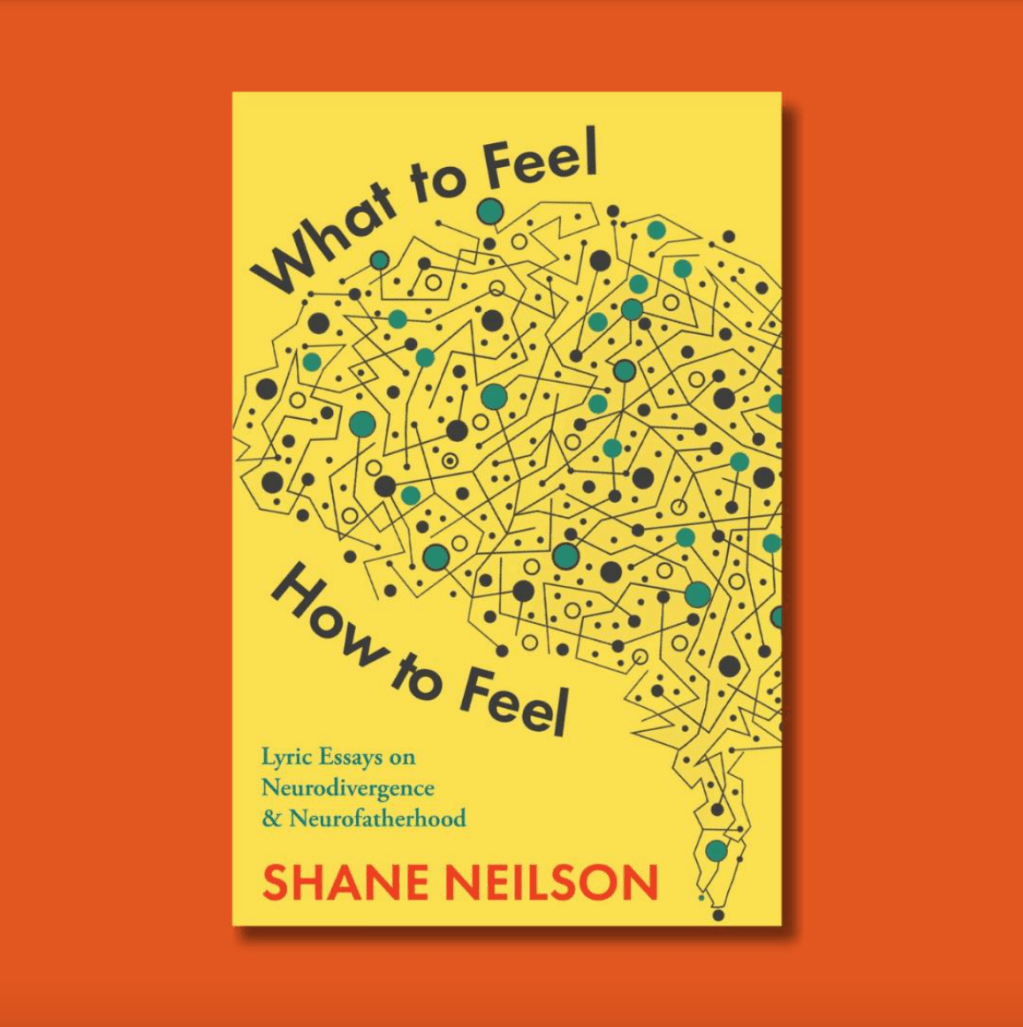
reviewed by Alex Boyd
People are sometimes only dimly aware doctors are human too. It’s among the various not-very-well-addressed concepts discussed by poet Shane Neilson in his immensely valuable book What to Feel, How to Feel: Lyric Essays on Neurodivergence and Neurofatherhood. On doctors learning from their own experience, Neilson states, “The physician’s experienced wound shows the naïve wound how to heal, yet there is less of a hierarchy as one might think. The wounds do not insist on rank, for the physician’s wound is tended to in the act of tending for. A harmonizing of wounds.” Elsewhere, Neilson notes “the physician who can listen for a time without design, who is curious, is a healer.”
If the book begins to sound like a recipe for being a decent human, that’s because it’s something that interests Neilson very much. His father was abusive, but Neilson takes pains to clarify his father didn’t get the treatment he should have had, and how damaging stigma can be: “The mechanism of stigma is to create pariahs, to convert suffering into moral weakness and insult.” Also, “to be neurodivergent does not entail a moral problem, but a lack of compassion shown the neurodivergent does.” Neilson mentions his father once saved a life, and while his own work may not be anything quite so dramatic, he believes in “reducing misery by a fraction each day.”
In a culture that increasingly values speed – sometimes above all things, it seems – the book is an articulate call for compassion. On the patience required to care for his son: “The factory installed a single low gear. If we fall behind, no admonishment can quicken him. This deep understanding of intellectually disabled physics enables me to discern the nature of care relationships in the wild.”
I’m not suggesting these are prose poems, but as a poet Neilson is skilled at staccato bursts of meaning, put to use here in a way I found both effective and refreshingly concise. At times, Neilson writes in an academic but still accessible way, clarifying the term “borderline” as “an accident of history, a name echoing forward to the present even though it contains little (but not quite zero) descriptive usage. A better name is ‘emotion regulation disorder’ because it accurately conveys the central symptom of the condition and is less pathologizing. Surely everyone can be a little emotional.” On other occasions, Neilson sounds more like he’s thinking things over: “The human soul, often exclusionary and mean, finds distraction in baubles and screens. We all seek the same thing – beauty. The clouds move by my window hour after hour, each one made of the same material, and yet unlike the last. I have never seen a human soul, but I have detected the darkness in bodies. Perhaps seeing a soul, seeing the ‘human,’ is a condition of normativity?”
Of course, humans care about meaning and significance, not just beauty. But it’s simply a section of the book Neilson is speaking more poetically and searchingly. The way the book shifts gear kept me engaged from start to finish. More importantly, I learned from this book, and I admired it.
Alex Boyd’s upcoming book of essays is called Take This for the Pain: Essays on Writing and Life.

 The Woodlot