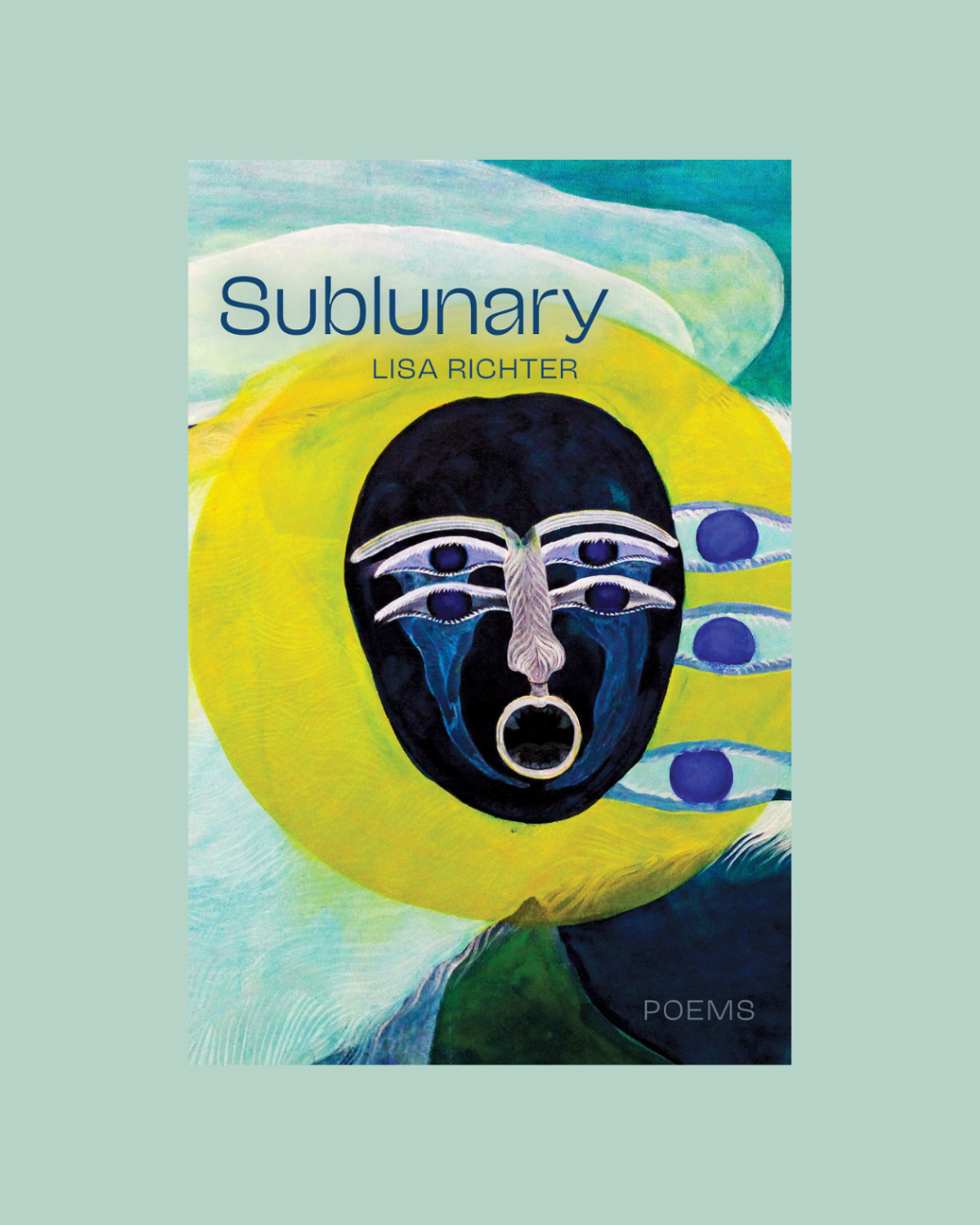
reviewed by Chris Banks
In the opening poem ”Staying Power” of Lisa Richter’s new poetry collection Sublunary out with University of Alberta press (Spring, 2026), the poet Richter writes, “I stayed passionately attached to the world / despite the systems conspiring to sever us” and later in other sections of the book, she admits “Some days it feels like all I do is reset forgotten passwords” or “How many years of my life / have I wasted trying to find matching lids for Tupperware containers?”
What are these systems conspiring to sever us? Routine, Late Stage Capitalism, financial precarity would be the ones I would buzz in if this were a gameshow, and not a poetry review, but lurking behind these modern plagues are other older, perennial systems that conspire against us: time and death.
The prescription for Richter, it seems, is to make one’s life fabulous, a fable, where the marvellous can bump up against the mundane in a poem, the surreal can be a way if not to escape ourselves, but to enlarge our one wild precious life.
In Sublunary, the poet Richter often uses repetition as enchantment, and juxtaposes dreams hitting the firewall of realities; there are poems about fathers and escape rooms; poems that strip us down to our nervous systems; poems that remind us “ Another year, another body”, that this world is not so much a globe but a crucible of change, so her poems, our poems, better reflect that. Topics range from “Self Portrait as Demolished Supermarket” to an Italian abbot Lancelotti, to fantastical yard-sales, to mood boards for artifacts of lost civilizations. As the poet says in her poem “Whatever It Takes”, she is “Parched / for anything the least bit fabulous”, anything that might help console us who are trapped in single-use bodies, and therefore experience only a fraction of this world which is a theme Richter plays with in a poem called “Onism for Beginners”:
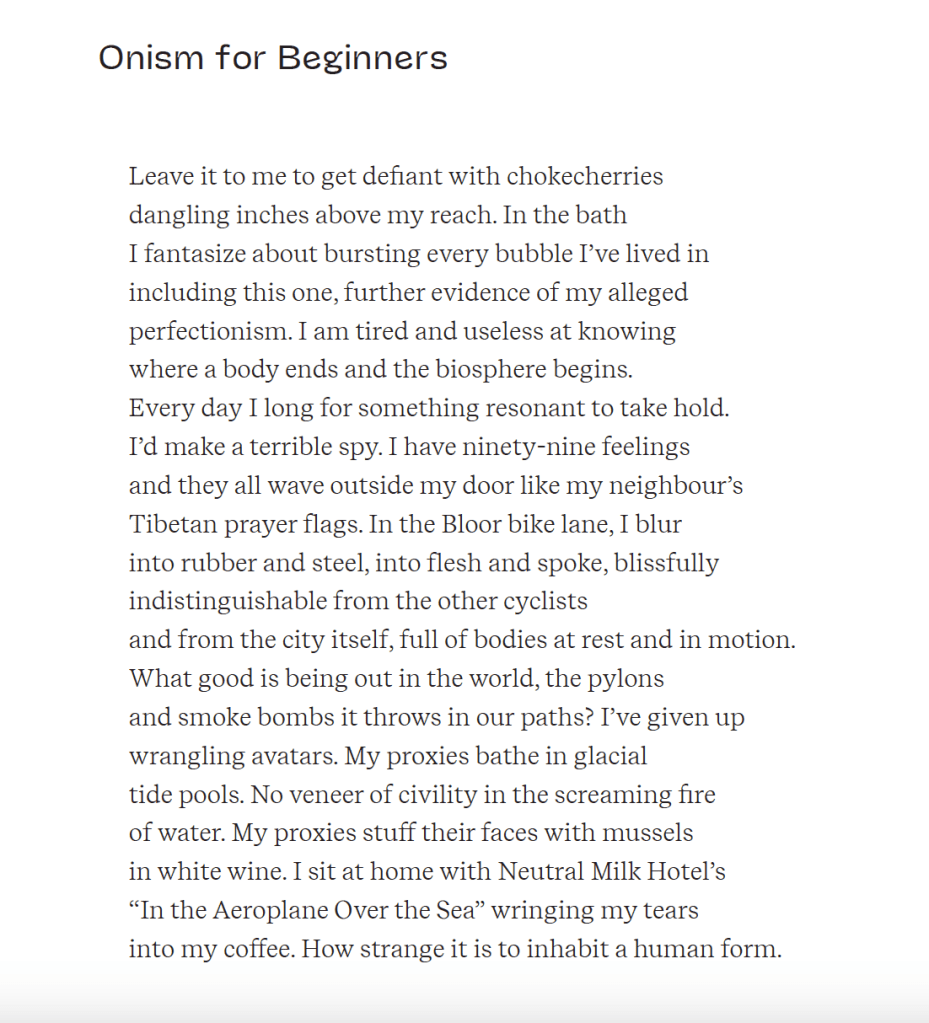
I can relate to the idea of not knowing where “a body ends and the biosphere begins” and longing for “something resonant to take hold.” The whole poetry collection really leans in to some fantastical, dream-like imagery where “The ocean postures like a photographer/ beneath a black cloth,” or from the same poem, “At night / it is so quiet you can hear a child’s /cough echoing across the harbour” and I guess, if I’m asked, I’ll take a little incantatory ‘word-magic’ like this over the workaday capitalist world and “its pylons and smoke bombs it throws in our paths.”
Yes, how strange it is to inhabit a human form. How strange indeed. I think this is one of the central questions of Lisa Richter’s Sublunary. Why just be a human being if we can also be “all manners of sparrow / and scarab, anthracite and fire opal.” The book is trying to open people up to wonder and awe.
In terms of structure, the book is broken down into three sections with poems in long uniform lines pouring down the page, poems in couplets and tercets and quatrains, poems that look like prose but in ‘surreal’ poetic clothing. And yet, going back to what I said earlier, not everything is incantatory and wondrous and fantastical as some of this book really lingers on the things of this world we cannot change with the stroke of the imagination, things like how time and a father’s death can change us.
There are many poems about the poet Richter’s father who died of an aneurysm some years ago, and the poet confronts this loss in the title poem:
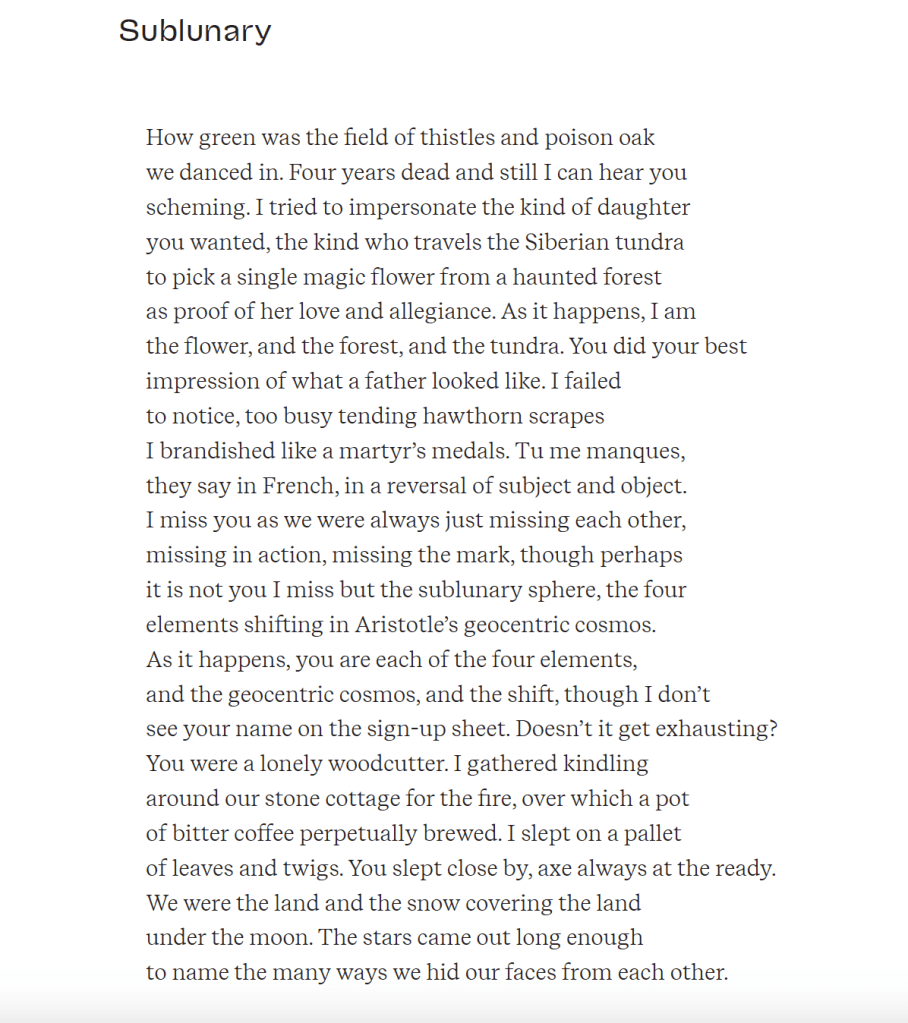
This poem is not just about the loss of a missing father, but about the ways he hide our true selves from each other, and perhaps by no fault of our own, so we take on roles –father, daughter, poet, woodcutter– and as much truth-telling as there is in this poem, Richter also makes it a kind of fairytale where the father is a “lonely woodcutter”, where “you slept close by, axe always at the ready”. Fathers are triggering subjects for many poets. This poem attempts to not separate the myth from the man but to stitch the loss of him, his absence, into the fabric of a family fairy tale, one that can be read and understood and appreciated, without hiding the fact “The stars came out long enough / to name the many ways we hid our faces from each other.”
In Lisa Richter’s Sublunary out with University of Alberta press this Spring, there is an abundance of extraordinary images, word play and dare I say ‘word magic’ trying to push aside both the quotidian and the familiar, in such a way so we, as readers, might escape our own looping internal monologues and pressing responsibilities long enough to remember this life is a miracle, a fairytale of our own making, where family and fathers and poems help us navigate a difficult world, a world that rarely shows what is truly important, or extraordinary, or fabulous, on its surface. This is a terrific collection of poems and I hope everyone has a chance to read it this Spring!
Chris Banks is an award-winning, Pushcart-nominated Canadian poet and author of seven collections of poems, most recently Alternator with Nightwood Editions (Fall 2023). His first full-length collection, Bonfires, was awarded the Jack Chalmers Award for poetry by the Canadian Authors’ Association in 2004. Bonfires was also a finalist for the Gerald Lampert Award for best first book of poetry in Canada. His poetry has appeared in The New Quarterly, Arc Magazine, The Antigonish Review, Event, The Malahat Review, The Walrus, American Poetry Journal, The Glacier, Best American Poetry (blog), Prism International, among other publications. Chris was an associate editor with The New Quarterly, and is Editor in Chief of The Woodlot – A Canadian Poetry Reviews & Essays website. He lives with dual disorders–chronic major depression and generalized anxiety disorder– and writes in Kitchener, Ontario.


 The Woodlot