By Chris Banks
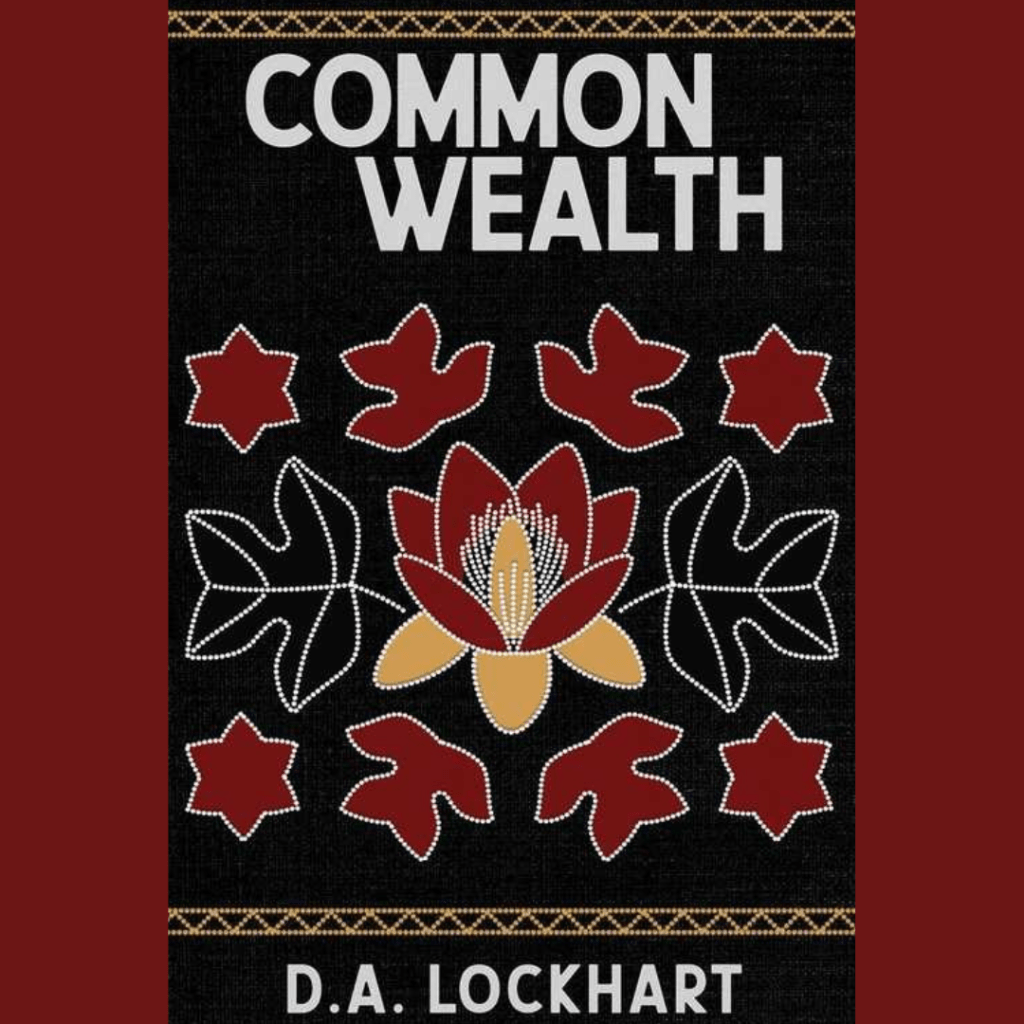
I am super impressed with D.A. Lockhart’s latest poetry collection Commonwealth (Kegedonce Press, Spring 2025), not simply because of how many terrific poems there are in this book, or that most of the book is written in proper feet (the poet deviates from an eight syllable to a ten or twelve syllable line often, but it was enough for me to notice), or that Lockhart mentions one of my favourite American poets Hayden Carruth, but honestly, it is mostly because this is an unabashedly lyric collection of poems, and lyricism to do well requires two things: paradoxically stillness and restlessness – and in “Commonwealth” you get the complexity of both.
Lockhart’s book is divided into five sections – Òsaohane, Ahchuwikee, Mëkëkèkink, Anukanink, Kitutènay Shinkàskunk – which translate to Across The River, Among The Hills, On The Prarie, Muddy Place and Large City In The Swamp. Lockhart has lived both in the States and in Canada, and as an Indigenous poet, part of his poetics is to see the land as his ancestors saw it which requires a kind of meditative stillness, a vision or insight that can see past the borders, and expressways, and dirty city streets full of “the metal tang of exhaust” to the hills and black earth that is home.
In an essay entitled “Lyric Yoga” by American poet Stanley Plumly whom I imagine Lockhart has read, Plumly states stillness is “inwardness and a way to prepare to speak, the deep dream…. …..Writing be[comes] the restlessness answering the stillness.” I choose this quote to talk about D.A. Lockhart’s Commonwealth because the poet Lockhart is paying witness in his contemplative poems to the places he has lived (and the places his ancestors knew and he tries to see) which is to remember these are the same places. The old is in the new. Rivers, hills, skies, earth– these are the archetypes of home, and it is through this type of archetypal witnessing, and the restlessness of a poet’s imagination to make sense of such witnessing, that the poet can gain the wisdom and insights of his ancestors. For instance, take the opening of Lockhart’s long title poem “Commonwealth”:
The land to the south of here is
called by its people a Commonwealth.
It is not our land. This earth beneath us
calls for roots, black earth. And the old
church reaches beneath, staring down
the Ohio as it passes, always moving,
always telling us there is life when we
fail to see it. We understand that our
kikayuyëmënaninka knew the hills,
the trickle of waters, the subtle shifts
between seasons, the manner earth
beneath them breathes, makes home.

In this opening stanza, there is reference to the poet’s kikayuyëmënaninka, or ancestors, who knew “the hills, / the trickles of waters, the subtle shifts / between seasons” which are not simply images, but a kind of archetypal experience passed down from generation to generation. In a different essay by Stanley Plumly entitled “Autobiography and Archetype”, he states, “When Wallace Stevens writes that you must become an ignorant man again and see the sun again with an ignorant eye and see it clearly in the idea of it, he is focusing on one of the things basic to an archetype, which is its original sense of itself.”
Lockhart is trying to get an original sense of the land, to see it before it got ruined, or if not ruined, before the churches and expressways and the governments were built upon it.
Up to this point, I have talked a lot about D.A. Lockhart’s lyricism requiring stillness, a kind of inner witnessing, in order for the imagination to restlessly give form to the poet’s experience as a modern Indigenous person who has lived both in the States and Canada, but now I want to talk about the technical prowess of the poetry. I loved the poem “Outside Cincinnati” where Lockhart contrasts an interstate arriving like an afterthought and the “Slow crawl traffic / through sharp-edge debris / of past commutes gone wrong” with his scanning:
each hillside and every rooftop
for evidence that all before us
could have arisen from land
I know of through ancestral
blood echoes, long-quieted stories
of wars between mastodons
and the breadth of creation.

Hayden Carruth once said, “The eye has knowledge the mind cannot share.” I would simply add so does the blood. I think Lockhart’s poem “Outside Cincinnati” is about both of these things simultaneously.
Another favourite poem for me was Lockhart’s poem “Behind Greer Street Our Night Fills with Howls” which I include here in its entirety:
Two cats face off
with night terror
howls behind Greer
Street, homes wreathed
in desiccate vines akin
to those climbing
viaduct walls behind.
Howls fill a night
between the passing
of freight trains,
oil cars aplenty,
and in the open door
to the gallery behind me,
Cincinnati fights against
a new moon softness
through two-turreted old
growth neighborhoods
Above viaduct tracks
in immaculate light
of Church spires, backlit
double crucifixes against
cold spring clouds
that threaten more rain
to muddy mean Ohio.
I shut the door, am left
with old man grumbles
of another passing train,
glass block windows quiet
atavistic feline battles,
domesticate this night
bracketed by the passions
of feral cats, and that
which cities fight against.

There is so much to love in this poem. The exacting concrete imagery of freight trains and “atavistic feline battles”, the four to six syllable lines, and the stark contrast between “backlit / double crucifixes against / cold spring clouds.”
The last excerpt I highlight here comes from a poem entitled “Two Poets Discuss Migration and Ars Poetica over Pho at Lucky Pho 77, Chicago, Il.” which is subtitled, “a mediation on Kazim Ali and Hayden Carruth and Arrivals”. I found this particular passage lovely:
Believe that the sweetest portion
of broth comes from that blue
of the lake nearby. Those waters
in constant commotion, free
in everywhere from time, naming,
borders, the exchange of goods.
We dwell and dine near the ether
that feeds dreams of promised lands.
Dreams racing from distant river
town sweet ramen through to this
inland sybaritic pho broth, we shuffle
chili oil spoons and oyster sauce in
patience, between all the words
that we understand to be stuck
in the mud of distant places, we
are men that carry ancestors closely,
listen to the whispers across myth,
across the borders we weren’t meant
to cross. Nations are the lies we tell
to hold people in place, ensure
that economics and power favor
land thieves and their apologists.

I guess what I like about this middle stanza is again the ideas of waters being a primordial archetype free “from time, naming, / borders, the exchange of goods.” Furthermore, the ending of this stanza too is also poignant in its condemnation of nations which “are lies we tell / to hold people in place, ensure / that economics and power favor / land thieves and their apologists.” This is OG knowledge, archetypal wisdom, that Lockhart’s ancestors knew, and we ignore at our own peril.
D.A. Lockhart’s latest poetry collection Commonwealth out with Kegedonce Press uses poetic structure masterfully, of which I have only given a mere taste, and descriptive imagery, but also a kind of lyric intuition that comes from being still, and witnessing, trying to reconcile the old ways with the new, the cities with what came before, and to understand, no, to “see” the rivers are alive and run preeternally through all our lives still. This is a wonderful book which I cannot praise enough. Go out to your local bookstore and pick up a copy for yourself!
Chris Banks is an award-winning, Pushcart-nominated Canadian poet and author of seven collections of poems, most recently Alternator with Nightwood Editions (Fall 2023). His first full-length collection, Bonfires, was awarded the Jack Chalmers Award for poetry by the Canadian Authors’ Association in 2004. Bonfires was also a finalist for the Gerald Lampert Award for best first book of poetry in Canada. His poetry has appeared in The New Quarterly, Arc Magazine, The Antigonish Review, Event, The Malahat Review, The Walrus, American Poetry Journal, The Glacier, Best American Poetry (blog), Prism International, among other publications. Chris was an associate editor with The New Quarterly, and is Editor in Chief of The Woodlot – A Canadian Poetry Reviews & Essays website. He lives with dual disorders–chronic major depression and generalized anxiety disorder– and writes in Kitchener, Ontario.