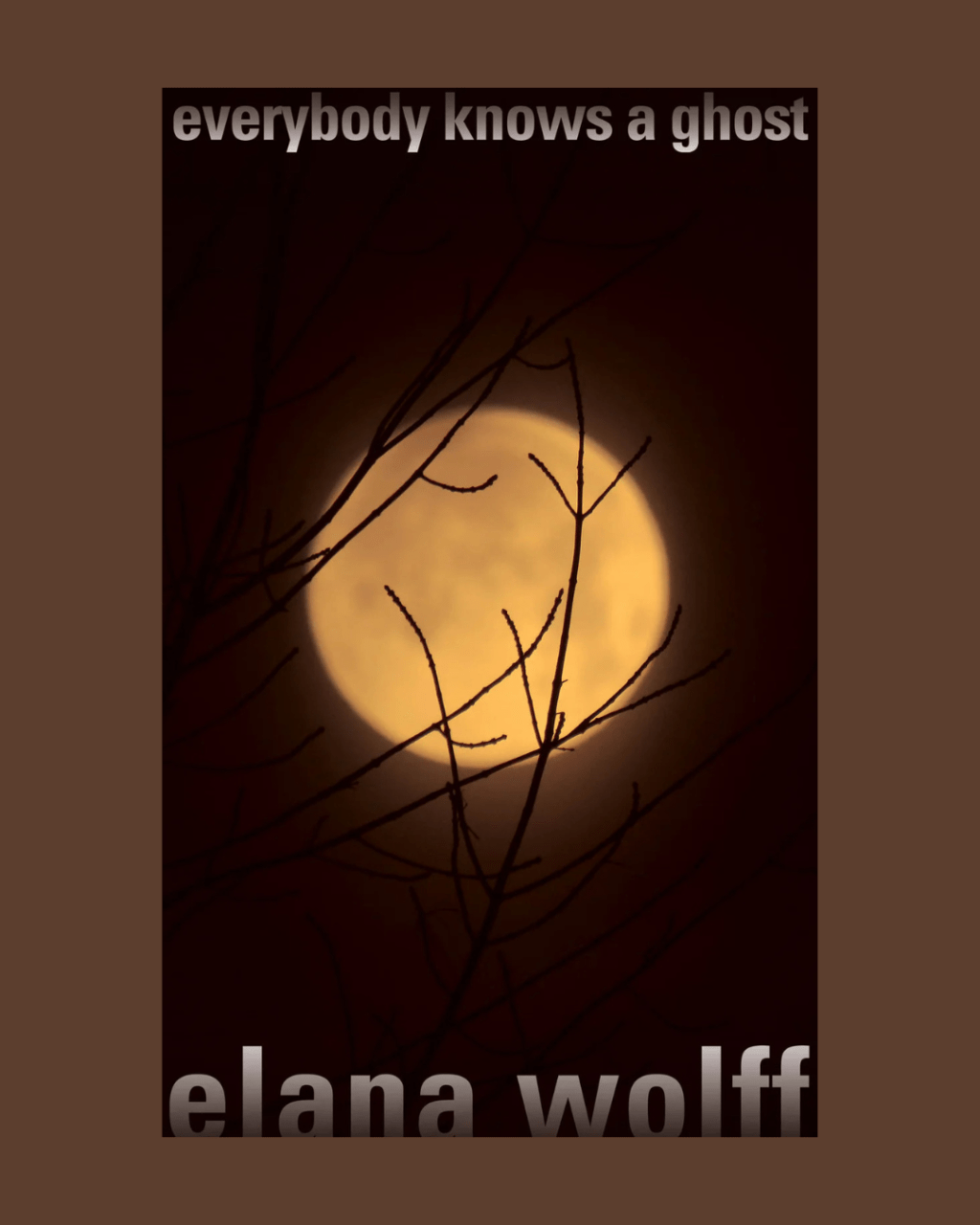
Reviewed by John Oughton
Elana Wolff is not an easy poet to read, but there’s no doubt that she’s a very good and original one. I know nobody else who writes the way she does. As for the worth of her work, even though my opinion may be favourably biased (full disclosure: she’s a long-time friend, and fellow member of the Long Dash Group), she wouldn’t have published eight previous collections, won various awards, or had seemingly every one of the poems in everybody knows a ghost accepted by journals and anthologies, without her work conveying excellence. While staying with free verse and only occasional rhymes, she uses a variety of stanza lengths and indents. Several works in this collection resemble ghazals, both in their use of couplets, and the sudden leaps between them.
I’m going to try something a bit different in this review: offering four keys to “getting” this collection. Before I Introduce them, though, why put “ghost” in the title? The author helpfully provides an etymology of the word, which concludes with “Disembodied spirit<faint semblance<haunting memory<slight trace.” In other words, her concern is not only with actual phantoms, but with echoes, memories, and the way everyday things can become eerie at times.
Here’s the first key: Emily Dickinson wrote “Tell all the truth but tell it slant —Success in Circuit lies.” This prescription for poetry is not straightforward statements and assertions, but an indirect approach. Wolff does circle around “all the truth” – which includes mentions of medical difficulties, the Holocaust, relationships, and death – with allusions, imagery, and emotions. Certainly, she also tells it slant. Some readers might wonder what a poem like “Gloss” is about, as it begins:
Blue at the back of the trees—
the tarp that never has to be fashioned,

air on air:
The chariot that crossed the sky on wheels in wheels

a fugitive
to every revolution.
There are references to a landscape and Ezekiel’s wheel here, but it’s the kind of poem you have to feel rather than understand: a progression of images and observations that lead up to the penultimate stanza, which says in part: “If you lose the words, just think in pictures.” And the title “Gloss” has, like many of Wolff’s terms, a double meaning. Superficially, it is the sheen on certain types of paper and paint. But in academic circles, refers to writing about a text – sometimes in the margins, or as a translation of it. The poem, then, is a kind of gloss on Wolff’s thoughts and emotions at a particular point in time and space.
A second key is magic. She often takes an experience or memory and pulls something surprising from it, rather like magicians removing their top hats and extracting a live bunny or pigeon. A good example is “Noon.” It starts with that time of day, “a slender slot on the clock.” But she finds herself humming an old song, the title tune from a Gary Cooper western, High Noon. And it ends – look what was in the hat! – with a fragment of dream she recalls: “the baby was located—/ deathly still yet breathing in the dust beneath the couch.”Third is ellipsis. Not only the punctuation mark of three dots trailing off, but of a device in syntax… omitting a few words that would normally be included for the sake of grammar. Symbolically, it can also represent the kind of comment someone makes that is intriguing yet mysterious, lacking context. In the poem “Tapioca,” one of my favourites here, after a discussion of Wolff’s favourite food(s) and her “fella’s”, she directly refers to this technique in the final stanza:
Luckily, my fella is discreet. He knows to leave
some things unasked, unsaid.
Ellipsis is a fine device—in writing, also in life.
That emphasis on what is left out – the link, the connector, recalls both the methods of “tell it slant” and the ghazal.
The final key I offer is jazz. In some ways, it is the most challenging form of music to perform, as players not only have to reproduce the chords and melodies indicated by the composer, they have to be ready to solo at the drop of a hi-hat, weaving something new while referring to and quoting parts of the composition. Where the melody calls for a B-flat, the sax player might intuitively drop in a B, for a startling or bluesy sound. Wolff, as she is writing her poetry, seems to test words similarly to see if they feel right, often choosing something rare or unusual, improvising with both the tone colour of words, and with their meanings. She mentions this process with lines from “Impromptu with an Empty Pen”:
Let’s navigate by plain first lines
that link to closing words
like knell and nugget.

While “knell” does echo earlier lines about time and short days, why “nugget”? Because it sounds right. “Impromptu” incidentally is a musical term: Google says “a free-form, usually short solo piano piece designed to sound improvised or "unprepared."
Bottom line? If you read this assured collection with an open mind, it will take you to many places and feelings, in a style that is unique. Buy it.
John Oughton first lived in Guelph, a block away from the birthplace of “In Flanders Fields” poet John McCrae. After sojourns in Iraq, Egypt, and Japan, he now resides in Toronto’s Beaches area. He studied literature at York U. with Irving Layton, Eli Mandel, Frank Davey, and Miriam Waddington, and later completed two non-credit summer sessions at Naropa U.’s Jack Kerouac School of Disembodied Poetics in Boulder, Col., where he was research assistant to Allen Ginsberg and Anne Waldman. He has published close to 500 articles, reviews, blogs, and interviews, as well as six full-length poetry collections, the most recent being The Universe and All That (Ekstasis Editions), and several chapbooks (most recently, Double Vision). He has also written a mystery novel, Death by Triangulation; and Higher Teaching: A Handbook for New Postsecondary Faculty. John retired as Professor of Learning and Teaching from Centennial College, where he taught English and then led faculty development. His current pursuits include guitar, photography, and kayaking.