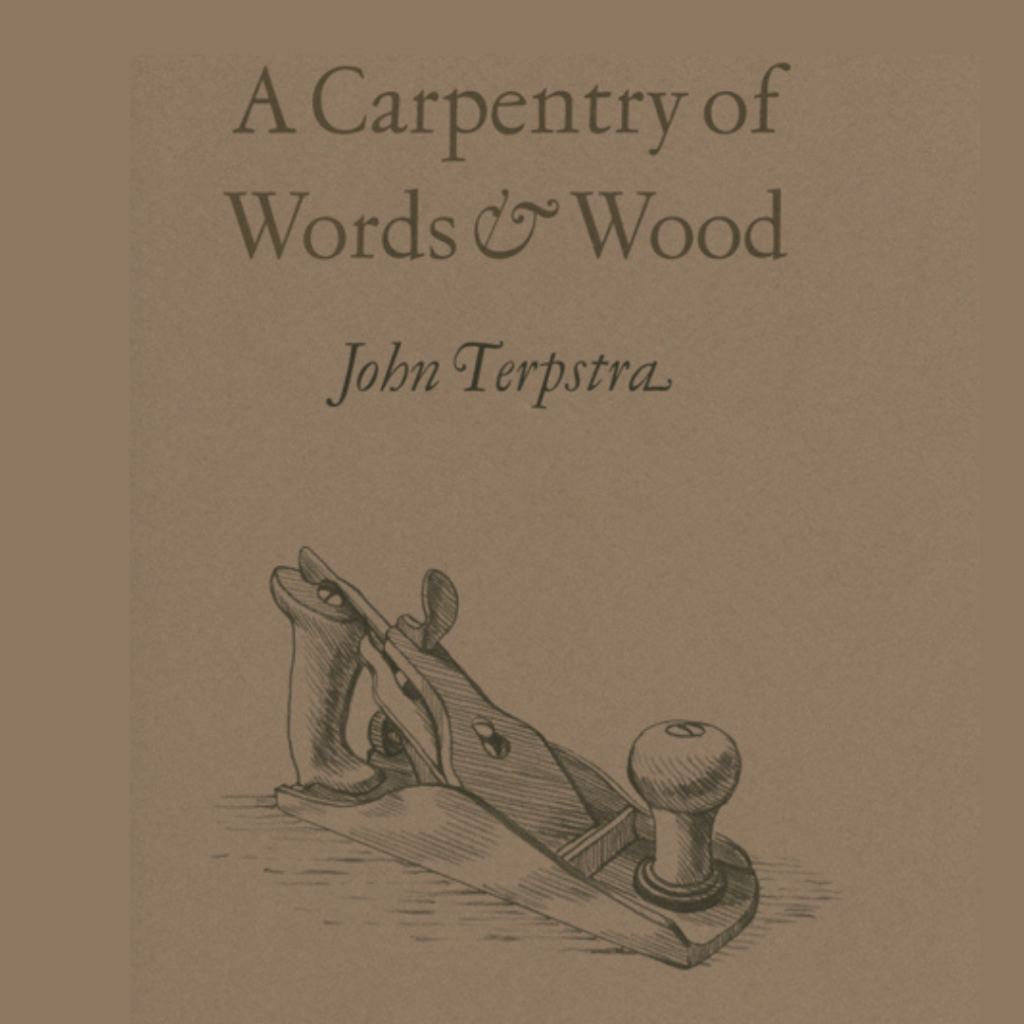
Interviewer Xavier Ibraheem talks with John Terpstra about his latest book, A Carpentry of Words & Wood
Xavier Ibraheem: I’m happy to talk with you today about your latest book published with Gaspereau Press, A Carpentry of Words & Wood. If I may be so presumptuous as to insert myself, I found your book compelling from the perspective of my short-lived career as an arborist.
To give us a ballast, I’d like to know your thoughts on the purpose of wood and trees in our lives. They provide us with oxygen, life, but they also provide us with the material to construct material necessities like cribs, coffee tables, coffins. The tree’s wood follows us from life until death. What do you think?
John Terpstra: I think that, like us, a tree and the wood that comes from a tree, also has a life cycle. And like us, it will decay and return to the earth from whence it came. The trees are our brothers and sisters. They speak a language it can take a lifetime to understand. One of the ways of understanding that language is through making things from their wood. There are other ways. Climbing into their branches, for instance. Breathing in. It is our responsibility as human beings to try and learn the languages of trees, and their many dialects. For we carry the pruners and chainsaws and have the power of life and death.
XI: In a previous interview with Mary Kenagy Mitchell, you mentioned you enjoy the “larger canvas” of nonfiction, and how it provides a “longer thread that [you] can follow as it winds itself who knows where.” Is this statement true to the composition of A Carpentry of Words & Wood? Was weaving this particular tapestry about the same experience as previous works?
JT: This book started out with me wanting to write only about my woodworking career. Talking about my writing career, such as it is, felt a little too self-involved. I’ve never reached the bright lights, so what’s to tell? I had forgotten that I had gotten into woodworking specifically because poetry was my life-track but I did not want to place the burden on it of having to provide me and my loved ones with a living. Woodworking presented itself as a way to keep myself out of trouble, financially and psychologically. So the two are inextricably interwoven together. I am not inwardly constituted for a career in teaching or academia, both of which, I thought, would anyway make too many demands of the same side of the brain. Keeping my hands occupied by making things out of wood turned out to be just the right balance to making things out of words. I was a third of the way through writing this book before the realization hit me. At which point I returned to the beginning and began to weave a writing thread into the narrative.
XI: I would like to speak more about that point. How are the experiences of woodworking and carpentry, and composing poetry, prose and memoirs, connected? I presume there is a certain amount of catharsis in both acts, but I want to know your thoughts on where they intersect and diverge. Was woodworking just a way to make a living to support writing? Is the pen merely another tool?
JT: It’s the same person sitting in a chair, at a desk, or standing behind the table saw. Making something out of wood, especially cherry, is hugely satisfying. And it is tangible, physical. Making something out of words is less tangible, perhaps, but more soul-satisfying. It’s closer to the core of what it means for me to be a human being with something specific to do on this earth. It aligns my stars. I love woodworking, but I can also retire from it after forty years and not feel bereft or as if I’m missing a limb. I can’t see retiring from writing. It doesn’t mean that it won’t happen, but if it does happen it will not have been my choice. Writing poetry and making furniture are complementary in many ways, but I resisted making a connection for a long time, because it just seemed too cute: the poet-carpenter. Give me a break. I have slowly relented. I shape words, and I also shape wood. The assemblage of disparate parts that go into a piece of furniture is definitely analogous the way meaning is constructed in my longer, non-fiction narratives.
XI: In the opening of the book, you write that “Humans exist by creative destruction. There’s no evading that reality.” Isn’t there some sort of irony in putting creative life/inspiration into poetry and woodworking, using trees we have killed?
JT: The quote about creative destruction comes from the Australian novelist, Tim Winton. When I first read it, the book I hadn’t yet begun began to coalesce in the backrooms of my mind. He hit on the head the nail that I hadn’t known I had patiently been holding all this time. We, especially we “creatives,” do not want to think of ourselves as destroyers. We are makers, builders, contributors to the cause. It’s a positive impulse. No one was hurt or injured in the making of this table, this dresser, this published poem, this painting. Yet at the very least a tree has died—to make wood, to make paper, to make a stretcher. Is it ironic, or simply how it goes on planet earth? It is our lot in life, it seems, to bring death to the natural world. We kill and eat plants and animals, as we must, in order to survive. Does any new life come without some kind of death? Maybe life and death are not a binary. Maybe one doesn’t cancel out the other. Indigenous peoples were much more attuned to this reality, and they showed much more respect for it and the natural world than we can seem to muster. Of course, they held a more sacral view of the world and had not learned to commodify.
XI: The march of the markets comes for us all. I’m quite intrigued about the commodification of a tree’s existence. Or rather, our seeming lack of attunement/respect to the value of the landscape and trees, their purposes and intertwinement with our lives of killing in order to live.
More to the point to your book, I’m thinking about the tree which provided shade to the elderly gentlemen being removed from Victoria Park, in the fifth chapter (as I refer to each section of your book), “Un-X-Ing Trees.” Where do we draw the line between a justified removal of a tree and a bureaucratic decision to maim the landscape?
JT: Don’t get me started. Urban parks are often at the mercy of landscape architects. I think that any landscape architect truly worth their salt would first familiarize themselves with the park that they were about to redesign, and learn to respect it—as it is. They’d introduce themselves to the denizens of the park, including its trees. Especially its trees, since for the trees this is home. It is where they were planted and grew. Where they hope and plan to grow old and broaden their contribution to the natural and social fabric. Generations have come and gone, neighbours have moved in and out, while the trees have stayed, here, in this one place. They have made it a place. For a landscape to be reduced to lines on a piece of paper or a computer screen, and the natural and built elements of that landscape moved around or removed as though they did not exist on the ground, as if they were inanimate pieces of a puzzle, is professional arrogance and the highest form of disrespect.
XI: It seems to me as if a lot of our aesthetic decisions (made by bureaucrats) are predicated on arrogance and disrespect for the value of objects, reducing them to statistics or obstacles rather than extensions of our natural world.
I’m a product of the information age. Whenever I have a line for a poem or a certain metaphor I’d like to explore I tend to write it down in my notes app. I was wondering what this process of composition looked like for A Carpentry of Words & Wood. Was it jotting down recollections whenever they came up, between shop sessions, or did you have a certain schedule for recalling and composing? How did you know what to turn into prose and what to turn into poetry?
JT: I jot not, neither do I journal. The writing of this book follows the same pattern as my earlier works of non-fiction. It started with a paragraph or a page. The paragraph or page suggested a further paragraph, not on the same exact subject, yet somehow related, suggested by the subject. Related in a way that will become apparent (to me as well) as the narrative meanders forward. It is an intuitive, riverine process. One that I have learned, and must constantly relearn, to trust. To mix the metaphor, my mind is something like a tree, I think. A fruit tree. It’s got all these branches. I reach and pick an apple. There is something about that one apple. While chewing on that one apple, another apple from elsewhere in the tree catches my eye, and I go to pick it. I say it catches my eye, but really, I am blindfolded during this process. So I’m not really sure how it works. The second apple could actually be a pear. If I am on a productive track, there is a certain hum in the orchard and in the tree, in the apple, the pear and in me. The hum is crucial. My prose writing is a poetic process. Poem, pome.
XI: In the 69th chapter you pose a question about one tree springing to life while the others remain stagnant. I was wondering about the symbolism here. I’m reminded of Lao Tzu, “the flame that burns twice as bright burns half as long.” Do you think of the poets and artists you’ve encountered as swaying while others remain stagnant? Is it better to burn out than fade away?
JT: Stagnant is a strong word. How about stunted, since we’re still talking about trees anyway? When I was in college and university, there were any number of other students who were writing poetry, and much better poetry, honestly, than anything I was coming up with. Not that I came up with much. I was pretty stunted myself at the time. Inhibited. Unsure. My saving grace, or burden, was the lack of choice in my future. I had to keep at it, one way or the other, or die. Slowly and painfully. The others, most of them, seemed to be able to take it or leave it. And leave it most all of them did. I have not seen or read of them since. Except for one. And I haven’t seen anything from her for a number of years. I suspect that my more poetically gifted peers were also gifted in other areas and were thus free to launch other careers, perhaps more in keeping with their true selves, or better paying, leaving the poetry to one-trick ponies like me (two tricks, if you include the woodworking).
XI: Stunted is definitely a much better word. I was hoping you’d be willing to share some authors or artists that have left a particular impression upon you. Each person is drawn to writing in their own way through various means. Who or what comes to mind when asked for recommendations and what has inspired you into channeling your creative energy?
JT: The writers that influence a person most come earliest, I think. At least they did for me. My models will not be as current today as they were when I was young. The first poet to truly gobsmack me was Richard Wilbur. He was so different than any other poet at the time. Formal in style, yet informal in speech. The everyday as sacred. Totally different than T.S. Eliot, whose liturgical style and almost over-serious intent I also found resonant, and irresistible. My first novelist was John Steinbeck, with his love of people on the fringes, social conscience and the poetry of his prose. Upon first reading John McPhee’s “Coming Into the Country”, I knew that I also wanted to write non-fiction, someday, and it came true, although my non-fiction is world’s apart from his. I don’t know what to do with the fact that none of these writers are Canadian, or female. Then along came David Jones. I was introduced to him by William Blissett, who taught English at the University of Toronto and was a friend of the Anglo-Welsh artist and poet. Bill died recently at the age of 103, may light perpetual shine on him. The writers that influenced me most are, of course, particular to me. They spoke to my needs and desires. They were my signposts toward what was possible, and my models for how to do it. In the end, I had to kill them all.
XI: In the 94th chapter, “Artists and Poets,” you quote Catherine Gibbon as saying, “there is little encouragement to the person who wants to be serious.” As you are someone who has been in the field of poetry and writing for a considerable amount of time, I was wondering if you had any words of encouragement or advice for emerging poets, writers or artists trying to find their ground, wanting to be serious.
JT: My two words of encouragement are persistence and community. If you are like me, you will not need to be told to persist, to simply keep doing it, because really, what choice do you have? Not to be too dramatic about it, but do it you must, or die. And that’s whether or not you receive much outside encouragement. Don’t be surprised if you have to recommit yourself to the cause at various times along the way. Community may first arrive in the form of workshops or writing groups, those bands of other wannabe poets and prosers with whom you can share your work. Hopefully, these will be a mix of those who are in it for fun and leisure, and those who are just as serious about their fun as you. The time will come when you will have to share your work with a wider audience. It is possible to cultivate a live audience locally. Find a venue. Recruit other band members to fill out the bill. A reading audience is good too. Submit your work to the journals. Lately I have also found myself taking the time-honoured path of producing chapbooks of my own work. A friend with graphic design savvy organizes the guts, while another friend designs a cover. I send the finished document to a local printer, have 100 copies made, and then head out to the local independent bookstores, who are happy to stock 10 copies or so, especially if you have provided an ISBN number (which is not difficult to apply for), allow them their usual 40% cut, and tell them that the proceeds will go to a local charity. The feeling of satisfaction that comes from having launched a series of poems into the world can last for months, and you’ll be surprised at how many copies you sell. Perhaps this sounds a little too downhome and lowkey, unambitious even. That’s the self-employed, woodworker side of me coming out. You’re making things that others do not yet know they want, that are missing from their lives, and giving them the opportunity to fill that gap. They’ll tell their friends, and then maybe they will also tell the world.
_______________________________________________________________________________
John Terpstra is a cabinetmaker, poet and writer from Hamilton, Ontario. John’s latest book, A Carpentry of Words & Woods, was published in March 2025 with Gaspereau Press. John has his own website where a more expansive encapsulation of his writing and woodworking career is available.
Xavier Ibraheem is an undergraduate student from Mission studying English Literature at the University of the Fraser Valley. Xavier’s poems have appeared in the 2024 Issue of Louden Singletree.