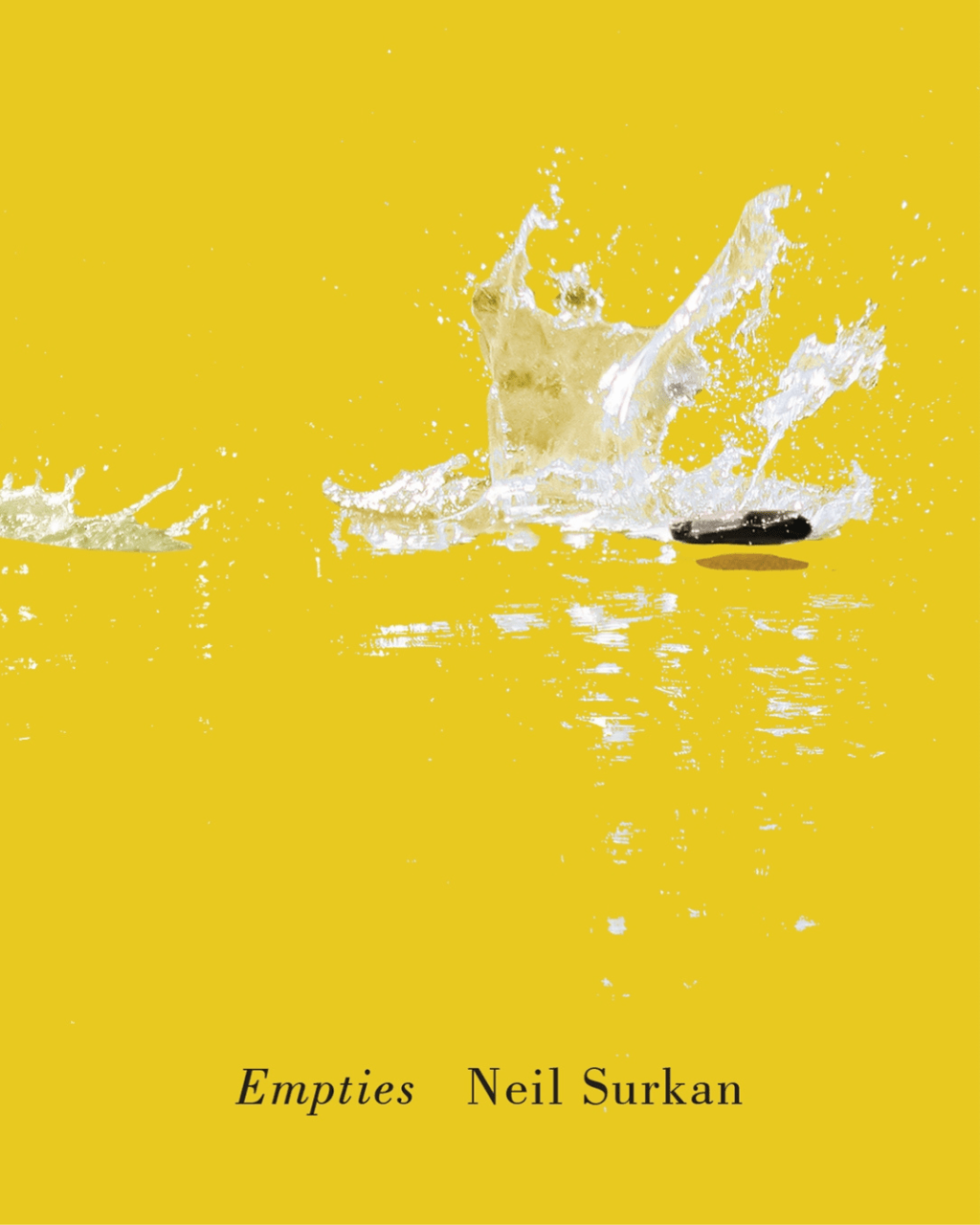
reviewed by dalton derkson
In his 1906 novel, The Jungle, Upton Sinclair writes: “All this was bad, and yet it was not the worst.” Is it an odd choice of quotation with which to open a review of a new book of poems? Sure. However, I do not invoke Sinclair to imply that Neil Surkan’s latest book Empties (McGill-Queen’s University Press, 2026) is “bad but not the worst”. No. In fact, I’d prefer we used Sinclair’s quote for the idea it presents: that pessimism begets optimism and (despite our best efforts) vice versa.
On the heels of two prior full lengths also released as part of The Hugh MacLennan Poetry Series (On High in 2018, Unbecoming in 2021), Surkan has used Empties to craft his unique journey of poetic thought into a trilogy of which lauded Hollywood story-teller Wes Craven would be envious. Empties, when read beyond the lens of a trilogy, is a work of cohesive, meticulously crafted lyric that works among flora & fauna, fatherhood, fears, and more. The poet & the text sing in a quietly assertive voice of what we might call the human ecosystem and of all the complexities that come with our existence therein.
Empties is cordoned into 3 sections, or shall we say essays (or perhaps more appropriately: essais), which each confront the imperfectness of existence and language in their own way, all the while maintaining a unified voice and a sense of deep-seeded apprehension. The poet’s attitude is not unlike what one might see in the eyes of a twice-scorned dog: a creature which knows trouble lurks eternally but it remains steadfast in its nature to sniff, to hunt and to uncover. In Surkan’s world hurt is our nature and nature hurts. From Optimism:
A fingernail is never enough
to scrape stick tack
from paint. It lingers

till you use more tack
and daub blue specks away.
Unmarking walls before we move,

I think how I do the same
with fear — draw it from my body
only with more fear.

(…)
Throughout his work Surkan has shown an adeptness in using stark line breaks and exploiting morphology to make the reader question their understanding of the language they use every day. This methodology began quietly in the pieces contained in On High and grew roots in Unbecoming — namely with the titular poem’s exercising of these intentionally messy meanings (to be unbecoming v. un-becoming something). Finally, in his third release, Surkan has distilled this effort by presenting a tightly woven collection of optimistically pessimistic (pessimistically optimistic?) verse. In an untitled fragment towards the middle of the book he writes:
Without you,
I'd just be
a wound, left

to close. Instead,
I let you
let me, make

me make, staved
open, more — saved
from saving up

for what?
For nothing.
Nothing remains something in Empties. The last sip rolling in the heel of the bottle. Empty is the adjective is the noun is the verb (in which ever order you fancy). Futility is still a feeling in these poems and the prospect of giving up, is a prospect nonetheless.
The final of the three essais in Empties is a reworking of an earlier chapbook from Surkan: Die Workbook (originally published by The Blasted Tree in 2024). While the entirety of Empties features little moments of record-skipping, attention-grabbing mischief, Die Workbook stands out instead as a director of the reader’s attention. It magnifies what you experience throughout the collection on the molecular level into a terrifying, yet striking image. This is your own skin seen under someone else’s microscope, your brain presented as egg in frying pan. Surkan takes the sleights of hand performed across the stanzas of the previous two sections and distills them into a new form of poem: a choose-your-own-adventure, in a sense.
1.	the dead can't 			you
		 		protect
		 		remember
		 		owe
		 		forgive
		 		love
		 		punish
No longer is the poet suggesting words contain multitudes. Now he gathers the multitudes and forces you to stare upon them. Forces you to count the unknowns and the imperfections, and to bask in the newfound fact that Mad Libs may not have just been a game we played growing up — it may very well have been our first incarnation of poetic thought.
In the explanatory notes, Surkan describes thinking first of trapdoors, then of rolling die when first crafting the unique format of Die Workbook. In so doing, he created 6 poems that ‘could be “written” in a multitude of configurations’ (author’s quotes), simultaneously giving the reader his poems in the form of both everything and nothing.
The pessimistic optimism (optimistic pessimism?) invoked in the opening Sinclair quote ties in nicely with the world Surkan presents in Empties. To call the sentiment of this collection “bittersweet” is not quite right… But in that not-quite-rightness, it may become the perfect term. Throughout the collection Surkan shows us the futilities of the human mind as it labours to compartmentalize, to organize, to create or even to understand what it encounters in the day-to-day. “Come and Swim this Fever” the poet writes in his piece, The Worst; a mad-hatteresque invitation you will not want to reject.
dalton derkson is a poet and radio host residing on the traditional territory of the Snuneymuxw First Nation. His work has been published by Discordia Review, Book*Hug Press and more. He is the co-founder of the poetry press + distro, a square house.