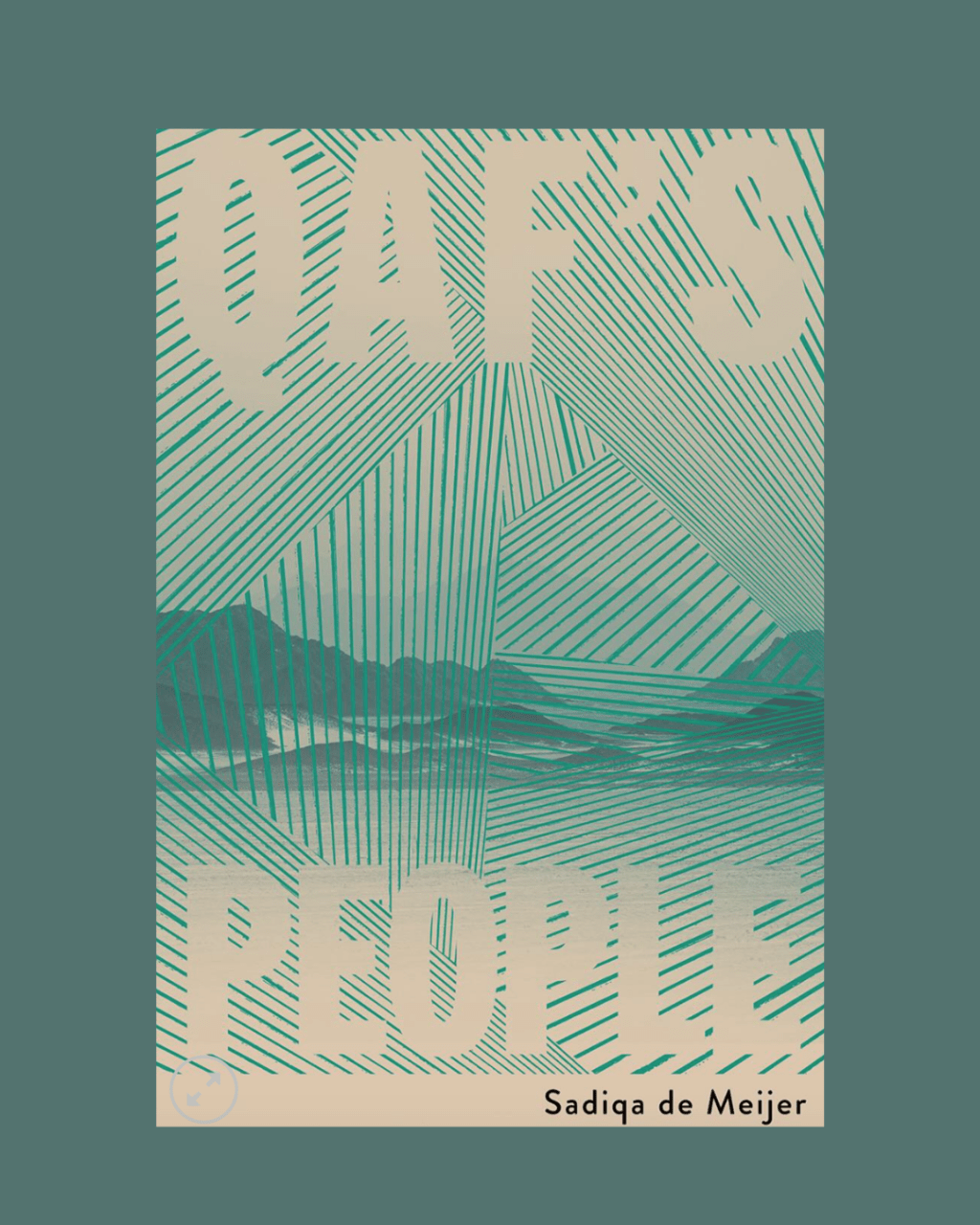
reviewed by Chris Banks
In an essay Hope and Nostalgia, the writer Leonora Simonovis has stated, “ exile for me is a lived experience that has influenced my sense of self and my relationships with land and with others” and later in the same essay, “For exiles, writing is also about re-locating the self and reconfiguring notions of home-land. In my case, home is not necessarily a place, but a state of being: home is wherever I am.”
I use these opening quotes because I think they make a good entry point into talking about Sadiqa de Meijer’s wondrous new book Qaf’s People out with Vehicule Press (Spring 2026). For me, the poet de Meijer is an exciting poetic voice because of her line-breaks, jaw-dropping imagery, and, of course, the complexities of her own mixed race identity she explores through the book. These are not easy poems to absorb in one sitting, and they really awakened my poetic sensibilities by creating an imaginary country, the mythic Qaf, a word and a place taken from Islamic mythology, A country that sits between a father land and a mother land. Or is a confluence of the two. Or maybe Qaf resides simply inside de Meijer’s imagination reconfiguring her own ideas about identity and homeland. Qaf appears to be a place of refuge and of creative renewal.
Look at her poem “Dual” which literally folds the geography of her parents’ different countries, the dividing lines of a Turkish map, into one another:
Dual

The old cartographers drew monsters at the edges of the earth—
where would we place them now

when history won’t let us take a breath? The sea between the mother
and father continents releases its drowned preschoolers

face down, is fissured with a war criminal’s flight path.
A Turkish map is how the father and the mother country atlas pages

fit inside my pocket: his channeling of subterranean fire,
her dulse-shaped conversation with the waves.

Inward along the faults I press them, sharpen creases
of a crossroads fold, form a collapsing star—until the quilted

billowing of hillside farms becomes continuous with lowland turf.
Then one uninterrupted body could squelch past flooded willows,

footfalls sparking frogs, into ochre grass that whistles hymns
to the acacias, and the herds of cattle wouldn’t even waver

from their grazing, some cows brown and concave, regal-horned,
some swollen, jig-sawed black and white.

Like a god I make their landscapes sleep against each other.
Watch the wreckage of the one single catastrophe

slide down the valley of the paper and blow out.
The map takes the shape of a house.

This poem has incredible imaginative power as it delves into specific, close-up images of the Turkish map or the “jig-sawed black and white” cows, but also has that far away God-like panoramic perspective of the two homelands becoming one and the same: “until the quilted / billowing of hillside farms becomes continuous with lowland turf.”
This is to say that the poet Sadiqa de Meijer’s language is charged and her images exacting in Qaf’s People as if she is not just reconfiguring the word homeland so its includes the countries of Netherlands, Kenya and Canada, but poetic language itself. There are “fishscale shingles of patchwork roofs” and the “anvil of a storm cloud closes in” which are note perfect. Other lines feel aphoristic in their precision like “A tulip is an upturned bell the wind rings” or “if you cry wolf long enough, the wolf will come.” I love poetic language and images that ripple out like thought from poems like these.
De Meijer writes “Qaf is clearest when you look a few degrees away” which is to say it is a myth, a powerful reimagining of the places the poet has come from and where she is going. Hardly a mirage, Qaf’s People is fully realized, and there so many wonderful images and turns of phrase I will be carrying with me throughout my week. An extraordinarily well-crafted poetic collection!
Chris Banks is an award-winning, Pushcart-nominated Canadian poet and author of seven collections of poems, most recently Alternator with Nightwood Editions (Fall 2023). His first full-length collection, Bonfires, was awarded the Jack Chalmers Award for poetry by the Canadian Authors’ Association in 2004. Bonfires was also a finalist for the Gerald Lampert Award for best first book of poetry in Canada. His poetry has appeared in The New Quarterly, Arc Magazine, The Antigonish Review, Event, The Malahat Review, The Walrus, American Poetry Journal, The Glacier, Best American Poetry (blog), Prism International, among other publications. Chris was an associate editor with The New Quarterly, and is Editor in Chief of The Woodlot – A Canadian Poetry Reviews & Essays website. He lives with dual disorders–chronic major depression and generalized anxiety disorder– and writes in Kitchener, Ontario.