reviewed by Chris Banks
I’ve been spending the last few days reading Bruce Taylor’s We Drove All Day For This: New And Selected Poems out now with Signal Editions, and I’ve been really struck by the narrative thrust, exacting imagery, the seriousness in which he treats his subject matter. Whether the poet is writing about how the brain does not regenerate cells, or a mine closure in Murdochville, or antique stores full of porcelain dolls, or paramecium studied under a Chinese microscope, Taylor treats his subject matter with near reverence.
I have to admit I have not really been too familiar with Bruce Taylor’s work, but certainly heard about how terrific No End in Strangeness was from friends and other poets who championed that volume when it came out in 2011, so it’s been nice to discover a “new-to-me” poet, double-points for Taylor being a Canadian poet, a poet who weighs not just every line against every other line, but every syllable and image to ensure the poem is clear, the originality heightened, but also very, very tailored. Read the collection and there is nary a loose word or syllable or lazy line to be found. That is profoundly impressive.
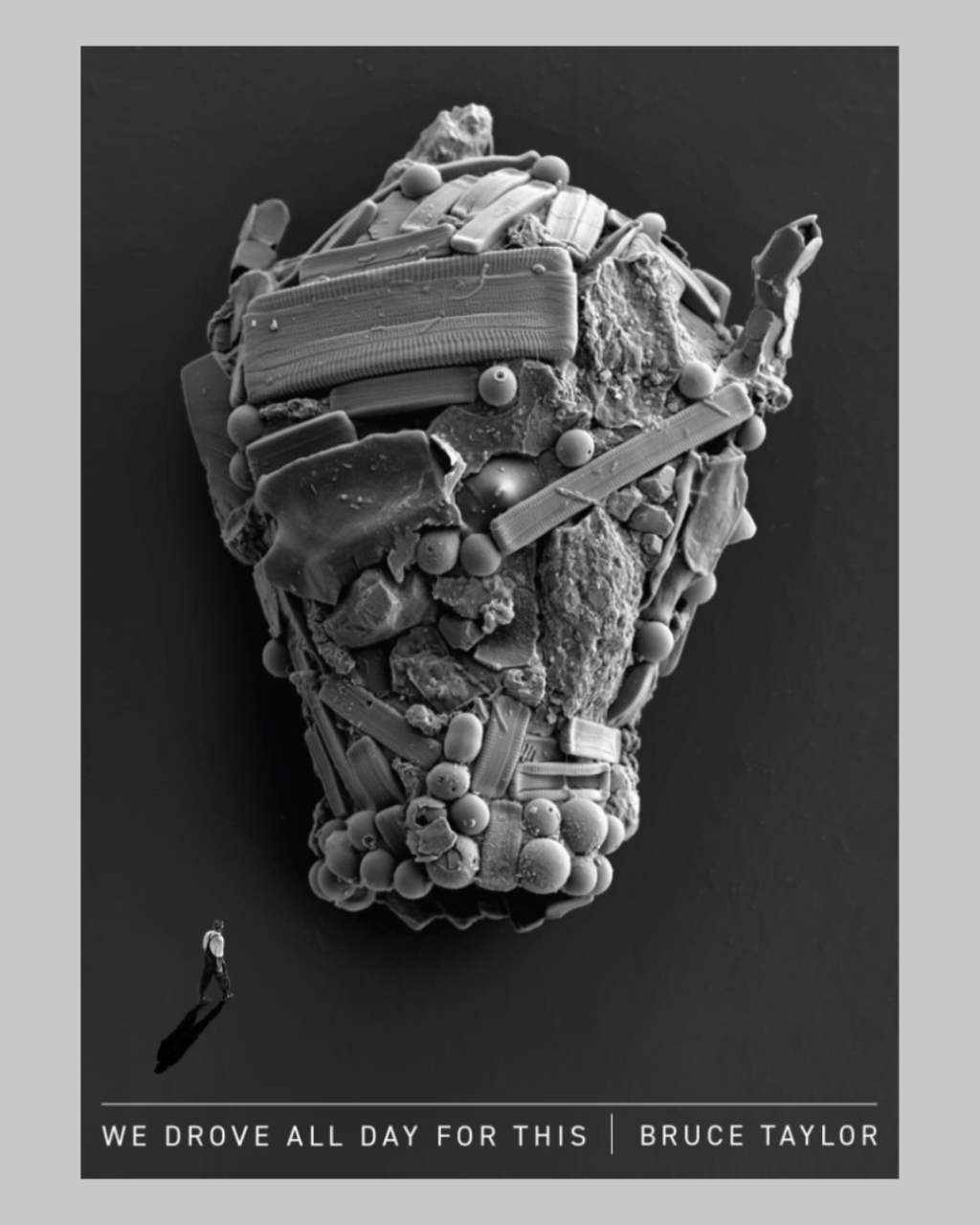
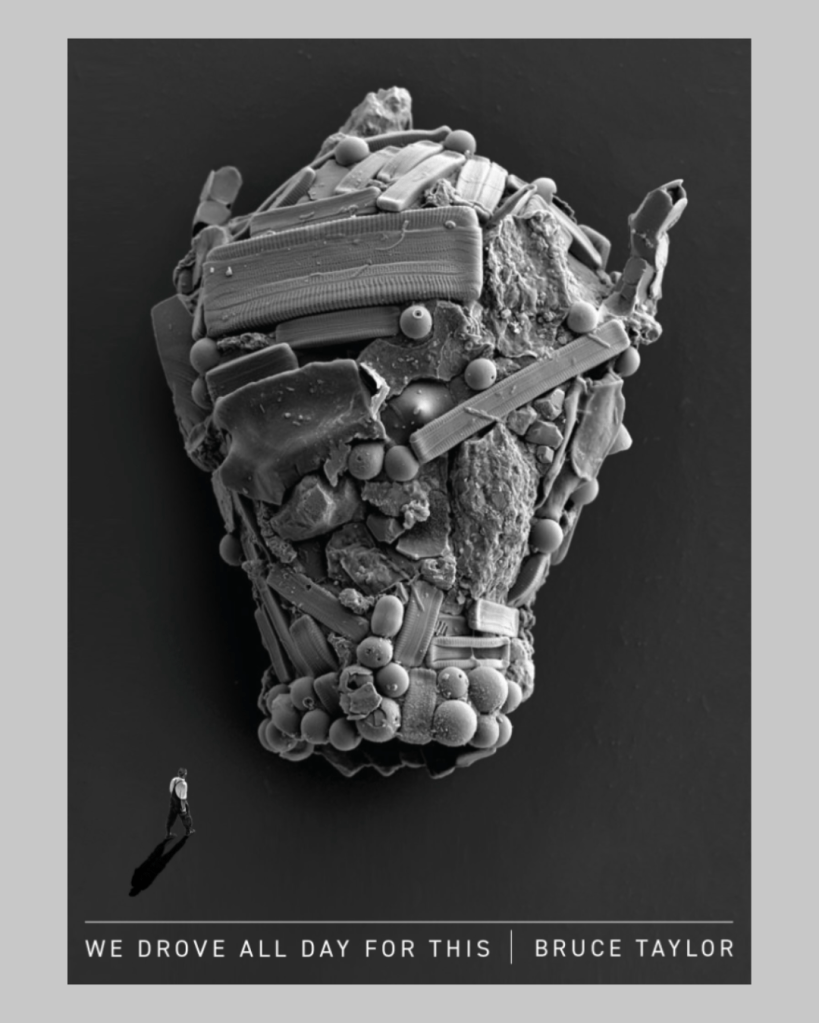
I love the cover design by David Drummond too which shows an electron micrograph by Bruce Taylor, and the image itself is of a shelled amoeba which the acknowledgements page tells me, “builds a dwelling for itself, using scavenged materials such as diatomes, algal cysts, and grains of quartz.” Maybe that is an apt metaphor for the poet Bruce Taylor who takes scavenged materials–sensory images like “You come in through a rip in the fog” or “the first banjo chords of Spring” and other feelings and pestering questions like “How many times must I have liked the wine / before I can honestly say / What years those were, / if only I had them back?”– and then folds them into inimitable, eloquent and perfectly voiced poems.
Nothing is just what it is in a Bruce Taylor poem. A crack in the wall is a “Nile-shaped crack” or a summer night “blackens like a fuse” or fireworks are “A parachute of violet fire” or even the poet’s own heart caught on an echocardiogram is a “looter on surveillance camera.” Wow. These are huge leaps in associations carried out in very few words. This level of individualism and imaginative verve feels rare in contemporary poetry.
These poems confront an all too familiar world, but stares such a world down until it offers up a glimpse of the past, or something new in the present, or even staring into the future, “closely inspecting the days left, / staring at them until they grow transparent, like the blades of a fan.”
Here is a poem I quite like from the collection simply entitled “Lovely” and I have really fallen under its spell:
Lovely

The past is lovely, it lasts forever.
Somewhere, I’m still
lying under the lawn sprinkler
with no Coppertone on,
the grass cool and elastic under my back,
A black spaniel muzzling my feet.
The cars are old-fashioned and optimistic,
the people who drive them
have fallen in love with the future.
They cant’ know that when they get here
they will love the past more,
that the present will look like
a stupendous machine
for forcing things to stop existing.
Well, to live for the moment
is best, but the moments, the little
jiffies, they are startled
to be here, like
The high-shouldered cuprous beetles
thar live beneath patio stones,
if you’re curious you lift one up
and let it run down your arm.
The other ones scoot for cover,
Struggling down into the leaf mulch,
kicking frantically.
Not sure why I chose this poem to excerpt. Maybe it is because I really like the idea of the present, the now of our lives, being characterized as a “stupendous machine / for forcing things to stop existing.” Does the past last forever? I think it does by not lasting. Or maybe its the even-footed syllabic count, or maybe I like this poem because it confesses or makes plain simply this: so much of our world, like the beetles under patio stones, is hidden from view out of necessity, out of mere survival, and it takes just a moment and a little patience for you to peek beyond the veil of the familiar to see how truly wondrous and strange it truly is.
Go purchase a copy of Bruce Taylor’s poetry collection We Drove All Day For This: New and Selected Poems (Signal Editions, 2026) and let its imaginative moments and imagistic “jiffies” work their spell on you. A powerful poetry collection by a master Canadian poet who navigates the abrupt edge between visible and invisible worlds! This book should be a part of every serious Canadian poet’s home library.
Chris Banks is an award-winning, Pushcart-nominated Canadian poet and author of eight collections of poems, with Bureau of Useless Splendour forthcoming (Fall 2026, ECW press). His first full-length collection, Bonfires, was awarded the Jack Chalmers Award for poetry by the Canadian Authors’ Association in 2004. Bonfires was also a finalist for the Gerald Lampert Award for best first book of poetry in Canada. His poetry has appeared in The New Quarterly, Arc Magazine, The Antigonish Review, Event, The Malahat Review, The Walrus, American Poetry Journal, The Glacier, Best American Poetry (blog), Prism International, among other publications. Chris was an associate editor with The New Quarterly, and is Editor in Chief of The Woodlot – A Canadian Poetry Reviews & Essays website. He lives with dual disorders–chronic major depression and generalized anxiety disorder– and writes in Kitchener, Ontario.