
reviewed by Chris Banks
Everyone has an inward wish to connect to something larger than oneself, whether than means duty to others, or something more spiritual in nature. Some wish to peel back the surfaces of the everyday, in order to see the world differently: to know even one true thought. I think this inner compulsion burns even brighter in a lyric poet whose fervent wish is to understand why one is here, why one loves or why one suffers.
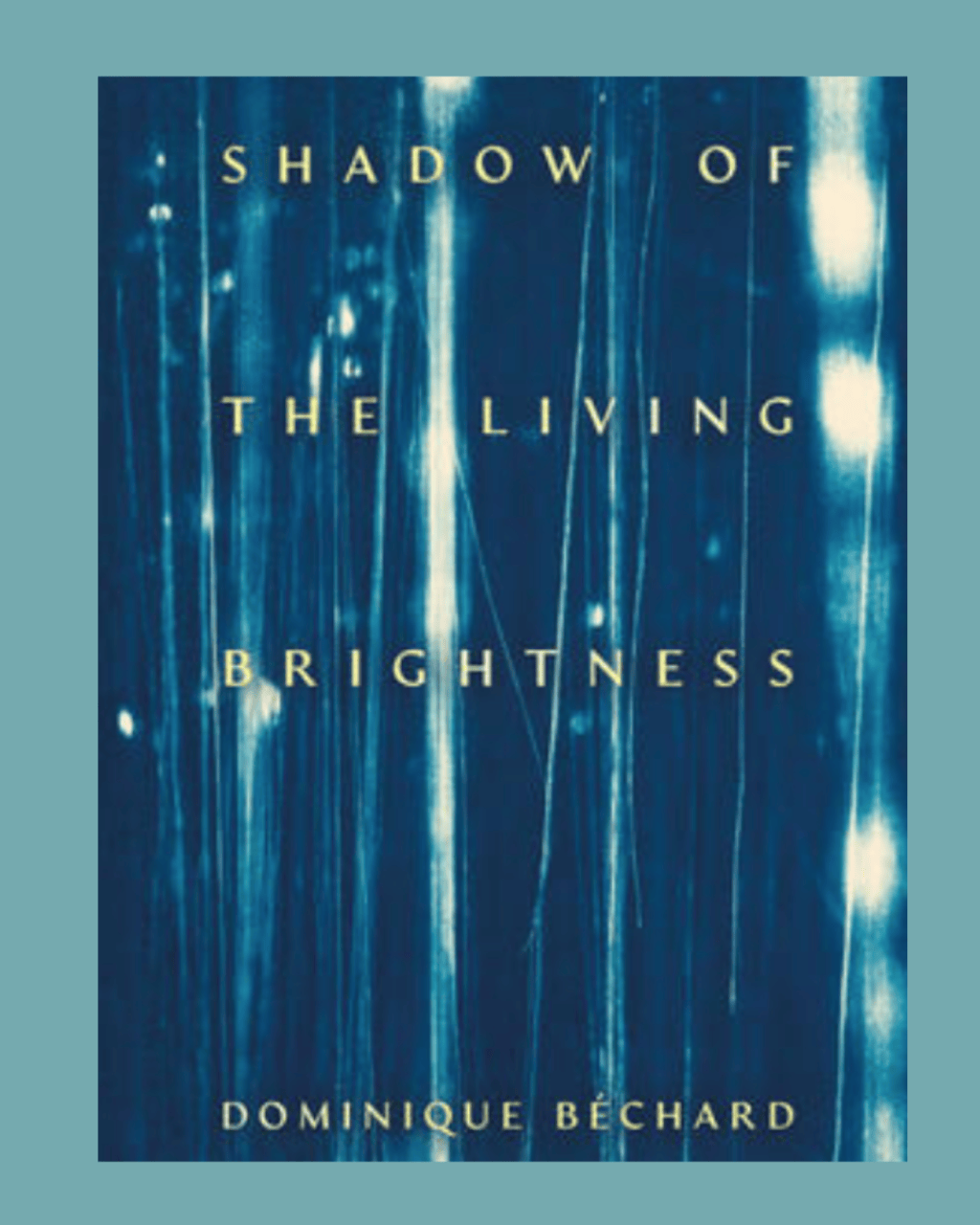
In Dominique Bechard’s sophomore poetry collection Shadow Of The Living Brightness, she employs a kind of secular lyric mysticism that tries to quiet the self, and really interrogates God’s absence by contemplating his works through language.
But language has its limits, even in the capable hands of a poet like Bechard who can conjure “dark hooves of rain” and toss out a phrase like, “At the bottom of the light a bell sharpens its claws.” Language like this feels charged with potential, but it only takes us so far to understanding a world that shows so little of itself on the surface. As the poet says in an early poem “Prelude To Eternity” when talking about the phrase shadow of the living brightness, a phrase taken from Hildegard of Bingen’s description of the ‘sensation of God’s presence, she writes of “a namelessness so acute you /are abruptly in the midst of things.”
The imagery in the poem in this book really is trying to awaken readers to their own spiritual potential, to stop the flow of rational thoughts, almost the way a Zen koan does, and open readers up to new understandings. This is how the poet can write, “I like to think of my migraine / as a pair of stone lions welcoming /hopelessness inside”. Wow! Or again, in the poem “Dialogical Light”:
The people I love are already
beginning to disappear,
but you wouldn’t know it,
the way so much insists on joy.
Here you have not just the juxtaposition of love and loss, but the insistence of joy above all other things. And yet we are not pure spirit. We are flesh and everything that is heir to the flesh: depression, anxiety, a self that most often feels isolated and alone. Bechard writes about the pound of flesh this world demands in a poem called “Interlude”: “The world takes / and takes its toll. / How do others live / without money or aplomb? / Or touch.” As someone who has chronic major depression himself, this feels like a mantra that has woven itself deep into my own heart.
But not everything in the collection is all doom and gloom, as this passage from the poem “Apophasis” (a phrase that means to learn what is divine by naming everything it is not, lets us know):
Something catches your eye
across the field, which strains green and tenebrous
as the mind reading theology.
You stand at the window
with your mug of orange juice, trained to look
and look until sense claps you on the back,
grips your hand in worldly camaraderie.
This something blinks enticingly,
tugs at your sleeve.
Maybe it’s just me, but my own spirituality comes from that invisible tether I feel between myself and a field of wildflowers, or between myself as a reader and a poet who is trying to fold back the familiar to uncover some spiritual knowledge. Maybe that tether, which feels real or not real, is the shadow of the living brightness, or a God of infinite connections. I think when we quiet the mind, we open ourselves up to spiritual truths, to being “endlessly revised by things” as Bechard writes.
There are long poems and short poems in this collection, poems that eschew punctuation and poems that use “spaces” to create not just a sense of emphasis, but a sense of quiet or contemplation if that makes sense, as if the mind is searching for answers to its own needs and desires and suffering. I think this idea comes into fruition in a poem from the collection “Epektasis” which I excerpt a little of below:
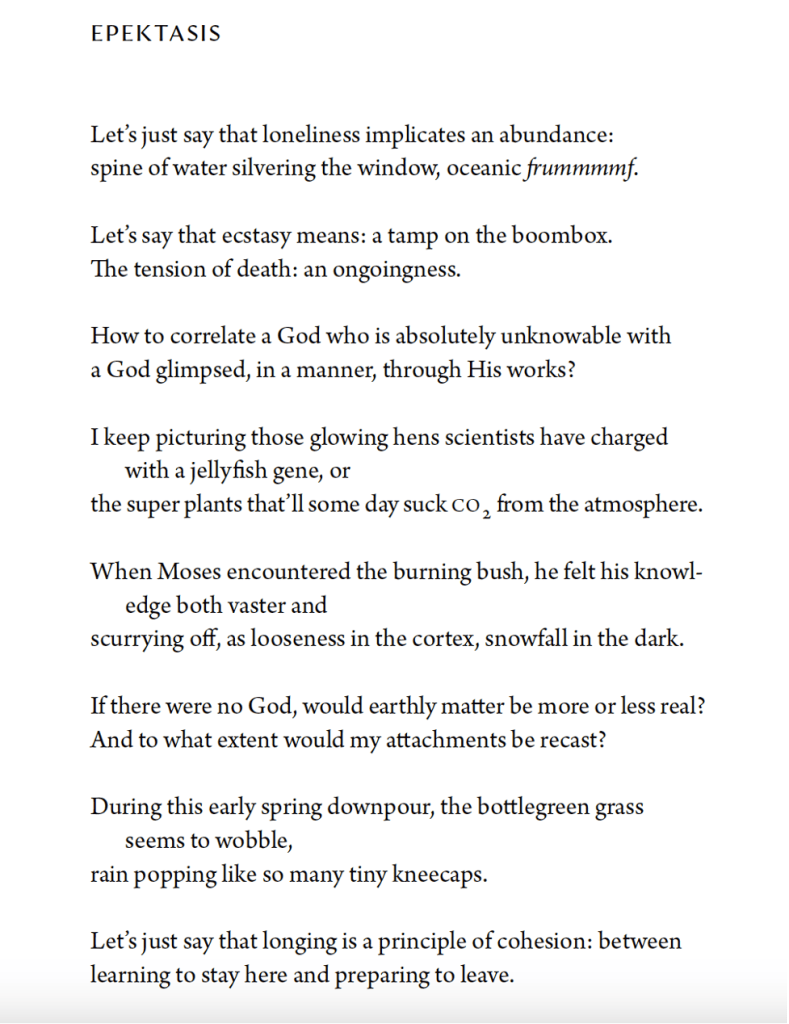
So much to love in this poem. I like the flipping of the self’s loneliness to imply an abundance of things that are not the self. I like thinking of ecstasy as a sense of “ongoingness”, of spiritual renewal and connection, and the ending lines are dazzling, as if connection or cohesion is a process of learning.
I hope I have read Domnique Bechard’s poetry collection Shadow of The Living Brightness the way she intended, and given these image-rich, spiritually-probing poems the attention they deserve.
How to write about the ineffable? About something one cannot see, but is felt? How to write about one’s own suffering and the confines of the self? I think you do it with all the patience and ache and in-dwelling spiritual attention one can muster. This is a lovely poetry collection that tries to find the abrupt edge between the secular and the spiritual, and I will be thinking of these poems for some time to come.
Chris Banks is an award-winning, Pushcart-nominated Canadian poet and author of eight collections of poems, with Bureau of Useless Splendour forthcoming (Fall 2026, ECW press). His first full-length collection, Bonfires, was awarded the Jack Chalmers Award for poetry by the Canadian Authors’ Association in 2004. Bonfires was also a finalist for the Gerald Lampert Award for best first book of poetry in Canada. His poetry has appeared in The New Quarterly, Arc Magazine, The Antigonish Review, Event, The Malahat Review, The Walrus, American Poetry Journal, The Glacier, Best American Poetry (blog), Prism International, among other publications. Chris was an associate editor with The New Quarterly, and is Editor in Chief of The Woodlot – A Canadian Poetry Reviews & Essays website. He lives with dual disorders–chronic major depression and generalized anxiety disorder– and writes in Kitchener, Ontario.