reviewed by Geoffrey Cook
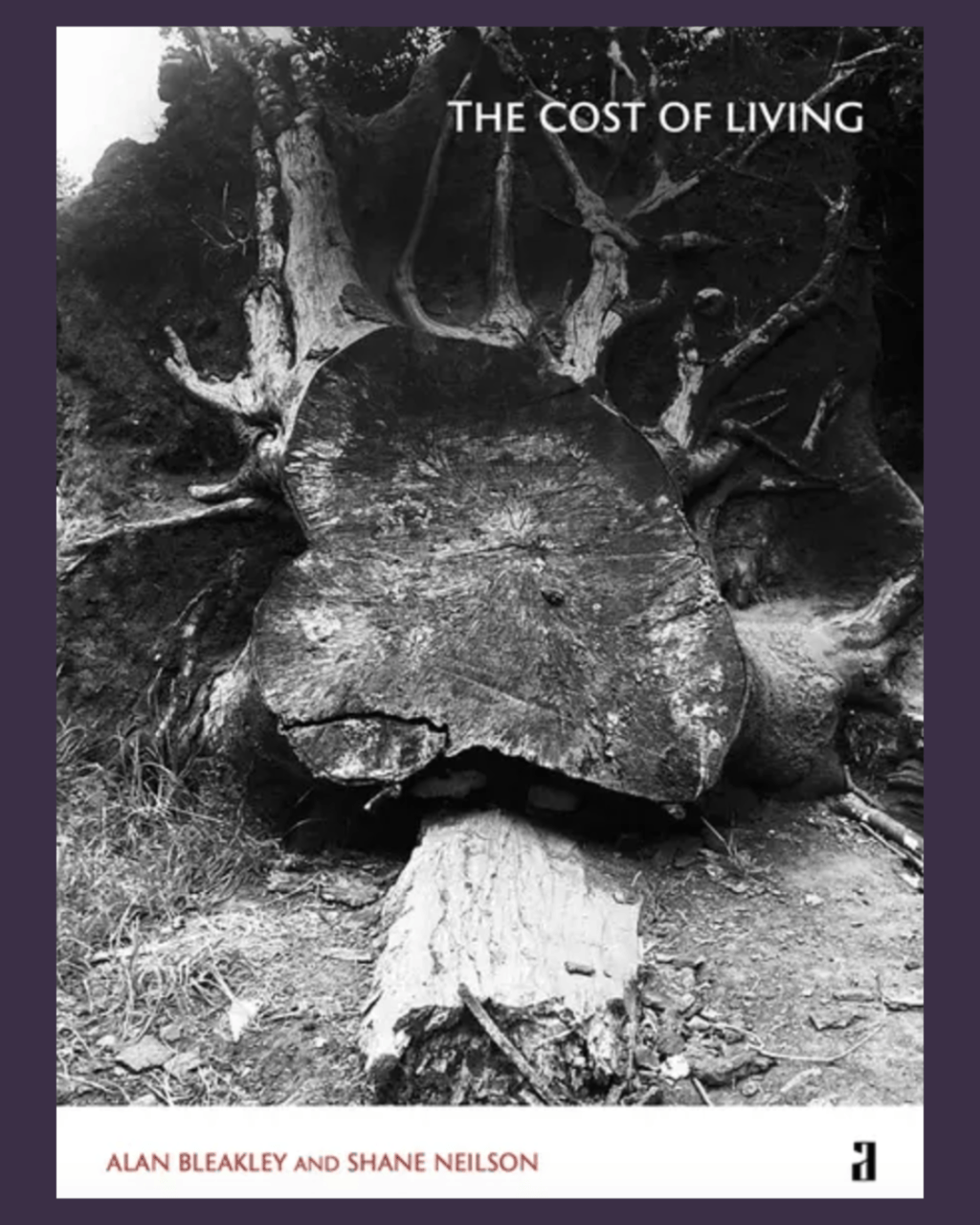
Poetry collections of dual authorship, like The Cost of Living, by default subvert the lingering romantic myth of individual poetic genius and instead promote the value of collaboration and dialogue. The Cost of Living should be seen in conjunction with Bleakley and Neilson’s scholarly work in Medical Humanities, where they challenge conventional assumptions of medical knowledge and practice: they co-edited The Handbook of Medicine and Poetry and Poetry in the Clinic: Towards a Lyrical Medicine, both published by Routledge in 2024. There is, then, a moral agenda to Bleakley and Neilson’s larger project. Literature that is responsible to its vision will embody a paradoxical dialectic at its core: by asserting the ethical value of the content, in allegiance to lived experience and its authentic representation, the literary text must at once work imaginatively (myths and metaphors strike the reader as true and real) and expose its own artifice (the text is only a story/narrative or only a poem/metaphor). This is a literature in which readers don’t just believe and emotionally invest, but through which they experience the contradiction between the lived world represented and the artifice of its representation. Such tension marks the integrity and authenticity of a literary text. It is somewhat like the traditional oral stories of Afghanistan which begin with the phrase “bood nabood”, meaning “there was and there was not”. One could read this phrase as a definition of the literary project, an explicit reference to the tension between the actual and the imagined, the real and the ideal, a disorientation in the liminal space that allows us to know both realms and, thus reoriented, to act with that fuller knowledge.
This dialectic in The Cost of Living is operative through the fundamental metaphors and themes of the poems: snake, wound, trauma, healing, father, love, and nature. In Bleakley’s “Red Boots” the poet “stood up for the singular/ Story against the numbers” lest “[b]y desiccated charts and numbers / [t]he patient [is] reduced to symptom.” The central metaphor of the poem is a re-animated and re-animating serpent, an ancient symbol of healing and rejuvenation (a snake is “reborn” in sloughing its skin). In Bleakley’s poem the serpent “slither[s] down the rod of Asclepius” (mythical Greek god of healing and medicine) to reveal “bibbed medicine de-frocked / Standing naked and ashamed.” This “story of the serpent” — the patient’s “flux of feeling” — leaves “the numbers, the numbers / … trembling in the face of the real.” “Numbers” or “linear formulators / and defect-bound evidence-texts” are inert data. In “Presence of Information” the threat of reducing the patient to these symptoms, of subtracting the patient’s story (or myth, as in narrative, not falsehood) from the medical diagnosis, leaves the biochemist “perplexed at the absence / of meaning that he so deeply craved”. In a companion poem by Bleakley, “Price of Information”, the problem of “[i]nformation trumping meaning” is implicitly overcome by language-enriching subjective experience, since the stories of our suffering are communicable only in metaphor, and the poem ends with “medical notes… stained in marsh mist blue / And the baby breath[ing]-in her indelible spirit”. Asclepius’s staff also appears in Shane Neilson’s intense “The Unforgetting” as a metaphor for the “double helix… pointing in opposite directions, up and down” (an apt image of dialectical tension). The metaphor is more specifically related to a major theme in Neilson’s poems, and his work more generally – the struggle to heal childhood trauma. The unforgotten and unforgettable is the original wound, its locus the farm of his childhood, which Neilson has explored most explicitly in What to Feel, How to Feel (Palimpsest Press, 2025). “The Unforgetting” is a cry from the nightmare of the unredeemed and unredeemable: “This farm is a dream / I’ll write of all my life, begging / my wife to understand, but she / cannot…. No one can understand.” Later, in Neilson’s “Opposite Action”, we will see it is perhaps as much the poet’s dissociating among dreaming, writing and living, as it is the wife’s understanding of trauma, and the reader’s understanding of metaphor that provides the route between the imagined and the actual.
The book’s title poem, “The Cost of Living” by Bleakley, uses another figure from Greek myth to represent the chronic, contagious wound of murderous competition and conflict. During their voyage to destroy Troy, the Greeks abandon Philoctetes for his reeking, suppurating wound (some stories blame a snake bite). The Greeks must later retrieve the scapegoat for their invasion and he “draws on the bone bow” to shoot at Paris. Meanwhile Achilles and Ajax, legendary rival members of the Greek army, play “bone dice to interrogate the cost of living.” Is the cost of living the chronic wound of war and killing? But Bleakley uses the image of bone (literally the material structural core of human beings) in a contrary meaning in “Heaven Admits”, where the poet calls us “ [to] play flute on the hollowed bones / In an enchantment of articulations” [I’ve reversed the clauses here for grammatical clarity]. The lines suggest music (poetry) is enchantingly articulate, healing, and peaceful. Interestingly, the very form of this poem, with its two “voices” in alternating couplets, one of which is italicized and indented, evokes the caduceus, twined serpents spiraled on a rod (and recalls Neilson’s double helix image). This, though, is the traditional sign of Hermes, god of messengers and merchants. In the context of The Cost of Living, the two voices in “Heaven Admits” can perhaps be read as representative of the tension between medicine as cold clinical scientific facts and medicine as also sensitive and responsive to the patient’s experience; i.e., between the different and possibly alienating or conflicting metaphorical languages of doctor and patient, a central theme in Bleakley and Neilson’ multidisciplinary work.
It is consistent with Bleakley’s concern for social justice, democracy and the ambiguity of metaphor, and particularly relevant at this moment in history, to point out that the U.S. Army Medical Corps adopted the caduceus for their insignia in 1902 … by mistake! The Corps then pondered for a hundred years the problem of which snake symbol to adopt — Asclepius’ single or the caduceus’ double –, as well as whether to include one or another version of the Confederate Flag in their insignia! They settled, in 2020 after much consultation with committees and communities, for the twinned serpents, hoping to obscure the original misreading of metaphor and myth by claiming that the primary significance of the Medical Corps is that they are not medical personnel so much as they are non-combatants. Thus, the caduceus of Hermes as god of heralds was a more appropriate symbol of the US Army Medical Army Corps. This rationalization can be found on the National Museum of Civil War Medicine website, where you can also read how mere aesthetics was privileged over substance in their decision. Recent surveys in the States found that while sixty percent of professional health care organizations prefer the rod of Asclepius as the symbol of medicine, seventy-two percent of commercial health care associations prefer the caduceus. In the end, it would appear that for the US Army Medical Corps, the symbol of healing and medicine has been trumped by that of commerce and war.
The metaphors and myths we’ve looked at in The Cost of Living coalesce around the notion of transformation, made explicit in the title of Neilson’s poem, “Insofar as I Transform Myself into Song, I Can Live Again”. The poet “marvelled at life, leave, those / words titanic anthems demanding how much / I could love a thing and yet feel condemned / to mistreat it.” How to learn love as healing instead of harm is fundamental to Neilson’s poetic ethos: acknowledging the wound that might never be completely cured yet could be cared for. At best the wound is survived: “Everything I know falls into the category of survivor” (“The Bard’s Masterclass”). The poem’s final stanza, moving in what seems the opposite direction of “The Unforgetting”, as if to undo that paralyzing trauma, reads:

Which is to say, what? that we are healed by song (poetry) that survives whether we do or not? A rather Rilkean or Keatsian vision of the immortality of poetry and as indifferent as Apollo (god of healing, father of Asclepius) to flayed Marsyas (the merely brutish mortal). The alliterative set of nouns “love”, “live”, “leave” and “language”” is a motif in some of Neilson’s other poems: “Let’s sing the word ‘love’ until it rhymes with any word, / is mistaken for leave, long, live,” (“The Poet Reins a Buckling Image to Charge in Violent Loveliness at Fact”). And in “Sky Floor” “sky becomes screen becomes love, / live, leave, random bolts from a panorama // that turn love into a question, leave / into imperative, and life ah, the song // can only tell of that transformation” — the transformation referenced perhaps in “Insofar as I Transform Myself into Song, I Can Live Again”? The most disturbing example of the wound is found in Neilson’s “Miss Smooth Face”, where the poet
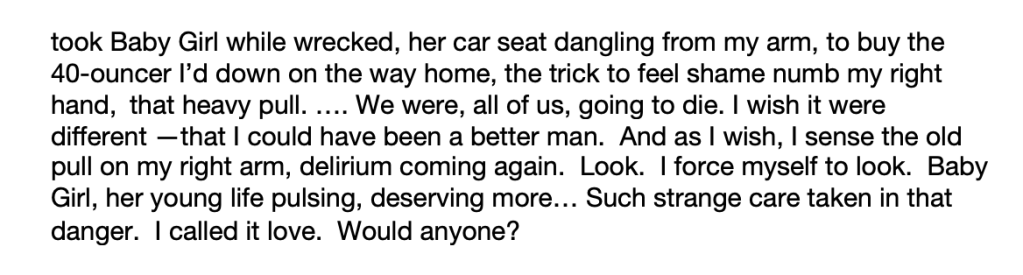
Here love is turned into a question we saw in “Sky Floor”, and we are left wondering whether song can help us understand how to transform a wounded life into a loved one worth living instead of leaving.
The final poem in The Cost of Living, Neilson’s “Opposite Action”, at once complicates and culminates fundamental themes we’ve traced, and lays bare the paradox of ethical poetics. The poem is immediately conspicuous since it is written in ballad form: no other poem in the collection employs traditional poetic structures. As to content, the poem pulls the rug out from under a major theme: song as transformative, as healing: “I would like to sing — / but there is poetry for that.” Note how this dismissal reverses the (positive) aspirations of “Insofar as I Transform Myself into Song, I Can Live Again”, as well as the negative despair of “The Unforgetting”. Philoctetes’ wound is exposed in the metaphors for emotion in “Opposite Action”:
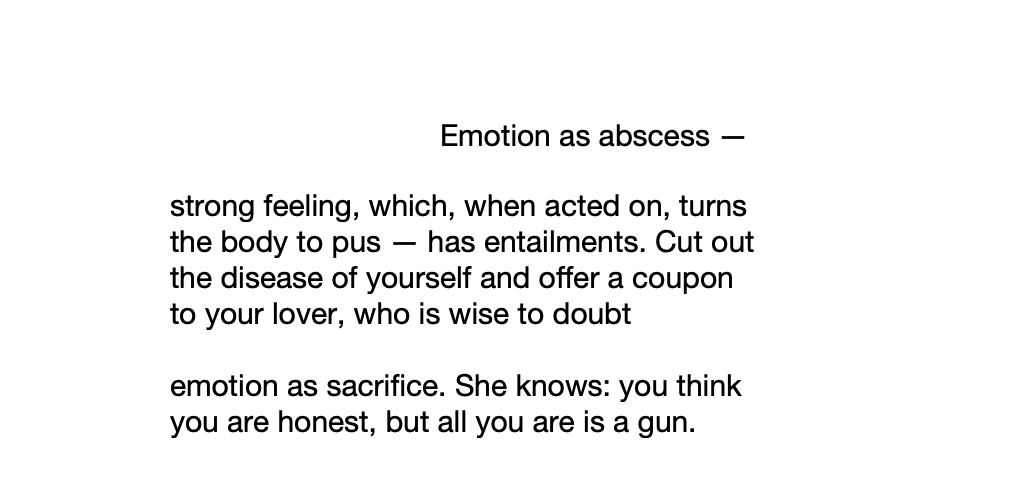
Poetry is only poetry; it “makes nothing happen”, as Auden provocatively wrote. While an important step in healing, once emotional reactions to trauma are accessed, subsequent feelings of self-pitying entrapment nonetheless may perpetuate the original wounding:
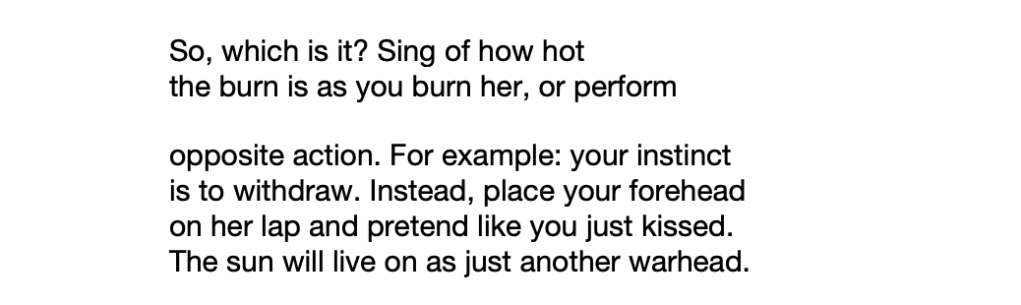
Look again at the last lines of “Red Boots” by Bleakley, “Where the numbers, the numbers / Lay trembling in the face of the real”. The “numbers” are the dead data of science. But “number” is also a metaphor for song, for rhythm and metre, even for dance. Bleakley’s poem is a tour de force on the value of the ambiguity of metaphor, and, like Neilson’s “Opposite Action”, as clear an example of the fundamental dialectic of The Cost of Living. A second key word in “Red Boots” has contrary metaphoric meanings as well: like “number”, “measure” can be a technical term of the hard sciences, but it also means song (poem) and dance. Thus Bleakley can describe the drama in “Red Boots as “a tale of measure for measure” capturing 1) the scene itself of a patient who, defiant of a grave medical condition, splurges on sexy red boots; 2) the tension between the distinctive metaphorical discourses and decisions of doctor and patient; and, 3) the tension within metaphor itself; all leaving both doctor and patient “trembling in the face of the real”, as is, this being the last line of the poem, the reader. And to return here to the point about the ballad structure of “Opposite Action”: as the only poem with a traditional form, and as the final poem of the collection, the authors know the exception cannot be missed, making a statement in itself: “There is poetry for that”; but not all of us can sing like poets. And this is a book, ultimately, for all of us. In actualizing the ambiguity of metaphor, a poem can advocate hope.
Finally, it is worth noting that the theme of trauma and transformation and the metaphor of the wound in The Cost of Living is linked to the figure of the Father in a number of poems by each author. Consistent with his other work in the book, Bleakley’s “father poems”, including “The Re-Trial”, “Psychoanalysis of an Ash Pit”, “My Father’s History in Ten Steps”, “Everybody Loves a Ghost Story”, are replete with nature imagery, particularly of the sea. In “Okeanos and the Body of Magellan – A Magical Realist Tale” the density of nouns and modifiers is structurally augmented by the somewhat Anglo-Saxon alliteration and rhythms despite the prose poem form: “the skull-tufted shags started at the sound of sea swilling across their common rock rise at the water force as common body then spearfish as singular divers until sated” or “recalling violent storms sailors tell of the sea’s smell turning from permanent salt to the sudden beef-burst of dark gravy”. A beautiful yet dangerously powerful and powerfully endangered nature is represented in the father poems as well: in “The Re-Trial”, the father’s house is threatened by wind; in “Everybody Loves and Ghost Story”, the ghosts of deceased parents are lovingly heard as are the living, enduring songs of nature, both geological and avian. Particularly significant is “Psychoanalysis of an Ash Pile” as it links father, nature, wound, and healing through the figure of Adam in the garden with the snake (again). The act of “scrying the ash pan” evokes an ironic meditation on, presumably, Ash Wednesday, when the Christian does penance for the first and fatal sin of disobedience. However, Bleakley’s ash becomes merely “dust catching the throat” and the imagined “other Adam, … working naked in the garden caught in the crossfire between two trees and a barking snake” and seeing “only the snake falling through air missing him by a hair’s breadth”, is also left “cough[ing] up ash”, and “the Garden”, ultimately, “vacant, [u]p for sale”. In Christian mythology, the original and chronic wound is, of course, ingesting the “wrong knowledge” triggering the Fall and Expulsion of the human from the Garden of Eden and thus the foreclosing of immortality: “Remember that you are dust and to dust you shall return” (Gen 3:9). “Psychoanalysis of an Ash Pile” de-mythologizes an ideologically problematic theology by ironically reducing symbol to material fact: ash is ash, mortality the human and animal condition, and an abandoned garden (nature) mere property “up for sale”. If there’s an alternate symbolism in this story of Fathers, it is that of ecology and the environmental emergency: the human has managed to reduce the garden of the earth and the human itself to mere ash.
In several of Neilson’s poems, (“Insurrection”,” The Heroes”, Daring Death”, “The Pane Intact”, “Basic Distress Tolerance Skills”) the primal scene is anxious and dark. “March 1, 2004” is explicit:

The light cannot get through for “What good is light when / I grew strange in the dark?” In “Insurrection”, “professions of love meant / Run, boy — for my life” (the boy fleeing his father is a motif in You May Not Take the Sad and Angry Consolations (Goose Lane Editions, 2022) and What to Feel, How to Feel (Palimpsest, 2025). And in “Basic Distress”, “you surrender to your pain and resign yourself to living / a miserable and unfulfilling life.” These poems are dark, companion pieces to “Miss Smooth Face”, for the son becomes father to his own child. But the transcendent hope we saw in “Opposite Action” is also found in the father poems and brings light to the dark. “Shadow Fort”, a poem about a father singing his child to bed beneath a quilt, begins, “The house-shadow stretches across the lawn. … [N]o unfiltered dark gets in, only the kind we create.” But this creation of the dark is opposite that of “March 1, 2004” where “[w]e form the darkness of the world”. In “Shadow Fort”, the son-become-father sings instead:
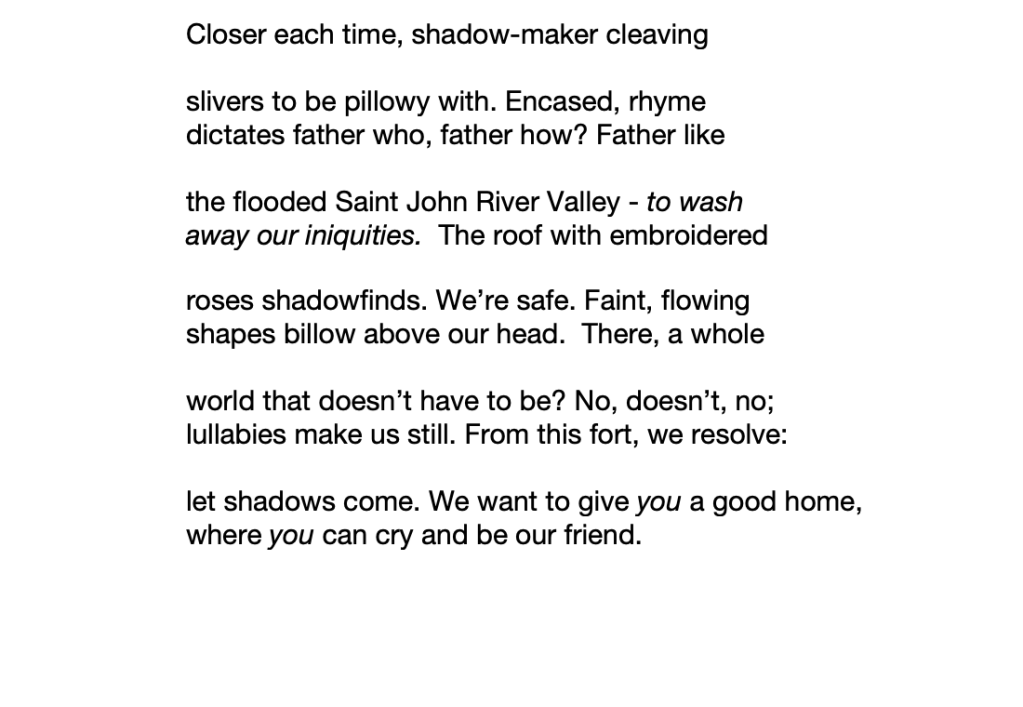
The sweetest poem in the book, “Shadow Fort” is a beautiful lullaby, a transformation of the Father, of the black hole of trauma into “a good home” through a defiant trust in the imagination and the heart, through poetry and love.
Geoffrey Cook’s poems and translations have been widely anthologized and are collected in Afterwords (Vehicule Press 2018) and Postscript (Vehicule Press, 2004).