reviewed by Chris Banks
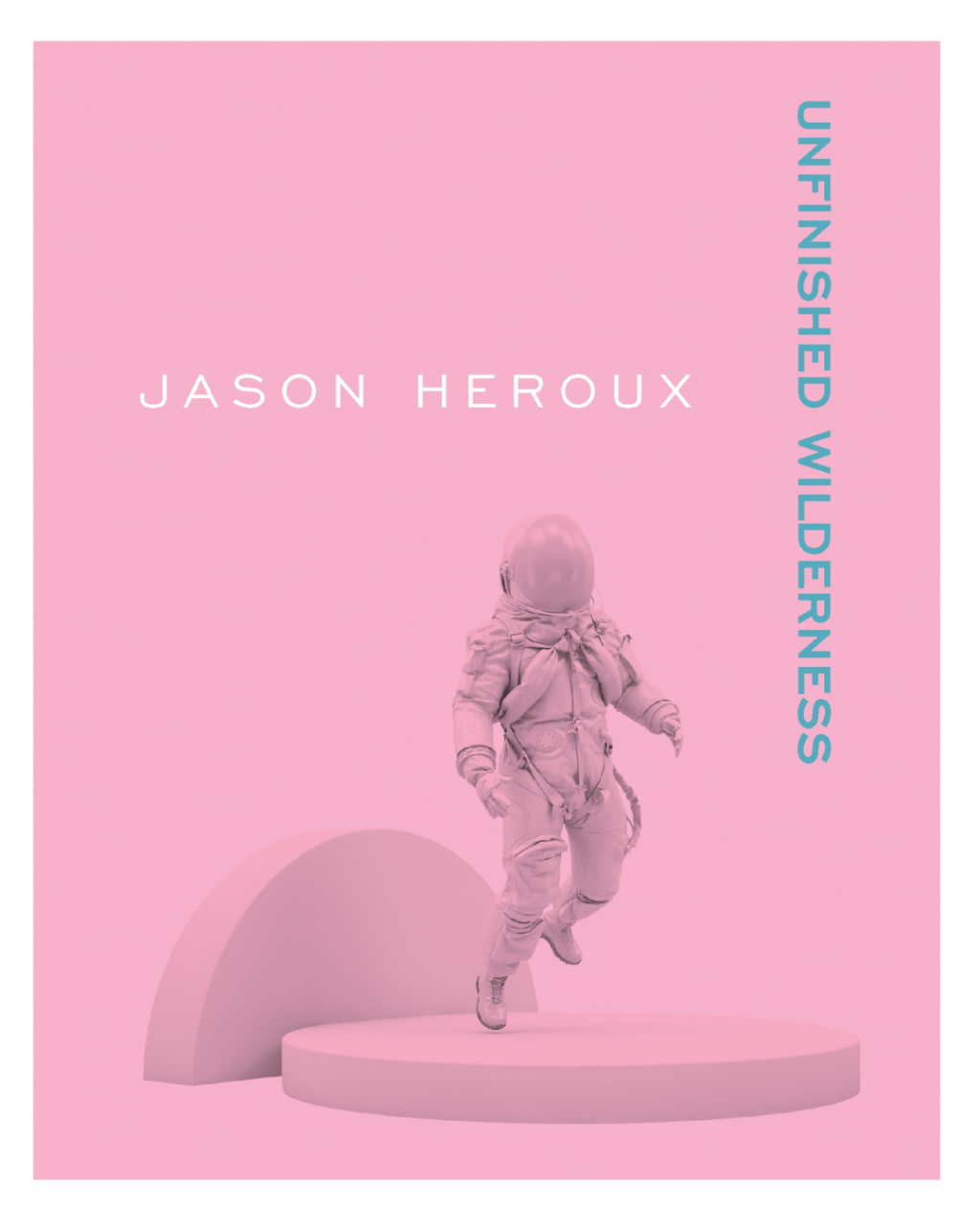
In “Unfinished Wilderness”, Jason Heroux’s new poetry collection out with Anvil Press, the poet writes “What’s gone is still always going on. / The missing thing is found in the end” which is from his poem “Where We Left Off”.
I really love Jason Heroux’s work, and particularly these poems, which feel informed from a lifetime of reading Charles Simic, Dean Young, et al, and I especially like the idea of “What’s gone is still going on” as if consciousness is as much our sensory experiences as it is our memories, but what about meaning?
Meaning, or poetic meaning, Heroux suggests is painstakingly hauled up, rung by rung, out of darkness, out of nothingness, and any meaning found always feels temporary, but yet satisfying, illuminating even, or as the poet says in another whip-smart poem “Marched”: “The kind of lamp / that needs the dark to shine.” This poetic line evokes the idea of negative capability, the idea of quieting the self, the ego, the rational mind, and letting the Imagination do-its-thing to reveal mysteries, or at the very least, some very satisfying linguistic “surprises”.
I share some of the aesthetic concerns of Heroux in my own poetry, but where I might write long, rangey poems, Heroux’s poems are on a whole much shorter, much more tailored, the lines and images less reckless, more curated, which is why I mentioned Simic earlier. The low-fi surrealism, the twisting wordplay, these things are all on display, but beneath the verbal hijinks, there is a really confident structure to the line-breaks, and a deeply felt authentic search for meaning or “the real”.
Heroux is a master of the koan-like line like, “We are left with what we leave”, or “The invisible dies the moment it’s seen” or “Blizzard of none, / you remind me of something / I’ve never seen.” It’s this fervent idea that poems materialize from nothingness, poems which show us things that we have never seen, poems that subjugate the rational, in order for us “to see” or to unfamiliarize the familiar, to understand that the moment is eternally passing, and so too our understanding –these are the main ideas I’ve taken from this collection.
Here is a poem from “Unfinished Wilderness called “Breaking News” in which Heroux sort of pokes and prods at words, but also interrogates how human consciousness uses language to generate our understanding of the world and our place in it:
BREAKING NEWS
We call goldfish goldfish
no matter how many there are.
The same with passionfruit and police.
One must meet another one before
becoming two. The head bone connects
to the neck bone, the past bone breaks
from the future bone. Like any parasite,
the moon deteriorates without its host.
The heart vanishes without its walls.
Last night, I saw two ladybugs dance
across the glass of a kitchen window,
two lost buttons fastening the same
dark sleeve. Did they know each other?
Do I know my other? Lord, we’re trying,
go easy on us. All we want is more, but
there’s not enough of it. I take a foot to step,
I light a light to see. The other day I was
fifty-four, and now I’m seventeen. We breathe
air, and look: we’re in the air being breathed.
I love this poem, and I absolutely connect with the idea of being a person in my fifties one moment, and being swept up into the memory of being seventeen in the next instance. There is also the terrific imagery of two ladybugs dancing like “two lost buttons fastening the same /dark sleeve.” There is also the idea of consciousness being a mere reflection of a larger, mostly unknowable vast world in the ending “We breathe / air, and look: we’re in the air being breathed.”
Another great poem is the first sonnet “Civil Twilight” in the collection which has these terrific lines:
The past is no longer what or how
it was. Fallen snow can’t say why it fell.
Our silent bell has forgotten its sound.
Lost river, we followed your drift—
For Heroux, the past is a lost river, a silent bell that no longer sounds, and so too our understanding of the past which is just made up of our unreliable memories, memories that are amalgams of raw events in the past, but also our feelings about them. A really stunning poem!
In “Unfinished Wilderness”, the poet Jason Heroux has written a very confident, masterly poetry collection full of paeans to surprising language and to the feeling of being unsettled, what leads readers to the poet’s acceptance that any understanding we gain from this life is always temporary.
As the poet Heroux writes in the title poem, ““If you’re here, or gone, or unsettled, / or forgotten, you’re home.” The poet becomes a vessel for this understanding, and I really feel Heroux has thoroughly digested his influences in this collection, and come out the other side profoundly his own man.
There are so many wonderful lines and phrases in this poetry collection, but my favourite just might be this one: “Like an echo, I was heard / by the ones who spoke me.” “Unfinished Wilderness” by Jason Heroux out with Anvil Press, contains multitudes and mysteries, and I was thoroughly charmed and challenged by these engaging, lightly surreal poems!
Chris Banks is an award-winning, Pushcart-nominated Canadian poet and author of eight collections of poems, with Bureau of Useless Splendour forthcoming (Fall 2026, ECW press). His first full-length collection, Bonfires, was awarded the Jack Chalmers Award for poetry by the Canadian Authors’ Association in 2004. Bonfires was also a finalist for the Gerald Lampert Award for best first book of poetry in Canada. His poetry has appeared in The New Quarterly, Arc Magazine, The Antigonish Review, Event, The Malahat Review, The Walrus, American Poetry Journal, The Glacier, Best American Poetry (blog), Prism International, among other publications. Chris was an associate editor with The New Quarterly, and is Editor in Chief of The Woodlot – A Canadian Poetry Reviews & Essays website. He lives with dual disorders–chronic major depression and generalized anxiety disorder– and writes in Kitchener, Ontario.