reviewed by Courtney Bates-Hardy
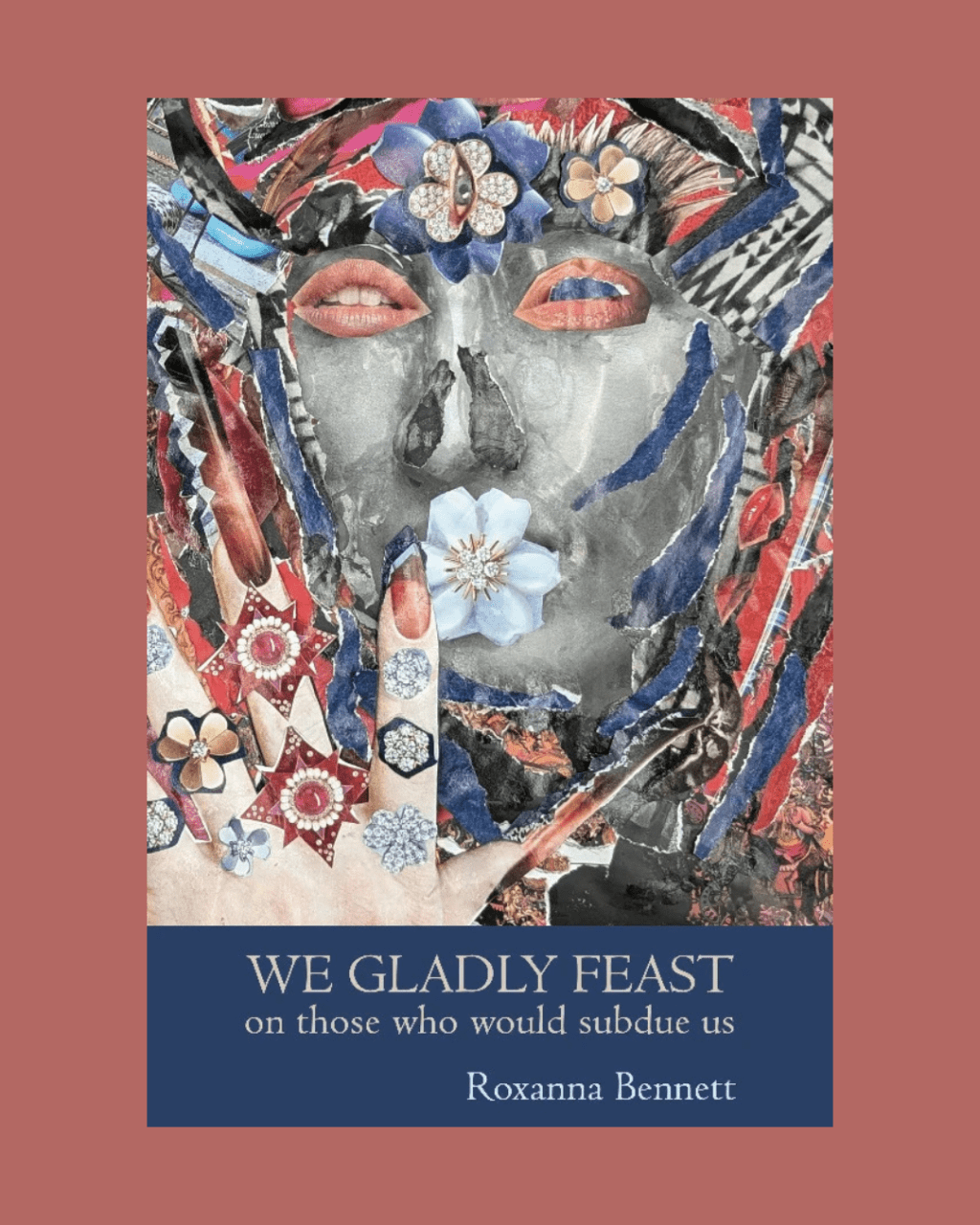
We Gladly Feast on Those Who Would Subdue Us is Roxanna Bennett’s fourth poetry collection with Gordon Hill Press. As a longtime Addams Family fan, I was intrigued from the moment I heard the title and realized it was a nod to their family motto from the 1991 film. I was also intrigued as a fellow disabled, neurodivergent poet who has written on some of these themes.
We Glady Feast marks a departure from Bennett’s usual poetic style, as established by her earlier collections—Unmeaningable (2019), The Untranslatable I (2021), and Uncomfortability (2023), which mainly play with the sonnet form. The process notes on the first page let the reader know what to expect: “many of these are ‘found’ poems using text from various sources.” Bennett is using “unconscious analog art-making methods such as cut-up, collage, & chance operations.” She is working with what’s at hand to create something new, which is one of the foundations of disability poetics.
The first few pages lay out Bennett’s influences, references, and sources, including a blog post about autistic speech patterns, a book of occult art, Marshall McLuhan’s Understanding Media, and about forty other sources. The collection is made up of three long poems: “The Oxford Dodo vs. The Anatomical Venus,” “The New Bodily Ethos,” and “Excavation of the Colossal Mother.” Each poem begins with a collage, presumably also created by Bennett, that sets the scene moving into the poem.
The collection is striking from the get-go, laid out as it is horizontally rather than vertical on the page, so that one has to turn the book in order to read it. The lines stretch and move across the page, both in length and size, adding to the collage effect. Images and dialogue layer together, making new meaning out of juxtaposition.
One can hear the echoes of nonsense poetry in this collection. Bennett nods to Charles Dodgson, the author of the Alice in Wonderland series and many nonsense poems, in “The Oxford Dodo vs. The Anatomical Venus.” “Dodgson himself was the Dodo,” she writes (or perhaps, channels would be the better word), referencing the character he most identified with as a result of his stammer that reportedly caused him to introduce himself as “Do-do-dodgson.”
Bennett is preoccupied with sound and language disorders throughout, making me wonder what would be added to these poems by hearing them read aloud. In “The Oxford Dodo vs. The Anatomical Venus,” she says, “In characterizing this sequence write entirely about experience. I shall therefore have to use the / language of So many”. By using many different voices in these poems, she translates the disabled experience.
In “The New Bodily Ethos,” words in larger font begin to interrupt on the page, creating the impression of a multitude of voices, all speaking in different tones and volumes. One of them says, “You really can learn to be creative as you pain. / It’s like anything she, it just takes some practice.” We Gladly Feast provides a roadmap for other disabled folks looking to be creative “as [we] pain.” It’s a reminder that our creativity and productivity don’t have to look like other people’s.
The final poem of the collection, “Excavation of the Colossal Mother,” is where we are introduced to the divine shadow feminine, who “will not be intellectualized, only embodied.” Larger text seems to be mainly representative of Her voice, which starts off the poem:
“I am ill
laughter & rubble

I am old
but here
beautiful”
She is a powerful figure of transformation—represented by various monsters throughout the poem: Baba Yaga, Leviathan, “bare-breasted snake creature, three-eyed god.” While She is a terrifying figure, She’s also a source of protection and comfort. “Ascend to my solitude,” She says, “take refuge / in me.” She is a representation of disability in all its fear and loneliness and strange power of endurance. Bennett reminds us, “the symbolic Being / is also / Self.”
While I sometimes felt that I was missing out on certain meanings due to a lack of familiarity with some of the source texts, the overall impact is powerful. I found it beneficial to read the poems closely and then skim through them again to see what “popped” out at me. The effect of the collage form makes it nearly impossible to read the poems narratively, as meaning flits between lines and can only be seen by taking in the greater whole and squinting a little.
Roxanna Bennett’s We Gladly Feast on Those Who Would Subdue Us is a challenging read, but a worthwhile one that I encourage you to pick up and read for yourself. It’s a thoughtful contribution to disability poetics that forces the reader to look closely but also allow the words to collect and move through them to create a larger picture. The collection is a “rough beast,” cut up and stitched back together, but lurking beneath is a greater whole, the divine shadow feminine peeking between Her fingers at us, occasionally making Herself known.
(Note: A review copy of We Gladly Feast on Those Who Would Subdue Us was received from River Street Writing)
Courtney Bates-Hardy is a poet and author of Anatomical Venus (Radiant Press, 2024) and House of Mystery (2016). Anatomical Venus was shortlisted for two Saskatchewan Book Awards. She recently co-wrote a chapbook, Prairie Queers (Gridlock Lit, 2026), with her writing group, The Pain Poets. Her poems have been published in Event, Vallum, PRISM, and the Canadian Medical Association Journal, among others. She has been featured in The Best Canadian Poetry and nominated for a Pushcart Prize. In 2025, she won the City of Regina Writing Award for her manuscript-in-progress, We Want to Live Like Trees. She is queer, neurodivergent, and disabled.