reviewed by Chris Banks
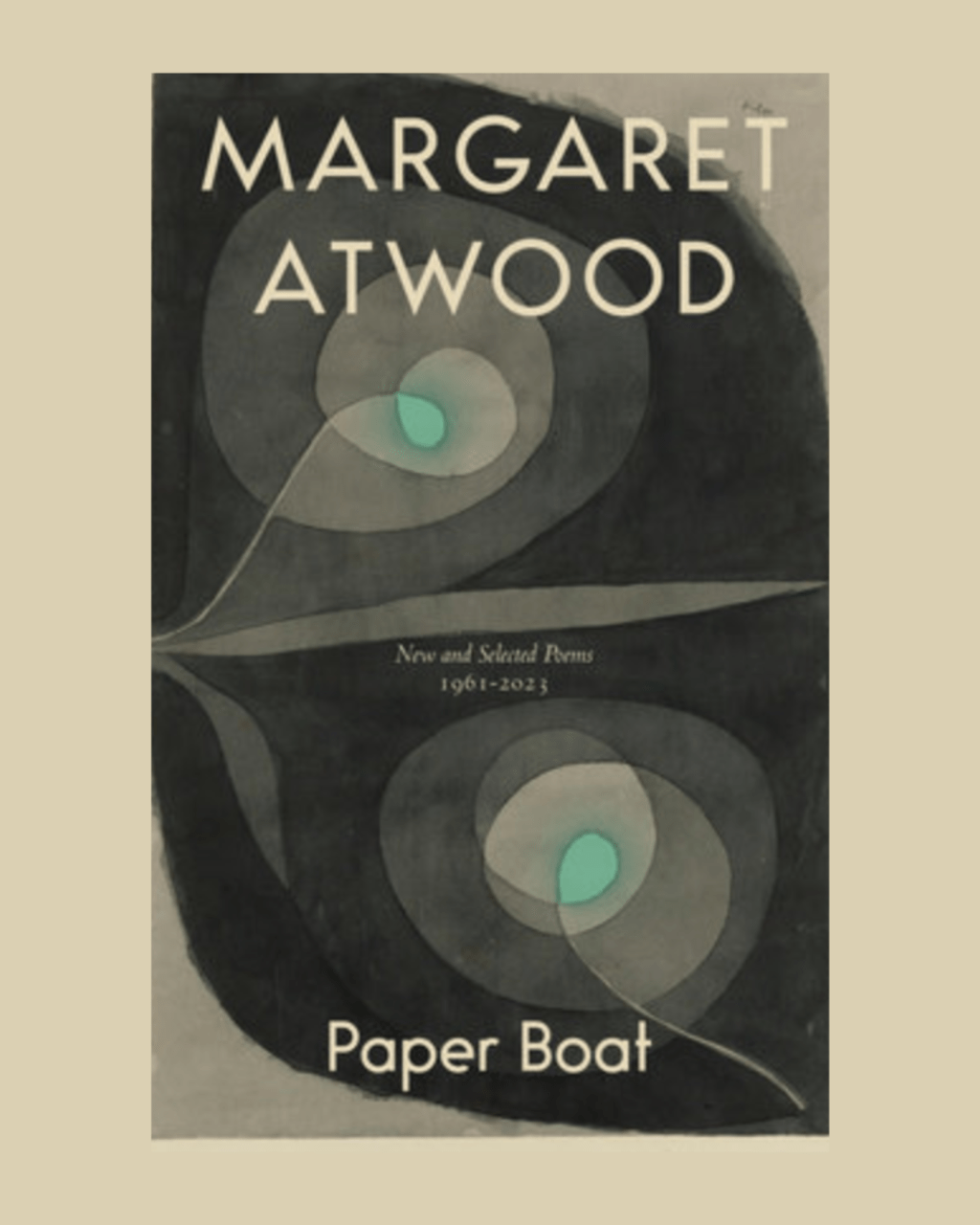
Usually I review books published within a given year (rarely do I reach backwards), but I somehow forgot to review Margaret Atwood’s Collected Poems Paper Boat out with McClelland & Stewart in 2024 which is a massive, six decade, career-spanning tome of poems. The inside cover description calls these poems “brilliant, beautiful and hyper-imagined”. I like that phrase “hyper-imagined” to describe Atwood’s poetry which for me has always been a rich amalgam of voice and whip-smart imagery.
In Paper Boat, Atwood’s seventeenth poetry collection, all your favourite poems like “This Is A Photograph of Me” and “You fit into me…” and “Variations On The Word Sleep” are there to be enjoyed again, the latter poem with its terrific stick-the-landing ending: “I would like to be the air / that inhabits you for a moment / only. I would like to be that unnoticed / and & that necessary.”
But there are plenty of new poems to be found, enjoyed, and puzzled over, too. Atwood really has some great titles like “Owl and Pussycat, Some Years Later” and “The Tin Woodwoman Gets A Massage” and “Update On Werewolves”, and I really like what Atwood does in the first line of her poem “Heart” from The Door:
Heart

Some people sell their blood. You sell your heart.
It was either that or the soul.
The hard part is getting the damn thing out.
A kind of twisting motion, like shucking an oyster,
your spine a wrist,
and then, hup! it’s in your mouth.
You turn yourself partially inside out
like a sea anemone coughing a pebble.
There’s a broken plop, the racket
of fish guts into a pail,
and there it is, a huge glistening deep-red clot
of the still-alive past, whole on the plate.

It gets passed around. It’s slithery. It gets dropped,
but also tasted. Too coarse, says one. Too salty.
Too sour, says another, making a face.
Each one is an instant gourmet,
and you stand listening to all this
in the corner, like a newly hired waiter,
your diffident, skilful hand on the wound hidden
deep in your shirt and chest,
shyly, heartless.

Such a lovely poem. I always think the true test of a poet is not if they can write a sonnet on the fly, or build out a cento, but how a master poet can take clichés like the human heart, and make them somehow new, palatable, turn them on their head, or stretch them into some new dimension. There is some real sensory diction, words both simple and revelatory, like “a broken plop” or “the racket of fish guts into a pail”, and, of course, the confident assured images of coughing up a human heart being compared to “shucking an oyster” or a “sea anemone coughing a pebble”.  Here, the human heart is both a meal for unnamed others, and a specimen of “the still-alive past”.

Another poem I quite liked was "Little Robot" which is part of a larger ensemble of poems entitled Plasticene Suite and the ending of the poem seems quite apt in light of the Artificial Intelligence boon-or-bust we are currently facing. At the conclusion of the poem, the speaker asks the little robot:
Will we become your ancestors,
Rapacious and tedious?
Or will you erase us?
Will you drop us on the floor?
Would that be better?
The robots are coming, the poem seems to be saying, and I for one hope we are not erased. To bring this review to a close, a review which is really an appreciation, let me just say no one needs me to tell you how great Margaret Atwood the poet is, but I was really struck when reading Paper Boat: New And Selected Poems 1961-2023 not just by the confidence of her imagery, but the ‘hyper’ poetic attention she gives to her subjects like the human heart, or a little robot, or even just cleaning out the fridge: “What are they for, / these little jars of sadness, these jars of tears?”
Margaret Atwood’s Paper Boat is a career spanning look at her best poetry, and it is a pleasure to dip into it, to find old favourites and new poems a reader might not have encountered yet. It is a book that inhabits you, not just for a moment, but moments, reminding us all why we turn to poetry in the first place. Because for some of us, it is necessary as breathing.
Chris Banks is an award-winning, Pushcart-nominated Canadian poet and author of eight collections of poems, with Bureau of Useless Splendour forthcoming (Fall 2026, ECW press). His first full-length collection, Bonfires, was awarded the Jack Chalmers Award for poetry by the Canadian Authors’ Association in 2004. Bonfires was also a finalist for the Gerald Lampert Award for best first book of poetry in Canada. His poetry has appeared in The New Quarterly, Arc Magazine, The Antigonish Review, Event, The Malahat Review, The Walrus, American Poetry Journal, The Glacier, Best American Poetry (blog), Prism International, among other publications. Chris was an associate editor with The New Quarterly, and is Editor in Chief of The Woodlot – A Canadian Poetry Reviews & Essays website. He lives with dual disorders–chronic major depression and generalized anxiety disorder– and writes in Kitchener, Ontario.