
reviewed by Leesa Dean
When I came across My Love is a Durian, I was immediately attracted to the title, having recently been to Thailand, where I experienced the dichotomous headfuck of this particular fruit, known for its sweet yet pungent potency. How might the durian serve as a central metaphor in a collection of poems? I wondered. I had to find out.
My Love is a Durian by Kelly Kaur is a powerful, stylistically diverse exploration of what it means to be a daughter, a rebel, and an activist. Like the durian, the poems are sharp-edged; they are also soft-centred, fragrant, and memorable. They operate on various emotional registers, oscillating from nostalgic, vivid renderings of the author’s early upbringing in Singapore to harsher reflections on being an unwanted girl child and later experiencing racism as an immigrant in Alberta. Throughout, there is a central tension between what the author refers to as “a permanent immigrant’s melody” and the desire for a world where “there is no border/there is no race (57).”
I was especially drawn to the numerous feminist poems in the collection. “Revolution,” for example, acts as a blueprint for many of the book’s central themes:

Rebellion, tongues, and non-compliance all recur throughout the collection, acting as forces of cohesion for the varied themes, relationships, geographies, and time periods portrayed in the book’s 56 poems. As a reader, I experienced a sense of travelling great distances, of processing multiple truths as I read and reread the collection.
Defiance and injustice are deeply embedded in multiple poems. In “Lotus Flower,” for example, Kaur reflects on how her father didn’t go to the hospital for two days after her birth—“only a girl/why bother?” she writes in reported speech. However, the father-daughter relationship evolves, remaining complex while also shifting toward empowerment. In the poem “Rising Up,” Kaur writes, “my father’s infinite love, reluctantly/gave me powerful degrees, one for each hand.”
Despite these emotional concessions, the origins of this father-daughter relationship cannot be extracted from its complicated beginnings. Kaur’s poems show how traumatic intergenerational cycles can be broken, using her daughter’s birth experience as testimony:
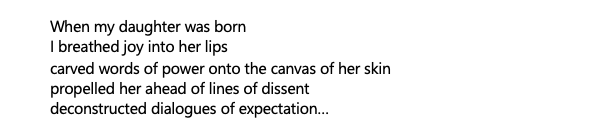
Structurally, there is no simple arc that moves from trauma to healing. Instead, the poems often loop back to the central premise that we live in a world where women are mistreated and where immigrants at dinner parties are told, “you really should learn to speak like a Canadian.” Kaur intentionally weaves a tapestry in which narratives of hope and oppression live side by side, equally weighted.
One of the most striking examples of systemic oppression is portrayed in the poem “The Hymen Test,” which centres on the experience of a woman in Jakarta who, in order to become a police officer, must surrender her body to a painful “medical” examination. There is a stark contrast between her innocent dreams and the cold, clinical setting of the examination room:
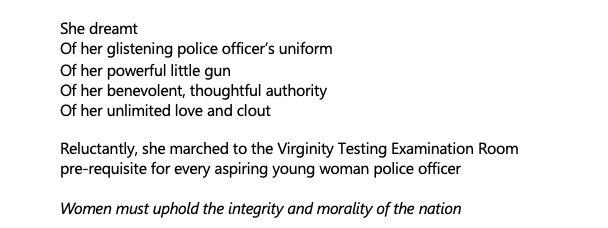
What strikes me most about this passage are juxtapositions such as the “powerful little gun” and the concept of “benevolent authority.” These juxtapositions ironically reflect the final statement that women should somehow be responsible for the “integrity and morality of the nation,” while virginity is the scale of measure rather than character.
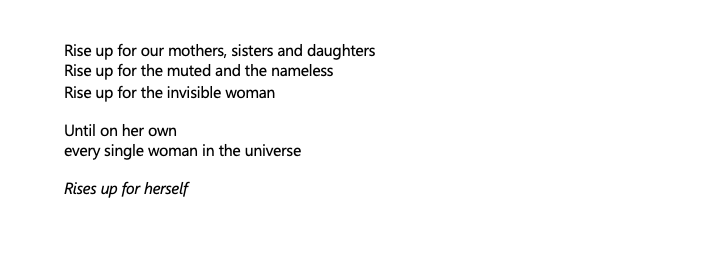
Overall, these poems are incredibly evocative and well-rendered. They raise awareness, explore complex family and race relations, celebrate rebellion, and serve as a feminist call to action:
Leesa Dean is the author of three books and two poetry chapbooks. Her first book, Waiting for the Cyclone, was a finalist for the 2017 Trillium and Relit Awards. Her most recent publication, Interstitial (Gaspereau Press) was published in Spring 2026 and features poems that were finalists for the Nick Blatchford Occasional Verse Contest, the Diagram Chapbook Contest, and the international Pacific Spirit Poetry Prize. She teaches Creative Writing at Selkirk College where she helps run The Black Bear Review, a journal dedicated to elevating the work of local and emerging writers. She lives in Krestova, BC where she recently finished writing a gothic romance novel about late 90s indie rock, female friendship, and complex families.