reviewed by Chris Banks
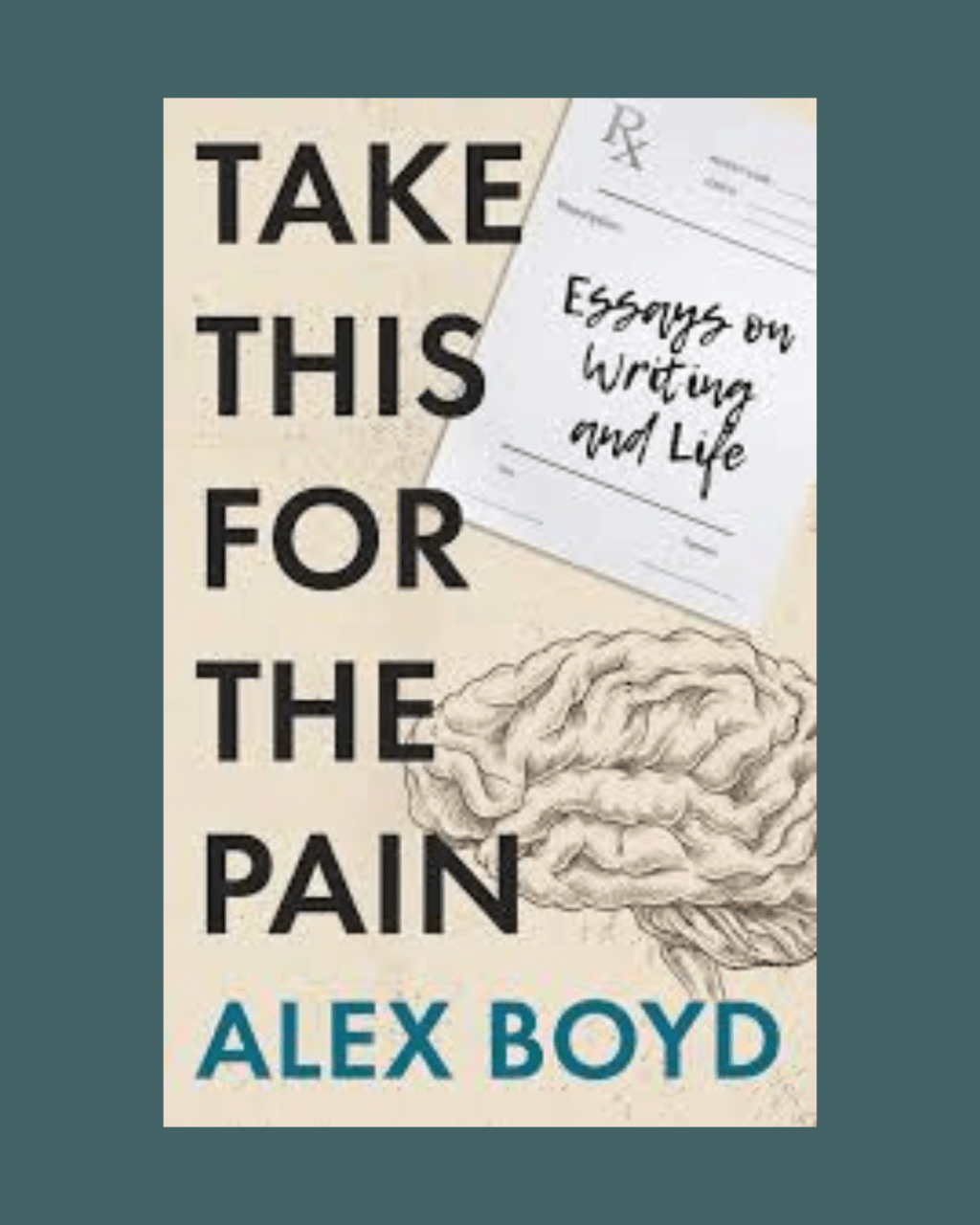
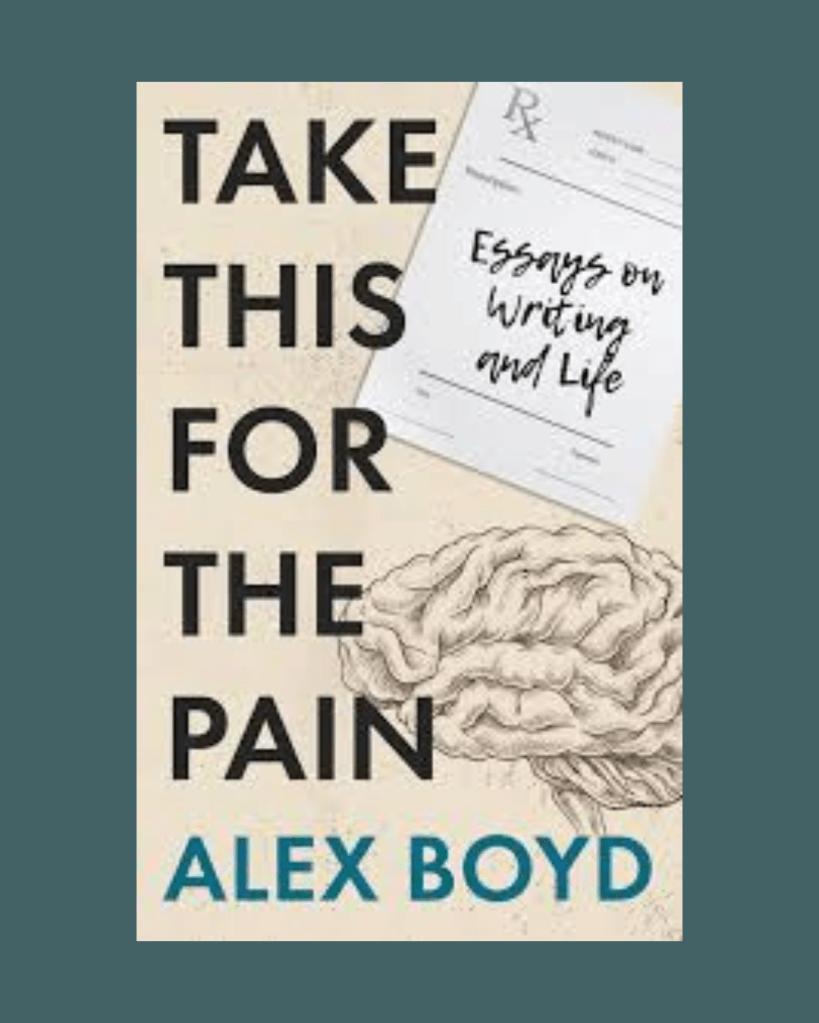
In his introduction to his collection of essays Take This For The Pain: Essays on Writing and Life out now with Palimpsest Press (Spring 2026), Canadian poet and novelist Alex Boyd talks about “trickle-up decency” and the need for a spiritual connection to our current world. He argues to not take ownership of the places we find ourselves, but to be connected to them, and to be present, but perhaps most of all, to humble ourselves by acknowledging so much lies outside of our perception, and that acknowledgement itself creates reverence, and reverence is what is needed if we are going to be worthwhile stewards passing on a better world to the next generation.
I believe this deeply, so I really related to Boyd’s essays about why read poetry, or being a bookseller at a large chain store in his twenties, his thoughtful ruminating tributes to Charlotte Bronte and John Wyndham and William Stafford, or his defence of graffiti practitioners or his account of an early journey to Ireland. Even his essay about Superman and storytelling and symbolism is really eye-opening, and Boyd’s thoughtful reviews of other writers’ work which conclude his new essay collection are incredibly thoughtful, and seem to be saying art, stories, wonder, being open to spiritual unknowns, these things help to keep the cynicism of our age at bay, and offer individuals greater connection to the world and each other which is what creates true contentment.
Whether it be a faith based practice or a writing practice, I think both if taken seriously can help an individual realize there are “spiritual elements in the world” and that experience is malleable. In his essay “Why Read Poetry?”, Alex Boyd writes, “we continue to produce books sent out like flares in the night, in the hope of connecting with a world that’s amused and mildly changed” (22).
There are also passionate paeans to creativity in Take This For The Pain: Essays on Writing and Life, as Boyd states in an essay about creating art post 9/11, “ “The reality is that society and art depend on each other. Society provides basic needs and funds special projects. At the very least, it should allow people to pursue things in their free time without requiring them to spend every waking hour on survival. In return, some people make creative contributions”(36). Life is not simply about national security or 401ks, it should also be about humility and realizing how small our lives are, really leaning in to ‘spiritual unknowns’ which is perhaps the best way to grow a sense of spirituality and a feeling of interconnectivity of things.
As he says in “Flying Blind: Thoughts On Faith”, Boyd writes “In humility we find recognition we play a small part in the world, a willingness to see there are unanswered questions, instead of a pointless attempt to gloss over it with overconfidence and stabs at power”(72). Faith is difficult for me, as I have really come to see myself as an atheist, but the idea of humility and trying to create meaningful connection through practising humility and writing poems and being present, but also thinking about why we are here, what is the purpose of this life, I find all of this very appealing as I find myself halfway through my Fifties.
One last quote comes from Alex Boyd’s own introspective look at turning fifty where he writes, “If dogs can smell at least ten thousand times better than we can—and this is really just one example—we should recognize that there’s a lot that doesn’t fit through the window of our perception”(138).
Awe. Wonder. Connection. Hope. Humility. Meaning-making. These are the big ideas, or flares sent up in the night, I find threaded throughout Alex Boyd’s Take This For The Pain: Essays On Writing and Life, out now with Palimpsest Press (Spring 2026) which is a brilliant essay collection about writing, culture and faith. It encapsulates twenty five years of Alex Boyd’s best thinking, and I’m not sure about you, but it’s these ideas I think of when growing my own spiritual sense of life, or to “stitch a human heart” as Dean Young once put it. I have read a few of the essays a number of times, and I’m certain other readers will too.
Chris Banks is an award-winning, Pushcart-nominated Canadian poet and author of seven collections of poems, most recently Alternator with Nightwood Editions (Fall 2023). His first full-length collection, Bonfires, was awarded the Jack Chalmers Award for poetry by the Canadian Authors’ Association in 2004. Bonfires was also a finalist for the Gerald Lampert Award for best first book of poetry in Canada. His poetry has appeared in The New Quarterly, Arc Magazine, The Antigonish Review, Event, The Malahat Review, The Walrus, American Poetry Journal, The Glacier, Best American Poetry (blog), Prism International, among other publications. Chris was an associate editor with The New Quarterly, and is Editor in Chief of The Woodlot – A Canadian Poetry Reviews & Essays website. He lives with dual disorders–chronic major depression and generalized anxiety disorder– and writes in Kitchener, Ontario.


2 responses to ““Trickle-up Decency”: A Review of Alex Boyd’s Take This For The Pain: Essays On Writing and Life (Palimpsest Press, 2026)”
[…] with my editor Jim Johnstone with excellent questions from Jim. The book has had good reviews at The Woodlot (my thanks to Chris Banks) as well as Hippocampus magazine (my thanks to Renee K Nicholson). An interview I did has appeared […]
LikeLike
[…] Thanks to Chris Banks for this rave review of Alex Boyd‘s TAKE THIS FOR THE PAIN on The Woodlot. “A brilliant essay collection about writing, culture and faith. It encapsulates twenty five years of Alex Boyd’s best thinking.” Check out the full review here: Woodlot review: Take This for the Pain […]
LikeLike