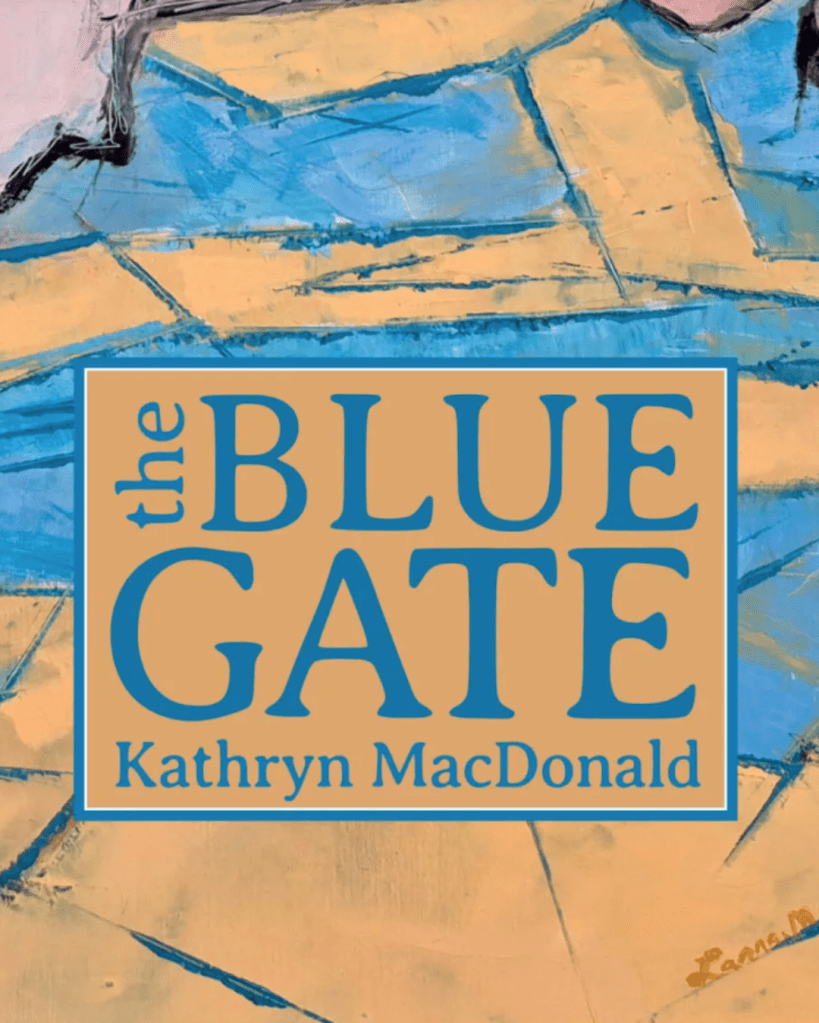
A review and a poem by by Antony Di Nardo
Enormous poems. Vast as a blue sky. Tiny poems … “as tiny as my hand/in yours on that evening.” Evening poems. That time of day between certainty and ambiguity. Clarity and reticence. “Our held breath/flowed silently into her song.” From a poem titled “On that Forbidden Evening.” The song belongs to a bird, but the words are Kathryn MacDonald’s, a very precise poet who knows about the verve and music of language and the lilt of a line. “I taste honey/pull feathers from my tongue.” I might say the same about her poems.
Trance-like and transfixed by the human experience, by what loss and words reveal, her poems vacillate between grief and grace. In the grip of a poet’s longing, they are surrounded by the beauty of rain, wet grass, “eternal savannahs” where “Red-tailed Hawks rise and rise before/clasping talons in courtship.” She writes of a “faded porch umbrella” and how “Soon dusk will settle over us/… as the earth pulls itself/to the dark side of our day/falling.” She writes, “Winter buries windfalls,/path and pond” and “Wind-whipped poplars stand grey/sky-dappled clouds ride deep blue” to illustrate an emotional landscape that informs both tone and voice. All the while she’s present, a witness in a state of awe, as her lover slips away. And she asks herself, “Can grief be a perpetual falling?”
These poems love being poems. They love to catch a glimpse of themselves. Correspond with each other. Poems you want to sit with, spend time with and say out loud. MacDonald follows her ubiquitous hawk from section to section and writes “It is not waxed wings I need/but cerement.” I had to look up the meaning. Cerement. A shroud to seal and bury the dead. It’s one of those words that’s easy on the tongue, fascinating to think about. Like so many of the poems in this collection.
And in the middle of the book come “The Blue Gate” poems that tell a poet’s story of hope and rekindling, of light and shadow in a foreign land. “I walk toward him—//Cross a threshold … We stop at a blue gate” and through that gate “memories invade the room” and turn into these poems.
The foreign land is Kenya where “All the workers’ hands are Kenyan black” and “grief is my jailor.” Beyond the blue gate she encounters “all the colours of Africa” and again the Red-tailed Hawk that in these poems becomes iconic, a talisman, a departed soul married to the sky. Her own spirit hovers in the shadow of Mt Kilimanjaro and when she finally sees the peak, it is “wearing a necklace of cloud.” As I said, enormous poems, some the size of a soul.
Reader and writer alike in this book meet in a lyrical “I.” Together we approach the end, the final poems, “searching for a warp in time” that just might slow it down. Here, the poems become contained, confined to tight spaces. They breathe in tiny rooms where
the candle sits unlit
and I have grown old in the silence
of your absence
Memory will have to do. Time cannot be reversed. Beyond grief and the many manifestations of the Red-tailed Hawk, themes of longing and reflection are at the heart of this collection in which ultimately “time merges years pass/love matures.” And the poet “walks/through changing seasons//singing singing still.”
After Kathryn MacDonald’s The Blue Gate

I can put faces to people
I’ve only ever met in books.
But whose face is that, I wonder,
	when I’m not looking.
The mirror is a big fat lair [sic].
Senses rise in the presence of absence.
Like-minded memories riddled
	and riled by the pond
		we happen to share.
It is not for lack of attending to time
	that poetry makes nothing happen.
The willows, the willows, the willows my own,
	how I wish there were more
		in this sentence.
Tonight, I’ll look beyond the clouds
	and feast on stars.
I’ll open the blue gate once again
	and walk right through.
The sky is only ever as close as it gets
	when you look up.
And I’ll be singing, singing still,
	once I shut the book.
Antony Di Nardo is the author of seven books of poetry. His latest, Forget-Sadness-Grass (Ronsdale Press 2022), was a CBC Books poetry pick. Recent work appears or is forthcoming in The Miramichi Reader, Pinhole Poetry, The Dalhousie Review, Queen’s Quarterly and CV2. “Among the Boughs,” first published in The Fiddlehead, will appear in the 2026 Best Canadian Poetry anthology. He lives in Cobourg, Ontario