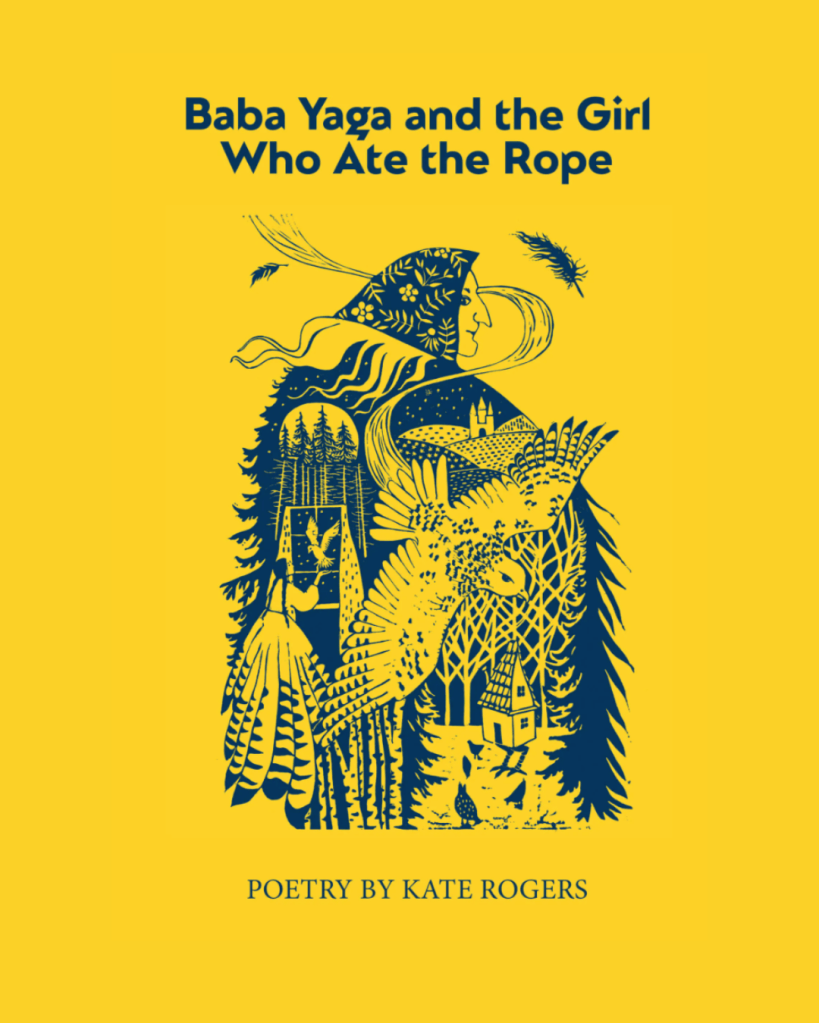
reviewed by Blaine Marchand
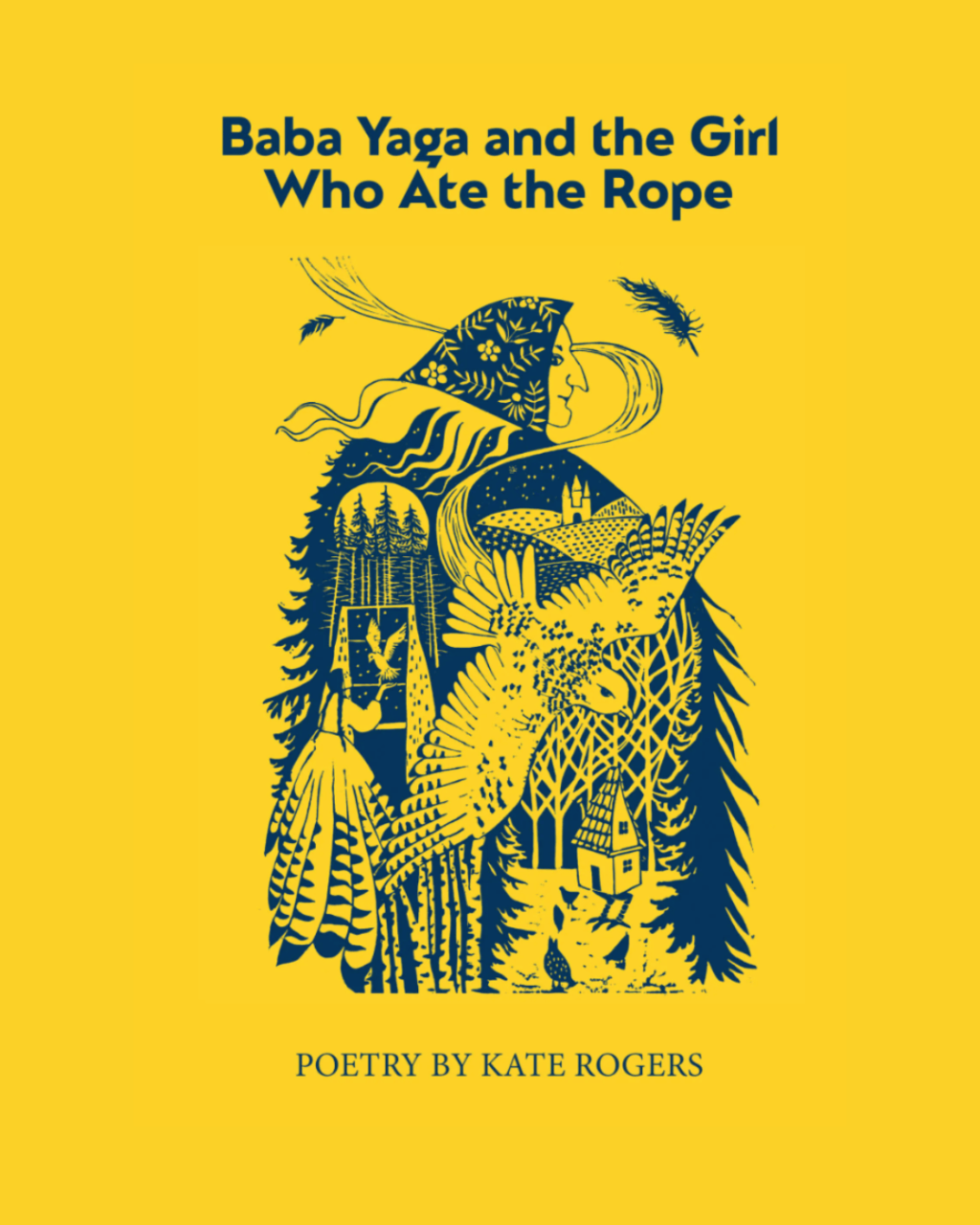
In this exquisite and compelling book Baba Yaga and the Girl Who Ate the Rope, Kate Rogers explores uneasy relations with her mother and her father, and the plight of the natural world around her. I highly recommend it for those who love well-crafted poetry and compelling, startling images.
Our lives with parents are complicated. While we know them when we are children, we experience them differently, with their strengths and frailties, as adults. But we can never really fully know the true extent of their earlier lives before we were born, or the experiences that shaped the persons they become.
In the opening of the book, Rogers gives the Oxford English Dictionary definition for the term Baba Yaga. It is one found in many of the Slavic languages, meaning witch. Baba on its own means grandmother. But in folklore, the person can be either a frightening old woman or one who helps the hero. In these masterful poems, she is both. And true to the Slavic stories, the poet’s mother lives in the forest and embodies traits of a witch.
When a parent is frail and suffering from dementia, the children increasingly become lost as the memories fail, confused and distorted. What surfaces is the core personality of the parent. As social graces erode, havoc in the relationship between parent and child takes hold. It is a difficult road to navigate.
In the case of Rogers, who spent years living abroad, she returns, as she writes in the opening poem, Prodigal, hoping “for the fatted calf”. Instead she finds a mother whose will power is “wrought iron as her frying pan”. This recalls how still her “childhood loneliness stalks the hall”. As she later confesses, both “are women who have lived/for ourselves firstly”.
The mother in the first sequence in the collection emerges as fiercely independent, who prefers her own company in a remote location in the woods where she tends to the needs of the animals and insects around her. She creates animosity between her two daughters, telling everyone: “I have only one daughter” and how the poet “rejected her breast, age six months”.
This sequence weaves past and present together, stitching the new harsh reality of dementia, past imperfect reminiscences and the delight found in the natural world, to portray fully the complexities of dealing with a failing parent, who eventually must be moved into assisted living.
The second sequence of poems is a precursor to the first, exploring the relationship of mother and daughter prior to diagnosis and the illness taking full hold. Frailty and vulnerability of both women are explored deftly and bravely. This was a time when the poet “learned our mother all over again,/ her life-long suffering”. Her mother loses her English; Rogers finds her own voice.
She becomes the caregiver, storyteller, scratching in her notebook, realizing she is very much “Baba Yaga’s child”. Like her mother, the poet has a close connection to the birds and animals in the forest and lake about her mother’s cabin. She writes: “Happiness the hand-me-down meadow/ where Baba Yaga and I sat side-by-side listening/ to scuttle and hum, inhaled sweet milkweed/scent.” She draws strength from the world around her that sustains her in this difficult time. Never far, always surfacing, is her difficult, independent and sometimes cruel mother. But equally close, nature brings her inspiration and solace though she recognizes that they are vulnerable in these times of climate change.
Even when in the care home, she writes of her mother: “her temple/ a winter sky, her eye a gloaming/ that lingers long after the light goes.” In another poem, she offers, “all the words you know/ for winged beauty/ freed from your tripping tongues. I will feed you their names/when you forget.”
In the first two sequences, there is no mention of a father. In the third series of poems, she turns her attention to him. Only four poems in length, they are in comparison with the preceding poems, stark and sparse yet powerfully honest.
Her father abandoned the family for a second, younger wife, also of mythic traits, in this case Diana, goddess of pagans. Rogers understands his own grief: “After your teenage sister died/ you closed the book of yourself.”
But he had a very public side to him. Well-known for his radio baritone, Rogers’ sister forgives him for his constant “Emceeing the room” while the poet “sitting across from him/ dial[s] my volume down.”
Unlike her mother, who visited her when she lived abroad, her father chose not to, never experiencing how she, too, can “hold the attention/ of a lecture theatre of students/ without a mic.” And when she moved back to Ontario, he moves to a Rocky Mountain town with a valley with “Echoes big enough for his voice.”
But this collection is not just filled with sadness and grievances. It is important to stress there is joy and serenity, particularly in the poet’s relationship with nature, instilled in her by her mother. In the final poem in the book, a standalone closing, dedicated to her step-daughter, she writes “You made snow angels with your fresh wings. We snowshoed/ through drifts tinkling, slow breaking glass.” It is a poem of hope and, in a way, of reconciliation
Baba Yaga and the Girl Who Ate the Rope is an impressive and rewarding collection. It explores family dynamics in a thoughtful and compelling way. It is a book to read and reread, each time discovering more nuances, more depth in the poetry.
Blaine Marchand lives on the unceded territory of the Algonquin – Anishinaabe people, known as the Ottawa Valley. His award-winning poetry and prose has appeared in Canada, the US, New Zealand, Pakistan, India, France and Ukraine. The author of 10 books, he has been active in the literary scene in Ottawa for over 50 years,. He is currently chair of the 104-member Senior Poets Caucus in the League of Canadian Poets. He was President of the League from 1992-94. His chapbook, Anthems for a Dead Youth, is forthcoming from Big Pond Rumours. His newest manuscript is Promenade and he is at work on another, tentatively titled, In Response.