reviewed by Chris Banks
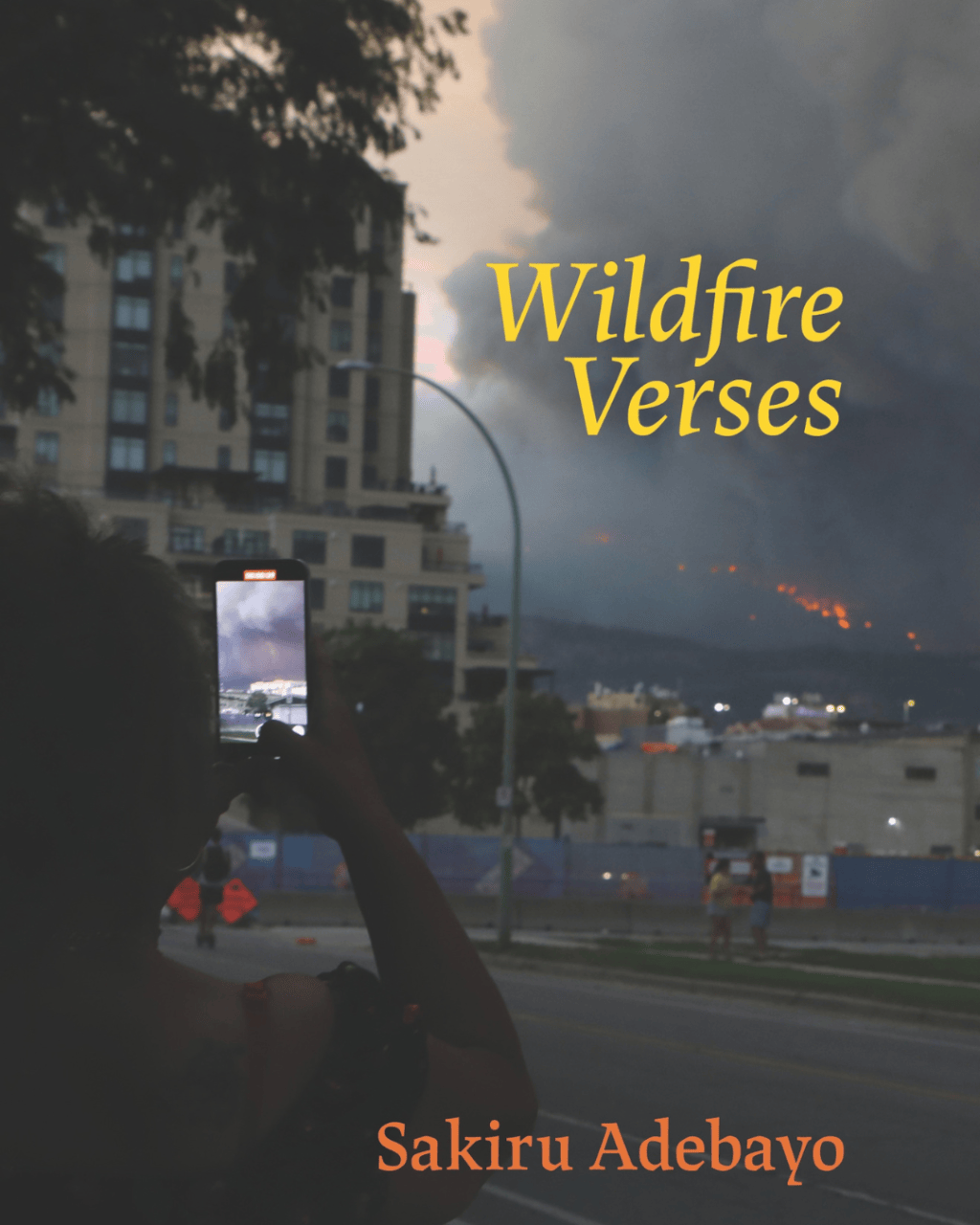
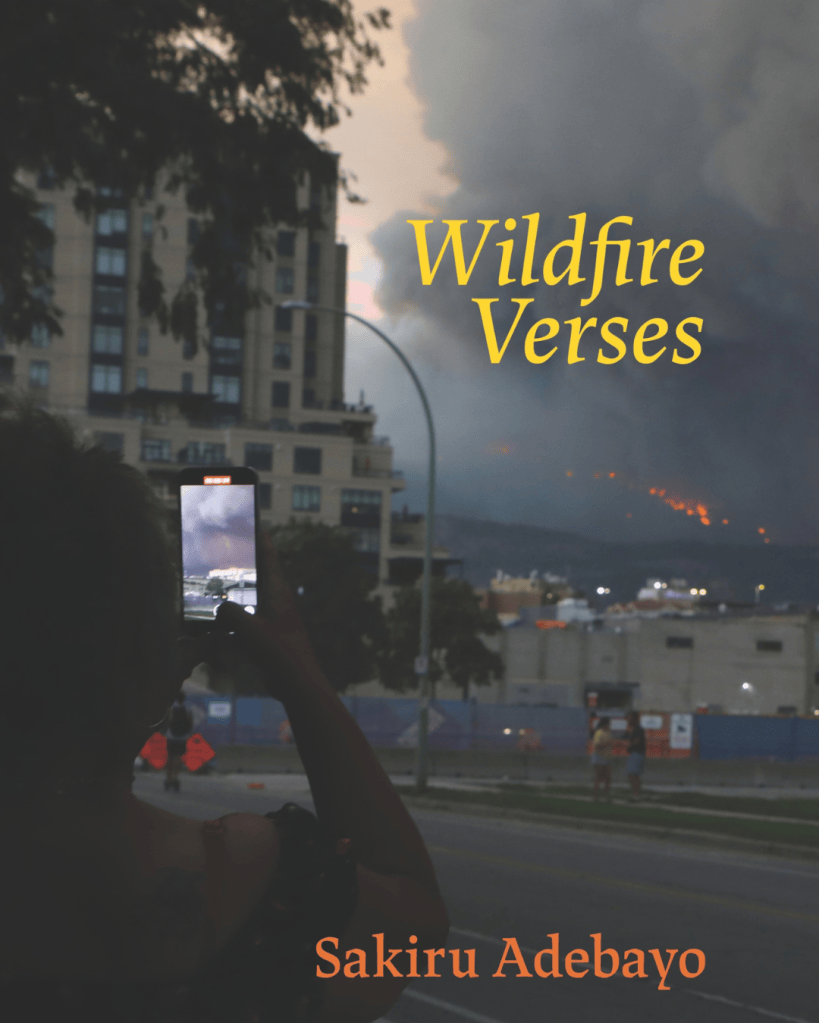
“Writing poetry after a wildfire / is a herculean task” writes Sakiru Adebayo in his poem “Wildfire Verses” which is also the title of his debut poetry collection out with Nightwood Editions this Fall. I have to admit, as someone with generalized anxiety disorder, and inwardly panics when I see the skies turn an orange amber a few days every summer due to distant Northern forest fires, this collection brings the climate crisis into clear, unflinching focus: something needs to really change or ecological collapse is a certainty.
Sakiru Adebayo is a professor at Western University, but before moving to Western, the poet Adebayo worked as an assistant professor in the English department at the University of British Columbia Okanagan from 2021 to 2025, and was made to evacuate his Kelowna apartment after an evacuation alert due to the tragic McDougall Creek Fire of August 2023 which burns beneath every poem in the collection.
Adebayo calls himself a “catastrophe poet” in this collection as if writing about eco-politics and climate catastophe are a vocation, his fate, perhaps his duty even, given his firsthand experience as a poet and a human being who survived the encroaching flames that lick at his images and short stanzas.
There are not a lot of pyrotechnics of language in this collection, but that’s not really the point of these poems. Sometimes a poem is a carnival of wordplay and off-the-wall-images, and sometimes a poem is a verdict. This book of poems is “of the verdict” kind. Take, for instance, these first lines from the poem “Kelowna Taught Me About Consuming Fires”:
In Ibadan,
I learnt about abstract theories;
In Johannesburg,
I learnt to see race in everything;
In Kelowna,
I learnt that the world will end by fire
For me, these lines are a verdict that challenges and uproots our social security safety nets, our carefully tended boundaries between people of different creeds and races, and simply pronounces we are all in real trouble. The fires will continue unabated, year after year, and what are we going to do about it? For Adebayo, he wrote this book. The simmering essence of the whole collection might just be the line, “Man’s felony against the earth is a felony against himself.” I read this and immediately connected to the truth of this statement.
There are poems about a marriage struggling amidst climate change, poems about “a post-humanist ‘we’” which suggests we need to stop seeing ourselves different from each other, but also different from the environment, the very trees and plants we depend on for air, poems about having left home to find a new home now on fire.
In the poem “The Climate Refugee”, Adebayo writes, “Climate wars have replaced civil wars, / but the calculus of displacement remains the same”. This is heartbreaking, sobering, unarguable.
Here is an early poem in the collection “Writing Poetry After A Wildfire” that feels simple, the language itself almost unadorned, but the clarity of the subject matter, its tone, is more than a little serious:
Writing Poetry After a Wildfire
In the acts of this fire season,
our cloven tongues
fail to produce
a syntactic symphony
Our conflagrated eyes
refuse to see
the aesthetics of
a comic language
Our furnaced minds
fall short
of flowery adjectives
And our flammable dreams
explode
in blazed brokenness
Writing poetry after a wildfire
is not a task
for the faint-hearted
Conjuring lines
in the wake of
flaming devastations
is an exuberance
of unscathed survival…
I like this poems which eschews “flowery adjectives” for saying it plainly: “Writing poetry after a wildfire / is not a task / for the faint-hearted”. Maybe this poem is not a “synactic symphony”, but certainly its flickering meaning is white-hot and all consuming. I get a real sense, a gut-level reality-check, that as a poet to survive unscathed a wildfire of the magnitude of the McDougall Creek Fire (where thirty thousand people were put under evacuation alert), maybe one needs to write about climate catastrophe, the elephant on fire in the room, and place all other poetic concerns off to the side.
Adebayo uses the word “eco-anxiety” in his poetry collection Wildfire Verses out this fall with Nighwood Editions, and I sharply inhaled when I read this phrase as I connect deeply to it, even though I live in SouthWestern Ontario away from the bushfires buring up North and out West (which are still burning even as I write this review). I’m not sure how my own poetry would change after an evacuation alert. Adebayo says late in the book, “who will interpret / this apocalypse in the clouds?” This feels like a challenge to all poets, as Sakiru Adebayo has made wildfires, the bad karma and retribition of “fire season”, the burning nexus of this book of poems, and it is up to us not to look away. To not just survive it, but to make real change.
Chris Banks is an award-winning, Pushcart-nominated Canadian poet and author of eight collections of poems, with Bureau of Useless Splendour forthcoming (Fall 2026, ECW press). His first full-length collection, Bonfires, was awarded the Jack Chalmers Award for poetry by the Canadian Authors’ Association in 2004. Bonfires was also a finalist for the Gerald Lampert Award for best first book of poetry in Canada. His poetry has appeared in The New Quarterly, Arc Magazine, The Antigonish Review, Event, The Malahat Review, The Walrus, American Poetry Journal, The Glacier, Best American Poetry (blog), Prism International, among other publications. Chris was an associate editor with The New Quarterly, and is Editor in Chief of The Woodlot – A Canadian Poetry Reviews & Essays website. He lives with dual disorders–chronic major depression and generalized anxiety disorder– and writes in Kitchener, Ontario.