reviewed by Wren Ashenhurst
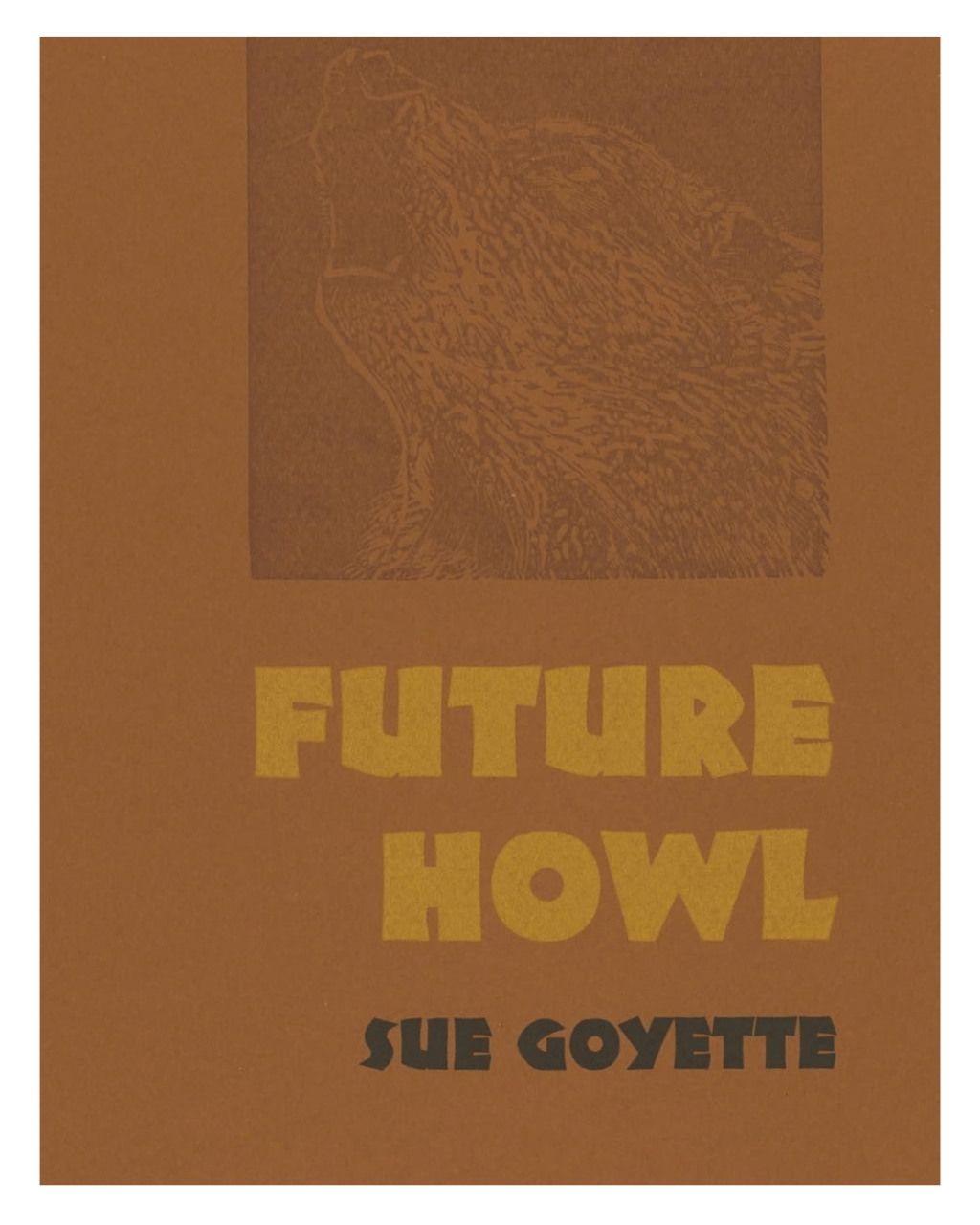
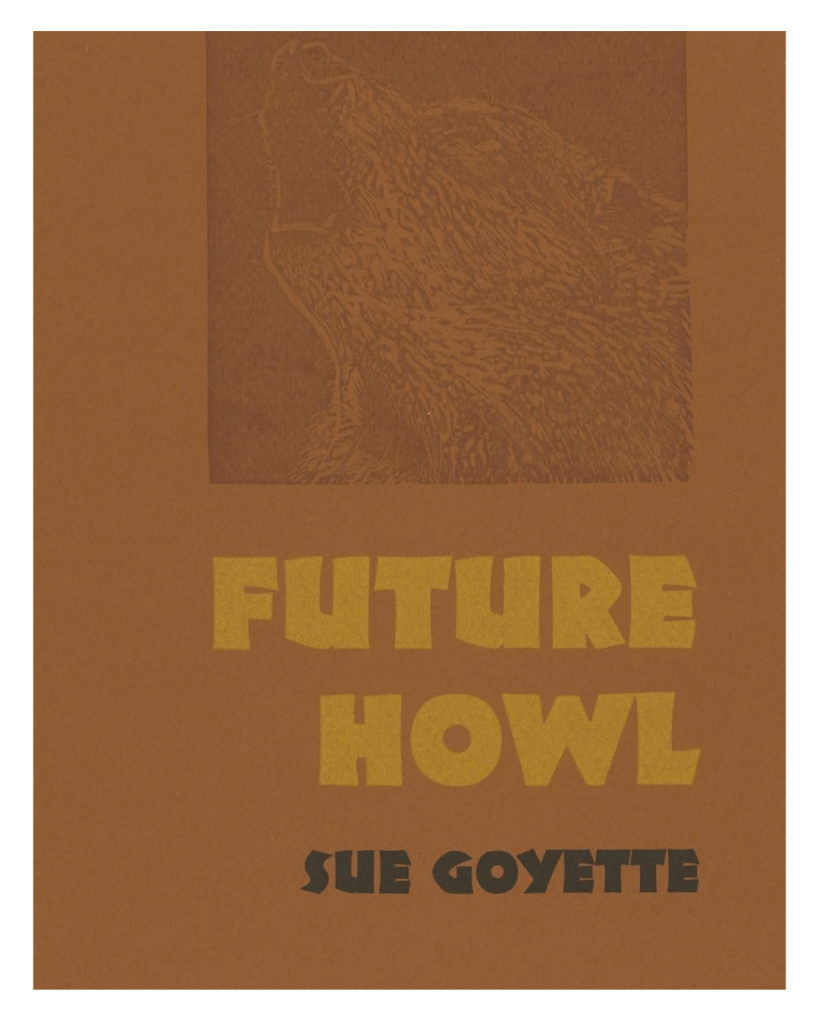
Future Howl, released in 2025 from Gaspereau Press, is the latest in Sue Goyette’s illustrious literary career. It meditates on themes of trauma and survival—personal, societal, and environmental—while weaving together references to the painting lessons of Bob Ross and the live cam of a pair of endangered red wolves. This mix of the psychic and metaphysical crashes into the real, natural and sublime, with Goyette applying colour and texture to her language as Ross might while painting his happy little trees. The result is an intricately painted picture that only becomes more rewarding when one stops to examine each brushstroke and subtle shift in colour.
I was first introduced to Goyette’s poetry in the spring of 2025. A classmate showed me her work through an in-class reading of a poem from Goyette’s 2013 collection, Ocean. To say I was immediately captivated would be an understatement, as I quickly ventured to get my hands on a copy—a process that was complicated as my local library no longer had it in circulation. I did, eventually, find a copy in my hands and was not disappointed by what I found.
So, when I discovered that Goyette had recently published a book, the elation and hesitation that filled me were palpable. The book sat near my desk for several weeks as I puzzled what to do if what I found didn’t live up to the hype I had manufactured for myself. Future Howl is quite the departure from Ocean, over a decade and ten or so books in between will do that, I suppose, but what I found was just as rich and moving as what initially drew me to Goyette’s poetry.
Future Howl is a book-length poem told in two parts, or perhaps two long poems that sing to each other from across the pages. In it, Goyette meditates on cycles and phases. Mothers and daughters. Trauma and survival. Her themes are woven through lunar metaphor and poetic structure, and the juxtapositions between the mythic and in some ways the hyper real. In Future Howl, Goyette writes a haunted and haunting poem that howls for the reader to listen to it in all its intricacies and idiosyncrasies.
The form of the poem is unexpected, and wholly engaging, as Goyette constructs it in precise ten-line blocks with little variation in line length. In contrast to this form, the language trips over itself, spilling between and across pages. Through this Goyette almost challenges the reader to meet the poem as a whole. This is not a collection of poems, nor even a journey or story told in verse, but a full and singular work that should be met in its fullest capacity.
It is of note, then, that the poem is functionally presented as two poems, that can be read separately (if one must take a break in between the reading and split the book into two distinct sections). These two poems, entitled “Private” and “Public,” exist in contrast and harmony with one another.
The first section, “Private,” is where Bob Ross, his paintings, and his recorded painting lessons provide the greatest guide. Goyette begins with the figure of the mother who swallows the moon. From there, the section drifts, shifting in location and character as it travels through a parking lot, a hospital, a kitchen, and from the mother to her older and younger daughters. This continues until eventually we find ourselves watching Bob Ross, and he is teaching us how to paint. The section is, ostensibly, about trauma, however this overarching thematic core is obscured artfully in the brushstrokes of Ross’ landscapes. Goyette links these two concepts—Ross’ painting lessons and trauma—using the former to explore the latter.
the dimmest version. As in: are you funny or did you have
a happy childhood? There is a pond in the photo and a line
of trees. Bob Ross counsels to first wiggle the brush through
the paint to bring it to a nice sharp edge. Wiggle it.
By wiggling it, it pulls the pain towards the end
of the bristles and sharpens it just like a knife. Son of a gun.
You could shave with it. The ghost of that sharp knife
revives that sense of meaning I’m after. There is,
after all, danger in remembering. Super sharp. Now then,
let’s decide, maybe there’s a happy tree. Start with just touching
the past and with the corner of the memory, dip into your voice
and begin pushing, making your heart go slightly downward.
see there? Look at that! Isn’t that a nice little tree?
Goyette’s decision to write survival and recovery of childhood trauma by utilizing reconstructed Bob Ross lessons is effective, due to the nostalgic place Ross and his work occupy in my mind. There is a nostalgia for Bob Ross, his paintings and his lessons which many readers either caught on public broadcast stations or through digitally archived episodes.
If “Private” is a Bob Ross painting—a clash of lines and colours to render a landscape, however abstract and misty—“Public” is a 4K livestream of two wolves. It is much more precise in its focus and imagery. There is still fluidity, but it is more through the non-linearity of the speaker’s thoughts as they obsessively watch the live wolf cam than through the shifting of place and character. This section is where Goyette is the most direct with the reader, her language clear, though no less rich. Here the question is of survival. Survival of the wolves, of the planet, of the human entity.
Goyette employs a fierceness and feral quality throughout the book, but this is especially effective in “Public.” We are no longer talking about the considered, if at times intuitive, brushstrokes of a painting. We are talking about here; we are talking about now; “Our once spectacular planet is now a dying clump / of something long and lingering.” The imagery is still of a natural quality, but it is sharpened and bright.
In this section, Goyette raises two questions of the humans watching the wolves: “The question that persists is how do we endure so much/cognitive dissonance?” then, over the page, “The other question that persists is what / the actual fuck? which can be applied to most everything.” Because this is what “Public” is about; how do we deal with all this? In earlier passages, Goyette writes, “It was a dangerous time. It is / a dangerous time” and “I’ve learned to critically / assess complexity by listening actively for who’s not / getting to speak.” “Public’s” section, with its framing device being someone watching the livestream of two endangered red wolves, poignantly talks about the climate crisis, the encroachment of industry, and the continually developing dehumanization that comes from living, as we do, in the age of watching destruction and dehumanization in real time from across a screen.
“Private” and “Public” are in a dance, or perhaps it is that they are duetting in some intricate song. It is a grappling of trauma and survival. How we survive the trauma of our childhoods, how we are traumatized, retraumatized, and how we survive that ordeal too. This feels, to me, something precious and poignant, a wondering of what all this was for, and whether this was the future we were promised as kids, when we read stories so full of hope.
Which is to say nothing of the beautiful language that Goyette uses to explore her themes. The language contained within Future Howl is sharp and cutting, rendering images of the red wolf’s environment with remarkable clarity and drawing the reader in with its free-flowing lines.
To say that Goyette ultimately delivered on all my self-inflicted hype is an understatement. As I sit with Future Howl and reread and recite its lines, I’m sure I will continue to find things to love and admire. Future Howl is a treat and a reckoning. A plea and a lament. It is haunted by the past, the present, and the hope for a future where we can try to be better, where we can heal and live in a sort of harmony with the Earth and each other. There is optimism, but it is not without its teeth. It may just bite you and refuse to let go.
Wren Ashenhurst is a queer trans/nonbinary writer from the Canadian west coast. Their poems can be found in Defunkt Magazine and Pulp Mag.