reviewed by Caitlyn Carr
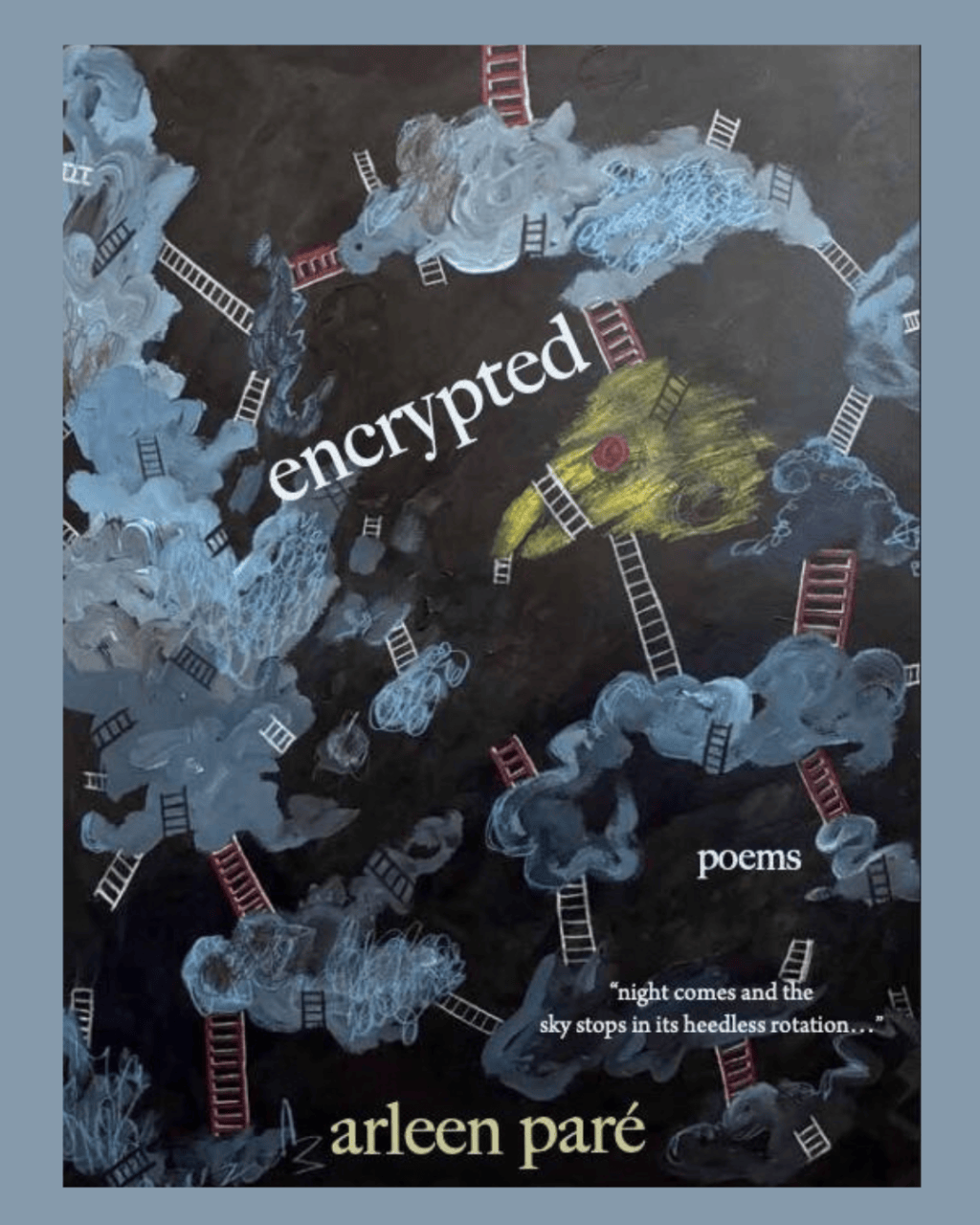
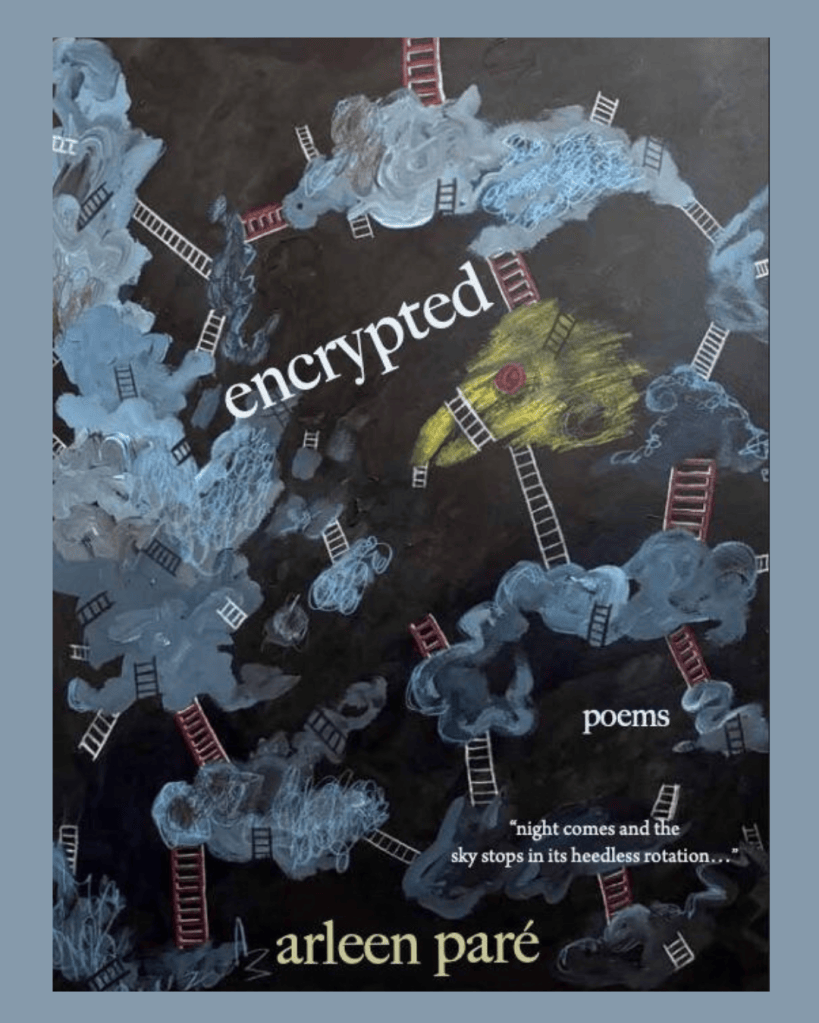
In the fall of 2020, Arleen Paré’s nineteen-year-old grandson moved into the basement of the home she shares with her wife in Victoria. While witnessing his struggles with depression, anxiety, and addiction to video games, Paré wrote her tenth poetry collection, Encrypted, as an outlet for her concern for both her grandson and other young adults struggling in an ever-evolving world.
Born in Montreal, QC, Paré received a BA and an MA in Social Work from McGill University before moving to Vancouver to be a social worker while pursuing an MA in Adult Education at the University of British Columbia. After retiring, Paré moved to Victoria, BC to study Creative Writing at the University of Victoria. Paré has since been awarded the Governor General’s Award for Poetry, the American Golden Crown Award for Poetry, the Victoria Butler Book Prize, a CBC Bookie Award, and was shortlisted for the BC Dorothy Livesay Award for Poetry.
A collection woven with compassion, Encrypted feels like a literary hug that only a grandmother can give. Paré’s flow of gentle lines coupled with her lack of capitalization and punctuation evoke both tender care and terrible worry. She further abandons convention in Encrypted by removing most titles, a choice which has left many, including Paré on Andrew French’s podcast, Page Fright, to conclude that the book is a single eighty-page poem:
I gave it to my very good friend and wonderful poet, Patricia Young…She didn’t have much to say, but she did say, get rid of the titles…And then it became a long poem, and I’m very happy that it’s a long poem.
The title of Paré’s book, Encrypted, refers to her grandson’s proclivity for computers, whether that be studying Computer Science or playing video games. Throughout her book, I felt as though Paré was taking me by the hand and allowing me a peek into her and her grandson’s microcosm as his depression and video game addiction both gradually progressed.
I found the details Paré shared about her grandson to be both intimate and relatable. As a twenty-four-year-old who also lives with a grandparent, Paré and her grandson’s relationship left a familiar mark on my heart. Through lines like, “without question you’d be wearing your favourite white hoodie / with the meerkat sketched on the front / you own a raincoat but // you wouldn’t be wearing your raincoat the raincoat isn’t the white / hoodie,” Paré proves a credible witness to the life of a depressed young adult. The notion of a forlorn youth forsaking a raincoat while outside during a storm and instead preferring to keep on their depression-hoodie is, for me at least, deeply relatable.
However, as I read Paré’s work, the ethics of writing about an experience that is not her own nagged at me. Given my similar living situation to that of Paré’s grandson, I asked myself how I would feel if my grandparent published a book about my personal struggles. Concluding that I would certainly like to be asked for permission first, I decided to do some research. Did Paré ask for her grandson’s approval before publishing?
Paré has published a similar book in the past about another of her family members’ personal challenges. Her 2024 book, Absence of Wings, shared the life and death of Paré’s adopted niece from Brazil, who navigated both racism and several mental health diagnoses. When asked by Kevin Andrew Heslop in an interview for The Miramichi Reader how Paré approached her position and responsibility when writing Absence of Wings, Paré explained that her method involved a focus on her own perspective in the story:
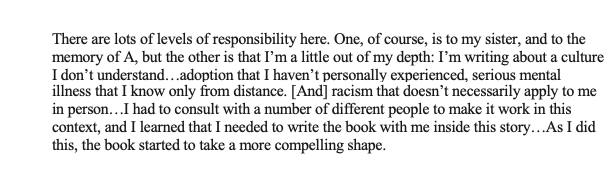
In the same interview, Paré explained that she worked with her sister to understand certain topics and that Absence of Wings “wouldn’t have happened without her.” Learning how Paré diligently approached writing about her niece’s experience satisfied my concern regarding Absence of Wings, but what about Encrypted? Was her grandson’s experience given the same care? Sure enough, in Encrypted’s acknowledgments, Paré thanks her grandson and his father—Paré’s son—for “graciously allowing [her] to publish these poems about a challenging time in their lives,” sharing that her son even proposed the book’s title. Therefore, it seems to me that approaching stories ethically is a priority for Paré when writing about experiences that are not necessarily her own. Personally, I think this method of inserting yourself into the story can be effective in avoiding exploitation, if done carefully. Everyone has a perspective, and I’d say Encrypted is simply Paré’s.
Through every carefully placed caesura forcing readers to pause in-between words, Paré conveys a patient tone. As Paré further described in her interview with Heslop, she favours writing in this less formal way:

I found Paré’s imagery throughout Encrypted to be quite poignant. One image that comes to mind is her comparison of addiction to a pair of fake-gold boots with soles made of lead. Coupled with her portrait of an open-hearted grandmother just outside the closed bedroom door of her grandson, as she patiently waits for him to “make it to open//even halfway,” Paré’s vivid and open language spoke to my heart.
In “The Rime of the Ancient Mariner,” Samuel Taylor Coleridge writes, “Day after day, day after day / We stuck, nor breath nor motion / As idle as a painted ship / Upon a painted ocean.” These doldrums that Coleridge refers to serve as the first laid brick in a large bridge built between Encrypted and Coleridge’s work. On Page Fright, Paré explained that her allusions to the 18th century poet in Encrypted are due to the similarities between modern depression and the doldrums in “The Rime of the Ancient Mariner”—that is, they both induce great despondency. Paré’s book caused me to shift some of my perceptions, including that depression is less about sinking deeper and deeper into a black pit, as it is often understood, and more as a painful period of stagnancy.
Aside from these doldrums, Paré alludes to Coleridge through a series of five poems with his surname serving as something like titles. One thing I love about Paré is her ability to take a famous poet from hundreds of years ago and make them relevant in a book that also references the League of Legends video game. First seen when she incorporated Franz Kafka into her 2007 debut book, Paper Trail, Paré’s drawing forward these long-dead poets evokes a timelessness in her work, demonstrating that while the world may seem quite different, the issues of yesterday might not be too different from the challenges of today.
In the last of her Coleridge poems, Paré alludes once more to the doldrums and concludes by claiming that “the poet / doomed in life’s real oceanics / rimed and overwhelmed / knows she must write.” And write Paré does—not only for her grandson, but for every young adult growing up in a post-COVID world ravaged by social media, AI, and climate change. Paré’s decision to occasionally write in a stream-of-consciousness style with no periods or commas conveys how loud and overwhelming the modern world has become, all of which circle back to her grandson as he retreats further into the virtual world.
Looking back over Encrypted while pondering how to end this review, I found that the most engrossing element of Paré’s work was the way she crafts her words selflessly, and with emotional vulnerability. Felt in proclamations like, “It will eat my heart too” and questions like “Have we loved you too much?” Paré’s words speak to the most sensitive part of my heart, and I appreciate that Paré writes from a place of genuine concern and curiosity about young adults today. About why they may be struggling to get out of bed, and why they may prefer the fictional realities of video games to this “truly duly too overmuch” world. From beginning to end, each carefully crafted line in Encrypted is simply, but no less impressively, woven in threads of pure love—and I can’t wait to see what Paré writes next.
Caitlyn Carr is a Creative Writing student working toward a Bachelor of Arts at the University of the Fraser Valley. So far, her work has been published in EVENT[CC1] , Louden Singletree and The Cascade. Caitlyn currently lives with her grandfather in Abbotsford, British Columbia.