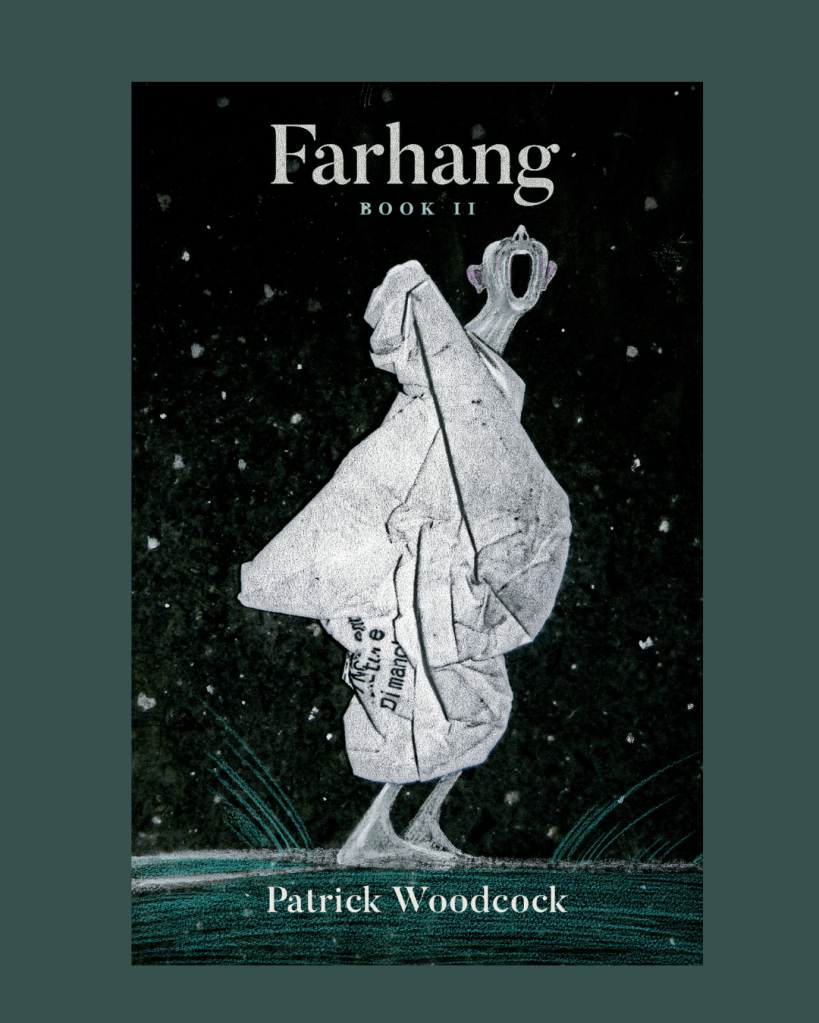
reviewed by Edward Palmer
There is a theory of creativity buried inside Farhang Book II, and it arrives in one of the most unsettling images in recent Canadian poetry. The prisoner Farhang, broken and feverish in his cell, grabs the wrist of his guard and whispers an explanation of what a poem actually is. A wasp comes in the night, he says, and plants images inside you. Each image is an egg. It grows. It feeds on you. “Each poem is killing you, hollowing your insides.” This is not metaphor dressed up as madness. In Patrick Woodcock’s hands, it reads as plain and necessary fact.
Farhang Book II is the follow-up to Woodcock’s earlier collection, and it arrives as something richer, stranger, and more ambitious than its predecessor. The book is divided into two sections. The first, “Eustress,” continues the story of Farhang, the imprisoned dissident whose broken body and visionary mind anchor the opening poems. The second, and far longer, section is called “Pareidolia,” which is the psychological phenomenon of finding meaningful patterns in random or ambiguous images. The word is perfectly chosen. These are poems that train the eye to see what others miss.
Woodcock has lived and worked across more than fifty countries, and every page of this book carries that weight. He currently divides his time between Toronto and Iqaluit, Nunavut, where every poem in this collection was conceived and written along the Apex Trail and in Sylvia Grinnell Park. That landscape is everywhere in the book, its ridges and sea ice and sled dogs and belugas woven through poems that also reach into Kurdistan, Tanzania, Poland, the Caspian Sea, the Mackenzie River delta, and the streets of a sandstorm-swept city that could be any city in the arc of recent history. The structural leap from the first Farhang collection is significant. Where that book organised its poems by country, this one refuses geography as a dividing principle. Instead, fragments from dozens of nations are threaded together within individual poems, creating something that feels closer to the actual texture of a life lived across borders.
The “you” that appears throughout “Pareidolia” is one of the book’s most quietly radical choices. Woodcock has set aside the lyric “I” entirely. The reader is addressed directly, pulled into the poem’s body, made complicit. In the poem “Chase the lantern where land and sky unravel,” this “you” lies on a bare Arctic ridge, unzipping its coat, embracing the cold as a form of absolution. The poem ends with a list of what “you” want to give thanks to after warming back to life: “the sea ice, the currents below, the sun, moon, / and misleading mirages. But mostly to the sky— / both stone-strong and soft, the keeper / of rising and setting / lanterns.” The line breaks on “lanterns” with the quiet confidence of a poet who knows exactly where to stop.
This directness of address is not a gimmick. It is a formal argument. By placing the reader inside the poem’s body, Woodcock refuses the comfortable distance that lyric poetry often grants. You are the one standing in a valley where snipers once “perforated oxygen for over three long years.” You are the one walking a minefield that was once a football pitch. You are the one who feels guilt watching a ship labour across Frobisher Bay while you merely observe and record from the Apex Trail. The poem “Guilt is a vessel on your horizon” ends on that precise note of self-accusation. The speaker watches a boat struggle toward open water, then asks: “What have you done but watch and record plodding vessels?” It is a question the entire collection seems to hold up to itself.
Woodcock is a poet of tremendous range. The “Eustress” section opens in prose poetry. Its sentences are long and dense, accumulating detail the way trauma accumulates detail, without full stops where you might want them. The Farhang poems move through imprisonment, hallucination, and a strange, damaged tenderness. In one of the most memorable passages, Farhang looks at photographs with his nurse and sees none of the people in them. A concert crowd needs to be in black and white. A lake with swimmers is merely “a thicker sky.” His photographs, the poem tells us, “like his memory, were unpeopled.” This is devastating and exact.
The “Pareidolia” poems are shorter and more lyrical, and they are where the book’s technical ambition fully reveals itself. Woodcock has a gift for the image that arrives from an unexpected angle and lodges there. In “The drowsing tree and the hushed fear below,” a tree slowly dying after unnamed violence is observed with terrible precision. “No bird, no matter how weary, lands on it now. / Not one. Never a nest. / Never a body exhausted by heat.” The triple refusal, the anaphora of “never,” does the work of an entire elegy in three lines.
In “Here, even the wish to leave is bound,” the litany of departures builds through a catalogue of “when” clauses. The poem lists condition after condition under which you should leave, then turns sharply: “Nothing leaves this.” The reversal is earned. Nothing in Woodcock’s world exits cleanly. Not grief. Not history. Not the speaker himself. “Everything / that tries is tide-torn and returned— / like boats, like ballast. / Nothing leaves. Not you. Nothing. Never.” That closing line accumulates weight the way ice does, word by word, until it is immoveable.
The collection’s deep strangeness comes from the way Woodcock moves between registers without warning. A poem about mud volcanoes in Azerbaijan slides into surrealism. A poem about walking through Duhok at night ends with a mythological serpent, a Shahmaran, slithering into the speaker’s room. A poem structured around a pub quiz turns out to be set somewhere past the bay, over the ridge, where the participants are not quite human. These are not failures of tonal control. They are signs of a poet who has internalised surrealism deeply enough to use it the way a novelist uses scene change, as a way of shifting the reader’s angle of vision without announcement.
The book is dedicated to two writers, Goran Simić and Admiral Mahić, both of whom lived through the Siege of Sarajevo. Their presence hovers over the collection’s persistent concern with what it means to bear witness. Woodcock is not a poet of easy solidarity. He is suspicious of his own position as an observer. He interrogates the ethics of watching and recording. He knows the difference between attending to suffering and aestheticising it, and he works that boundary with discipline and care.
Farhang Book II is not a book you will read all at once, nor should you try. These poems ask to be sat with. They reward return. You will find yourself coming back to a particular image, a turn of phrase, a closing line, weeks after first reading it. The book stands as one of the most serious and accomplished collections of Canadian poetry in recent years. It arrives from a writer at the height of his powers, rooted in the Arctic landscape where it was written and reaching outward to the full, difficult scope of a life spent paying attention to the world.
Edward Palmer is a nomadic physicist, teacher, and writer currently based in North Wales. His work and travels have taken him across a wide range of landscapes and communities, shaping both his scientific outlook and his creative writing. In his spare time, he pursues his two great passions: chess and poetry. When he is not reading, he is working on his first collection of poems, Heddwch Meddwl, exploring themes of place, reflection, and the quiet search for inner peace.